BIOL 105 Lecture 21 10/14/26
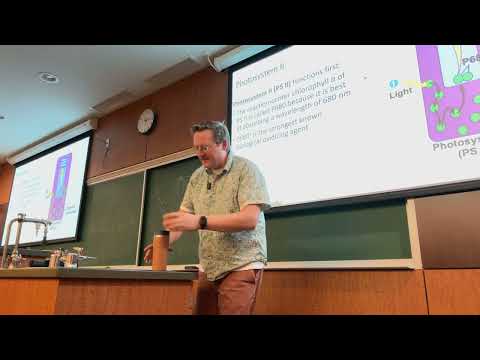 Watch on YouTube →
Overview
Jonathan Montgomery explains how photosynthesis converts light into ATP and NADPH through the light reactions, then uses those products to fix CO₂ in the Calvin cycle. He traces linear and cyclic electron flow, the role of photosystems II and I, water splitting and oxygen release, and the Calvin cycle’s production of G3P; he emphasizes that students should understand the pathways’ inputs and outputs rather than memorize every intermediate.
Key takeaways
- Linear electron flow uses photosystems II and I to produce both ATP and NADPH, while releasing oxygen when photosystem II replaces lost electrons by splitting water.
- Cyclic electron flow sends photosystem I electrons back through the proton-pumping chain, producing ATP without NADPH or oxygen.
- P680+ is a strong oxidizing agent that extracts electrons from water; the released oxygen comes from water, not from CO₂.
- ATP provides energy for Calvin-cycle reactions, while NADPH provides the reducing power needed to build carbon-rich molecules from CO₂.
- The Calvin cycle directly produces G3P, not glucose; some G3P leaves the cycle and the rest helps regenerate RuBP.
- RuBisCO starts carbon fixation by combining CO₂ with RuBP, making the enzyme central to the Calvin cycle.
Chapters
0:00
Photosynthesis Uses Light to Supply the Calvin Cycle
- Photosynthesis has two linked stages: light reactions and the Calvin cycle.
- The light reactions produce ATP for chemical energy and NADPH for reducing power.
- The lab midterm becomes available Thursday and closes Sunday at 11:59 p.m., with no late submissions.
3:17
Photosystems Focus Light on Reaction-Center Chlorophyll
- Photosystems are pigment-containing protein complexes embedded in the thylakoid membrane.
- Light-harvesting pigments pass absorbed energy toward a reaction-center pair of chlorophyll a molecules.
- Photosystem II’s reaction center is P680, while photosystem I’s is P700; the names refer to peak absorption wavelengths of 680 and 700 nanometers.
8:11
P680 Oxidizes Water and Releases Photosynthetic Oxygen
- When P680 loses an excited electron, it becomes P680+, a powerful oxidizing agent.
- P680+ draws replacement electrons from water through enzyme-catalyzed reactions.
- Water splitting supplies electrons to photosystem II and releases the oxygen produced during photosynthesis.
11:30
Linear Electron Flow Links Photosystems II and I
- In linear electron flow, photosystem II excites electrons that travel down an electron transport chain before reaching photosystem I.
- The transport chain pumps protons into the thylakoid space, creating a proton-motive force.
- Protons flow through ATP synthase to produce ATP; light re-excites electrons at photosystem I for the next step.
17:10
NADP⁺ Reductase Produces NADPH After Photosystem I
- Photosystem I re-energizes incoming electrons, which are transferred to NADP⁺ rather than used to drive the ATP-producing proton gradient.
- NADP⁺ reductase reduces NADP⁺ to NADPH in the chloroplast stroma.
- NADPH supplies high-energy electrons for building organic molecules from CO₂; ATP supplies energy.
21:25
Cyclic Electron Flow Produces ATP Without NADPH
- At photosystem I, energized electrons can return to the electron transport chain instead of reducing NADP⁺.
- Cyclic electron flow pumps protons and generates ATP, but produces neither NADPH nor oxygen because it does not use photosystem II.
- Montgomery contrasts the proposed role of cyclic flow as an electron-release mechanism with the hypothesis that it reflects an earlier photosystem I-only pathway.
27:27
Calvin Cycle Depends Indirectly on Light
- The Calvin cycle does not use light directly, but depends on ATP and NADPH made by the light reactions.
- CO₂, ATP, and NADPH are needed across the cycle’s steps, though not necessarily at the same instant in an individual reaction sequence.
- Stomata admit CO₂ but also allow water loss, creating a tradeoff that contributes to adaptations such as CAM photosynthesis.
36:05
Calvin Cycle Produces G3P Rather Than Glucose Directly
- The cycle uses carbon from CO₂, energy from ATP, and electrons from NADPH to produce G3P.
- G3P is an energy-rich three-carbon molecule that can contribute to glucose, starch, cellulose, sucrose, and other plant compounds.
- For BIOL 105, glucose is an acceptable simplified description of photosynthesis’s output, but the direct Calvin-cycle product is G3P.
41:04
RuBisCO Fixes CO₂ onto RuBP
- Carbon fixation begins when RuBisCO adds CO₂ to ribulose-1,5-bisphosphate (RuBP), a five-carbon molecule.
- The resulting compounds are processed using ATP and NADPH to form G3P; some G3P exits the cycle while most helps regenerate RuBP.
- Montgomery identifies RuBisCO’s CO₂-fixation step and G3P production as the key takeaways, and previews a follow-up discussion of RuBisCO.
Summary, takeaways, and chapters were generated by AI from the video's transcript and may contain errors. The video belongs to its creator, Jonathan Montgomery.