BIOL 105 Lecture 13 9/25/26
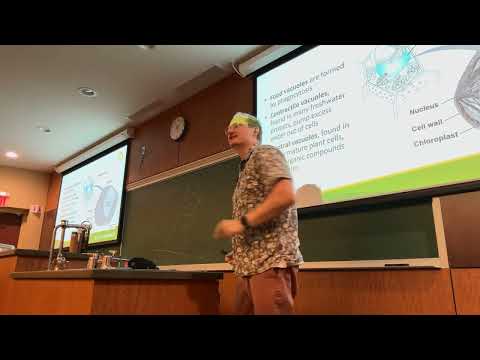 Watch on YouTube →
Overview
Jonathan Montgomery connects organelle structure to function, reviewing endosymbiosis, vacuoles, mitochondria and chloroplasts before explaining how the cytoskeleton and cell-to-cell connections support cellular organization. He closes by introducing the fluid-mosaic plasma membrane, whose phospholipids, proteins, cholesterol and carbohydrate-bearing molecules help determine what a cell can do.
Key takeaways
- Mitochondria and chloroplasts retain their own genomes and ribosomes and can divide independently—features that support the endosymbiotic explanation for their origins.
- Freshwater protists face continual osmotic water influx because their surroundings are hypotonic; contractile vacuoles help prevent excess water from accumulating.
- Folded inner membranes in mitochondria and chloroplasts increase the surface area available for proteins that perform key organelle reactions.
- Microtubules and actin filaments provide tracks for ATP-powered motor proteins, enabling intracellular cargo transport and cell movement.
- Cells in tissues rely on extracellular connections: plant cells use pectin and plasmodesmata, while animal cells use extracellular matrix and junctions such as desmosomes and gap junctions.
- A cell’s membrane proteins help define its specialized functions, while gene-expression regulation determines which proteins that cell produces.
Chapters
0:00
Endosymbiosis and Vacuoles: Origins, Digestion, and Water Balance
- Endosymbiotic theory proposes that mitochondria and chloroplasts descended from free-living prokaryotes engulfed by an ancestral cell.
- Vacuoles are large membrane-bound compartments; food vacuoles can receive material through phagocytosis and fuse with digestive compartments.
- Contractile vacuoles help freshwater organisms expel water that enters by osmosis from the hypotonic environment.
- Plant central vacuoles store water and other compounds and help maintain turgor pressure against the cell wall.
8:36
Mitochondria, Chloroplasts, and Maternal Mitochondrial Inheritance
- Mitochondria carry out cellular respiration, while chloroplasts use light energy to build sugars through photosynthesis.
- Both organelles have their own genomes and ribosomes and can divide independently, evidence consistent with an endosymbiotic origin.
- Their folded inner membranes increase surface area for proteins and enzymes involved in essential reactions.
- Because the egg contributes nearly all the mitochondria to a zygote, mitochondrial DNA is generally inherited through the maternal line.
16:02
Chloroplast Membranes, Peroxisomes, and the Nitroplast
- Chloroplast thylakoid membranes form stacks called grana; the surrounding compartment is the stroma, while the thylakoid interior is the thylakoid space.
- Peroxisomes produce hydrogen peroxide during some reactions, and catalase enzymes break hydrogen peroxide down in cells.
- A 2024 report described the nitroplast, a newly recognized organelle associated with atmospheric nitrogen fixation in a eukaryote.
- Lynn Margulis helped advance endosymbiotic theory, which is supported by organelle genomes and other similarities to free-living organisms.
25:00
The Cytoskeleton’s Three Structural Systems
- The cytoskeleton provides internal support and serves as a framework for movement and transport within cells.
- Its three major components are microtubules, microfilaments and intermediate filaments, which differ in structure and mechanical properties.
- Microtubules are hollow structures assembled from alpha- and beta-tubulin subunits.
- Microtubules resist compression, while filament systems such as actin and intermediate filaments contribute to tension-bearing support.
29:20
Microtubules: Cilia, Flagella, and Intracellular Transport
- Microtubules form structural elements in cilia and flagella, which support movement; cilia also move mucus along the respiratory tract.
- Motor proteins use ATP to carry vesicles and other cargo along microtubule tracks inside the cell.
- Centrosomes organize microtubule formation, and their role becomes especially important during cell division.
- Cilia and flagella beat in distinct patterns that produce directed movement through a fluid or move fluid past a cell.
33:41
Actin Microfilaments, Muscle Contraction, and Cytoplasmic Streaming
- Microfilaments are built from actin, a protein central to muscle contraction and other forms of cell movement.
- ATP-powered motor proteins interact with actin filaments to pull them relative to one another, producing muscle contraction.
- Actin-based movement can contribute to cytoplasmic streaming, which circulates material through a cell.
- In plant cells, streaming can move chloroplasts around the cell perimeter, helping distribute exposure to light.
38:24
Intermediate Filaments and Connections Between Cells
- Intermediate filaments form cable-like supports that help cells withstand tension; keratin is one familiar intermediate-filament protein found in hair and nails.
- Plant cell walls are joined by pectin, and regulated plasmodesmata connect the contents of adjacent plant cells.
- Animal cells lack cell walls but attach to an extracellular matrix made partly of structural proteins.
- Tight junctions, desmosomes and gap junctions help animal cells seal, anchor to or communicate with neighboring cells.
42:34
Membrane Proteins, Cell Identity, and Gene Expression
- Membrane proteins can function as receptors, enzymes, transporters or adhesion points, giving cells distinct capabilities.
- The proteins present in a cell are a major factor in its specialized function, including its ability to sense signals or move substances across the membrane.
- Although cells generally contain the instructions for many proteins, gene-expression regulation determines which proteins they produce.
44:24
The Fluid-Mosaic Plasma Membrane and Fluidity Preview
- The plasma membrane behaves as a fluid sheet rather than a rigid wall: embedded lipids and proteins can move within it.
- Its major components include phospholipids, proteins and cholesterol, along with glycoproteins and glycolipids that carry carbohydrate groups.
- Cholesterol is a hydrophobic lipid embedded among membrane components; membrane structure also differs between its inner and outer surfaces.
- Membrane fluidity depends partly on phospholipid saturation, and cholesterol can act as a fluidity buffer; these factors are introduced for the next lecture.
Summary, takeaways, and chapters were generated by AI from the video's transcript and may contain errors. The video belongs to its creator, Jonathan Montgomery.