Beyond Instinct: The New Science of Animal Logic | SLICE EARTH | FULL DOC
 Watch on YouTube →
Overview
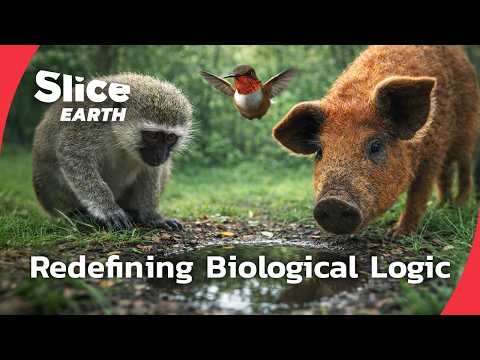
Researchers including Louise Barrett, Peter Henzi, Shane Gero, Andy Hurley, Anna Wilkinson, and Carl Safina show how animal intelligence is adapted to each species’ environment rather than measured by human standards or brain size. Field observations and controlled tests reveal vervet monkeys’ social strategies, sperm whales’ family dialects, hummingbirds’ timed food memories, tortoises’ rapid learning, fish’s long-term memory, bearded dragons’ imitation, and pigs’ spatial and social reasoning.
Key takeaways
- Animal intelligence is best assessed against the demands of an animal’s ecological niche: a hummingbird’s precise food-location memory can be more survival-relevant than human-style calculation.
- Sperm whales use patterned clicks to signal individual and family identity, while long-term study and acoustic tags help researchers connect calls to particular animals and social groups.
- Experimental design can hide animal abilities: Anna Wilkinson found that reptile performance depends on suitable warmth and avoiding cues, such as looming over a tortoise, that may signal predation.
- Social intelligence appears in different forms across species, from vervets using grooming to maintain alliances to pigs following knowledgeable group members in a food maze.
- The cichlid study challenges the three-second-memory stereotype: six of seven fish remembered a visual pattern associated with food after 12 days.
- Studying animal cognition can affect human choices: Esther’s learning and social behavior led her caregivers to open a sanctuary and become vegan.
Chapters
0:00
Animal Intelligence Beyond Human Standards
- The opening contrasts familiar claims about elephants, hummingbirds, monkeys, fish, and pigs to question assumptions about animal minds.
- Researchers argue that intelligence should be understood in the context of what an animal must know to survive.
- A central challenge is looking beyond human-centered comparisons and studying animals in their own environments.
1:09
Louise Barrett and Peter Henzi Test Vervet Monkeys in the Wild
- At South Africa’s Samara Reserve, Louise Barrett and Peter Henzi study how vervet monkeys respond to danger and manage social relationships.
- When researchers play a recorded alarm call without a predator present, monkeys look for more information instead of automatically fleeing.
- A stuffed caracal prompts a real alarm response, illustrating how direct visual evidence changes the monkeys’ assessment of danger.
- Grooming serves both as hygiene and social bargaining: lower-ranking monkeys can build relationships with dominant troop members.
6:00
Shane Gero Decodes Sperm Whale Calls and Family Ties
- Shane Gero’s Dominica Sperm Whale Project follows individuals and families among roughly 300 sperm whales living in Caribbean waters.
- Directional hydrophones locate whales by their clicks; researchers use suction-cup tags with mini computers to record a whale’s underwater behavior and calls.
- Sperm whale click patterns can identify an individual, its family, and its wider Caribbean community, functioning like acoustic names and dialects.
- Family members cooperate across deep dives, with relatives staying near the surface to care for calves.
12:33
Andy Hurley Measures Hummingbirds’ Episodic Memory
- For 25 years, Andy Hurley and Sue Healy have tested wild rufous hummingbirds using artificial flowers filled with sucrose.
- The birds learn flower locations and distinguish feeding sites replenished after 10 minutes from those refilled after 20 minutes.
- This task tests memory for what was visited, where it was, and when food should be available—abilities described as episodic memory.
- Hummingbirds need to feed about every 10 minutes, making efficient food-finding essential despite their brains being only about the size of a grain of rice.
19:34
Anna Wilkinson Shows How Tortoise Cognition Depends on Conditions
- At the University of Lincoln’s Cold-Blooded Cognition Lab, Anna Wilkinson tests how tortoises learn to distinguish visual cues, including red from green.
- Tortoises can learn color associations quickly, and some have learned to interact with touchscreen technology.
- Wilkinson emphasizes testing reptiles in suitable conditions: cold temperatures or human movements resembling a predator can suppress their behavior.
- Her work argues that reptiles’ learning abilities are easily missed when experiments ignore their ecology and temperature needs.
23:29
Fish Memory, Recognition, and Cleaner Wrasse Strategy
- Trevor Hamilton trained cichlids to associate food with moving black-and-white patterns; six of seven chose the correct pattern after a 12-day delay.
- Jonathan Balcombe describes evidence that fish recognize individuals, show social preferences, and can distinguish musical styles and composers.
- Cleaner wrasse remove parasites from larger client fish, which tolerate cleaners entering their mouths; the relationship benefits both species.
- Cleaners may also bite nutritious skin mucus, giving the service relationship a strategic, sometimes exploitative side.
28:32
Bearded Dragons Demonstrate Social Imitation
- Researchers show bearded dragons an 11-second film of another lizard opening a food gate to the left or right.
- After watching, dragons tend to open the gate in the same direction as the demonstrated animal on their first successful attempt.
- A control group sees a gate open without a visible lizard; those animals fail to solve the task, supporting learning from another dragon’s behavior.
- The experiment is presented as the first evidence of imitation in reptiles and a sign of sophisticated social learning.
31:05
Pig Maze Tests Reveal Spatial Memory and Social Tactics
- Farmer Sarah Buttle recreates research advised by University of Bristol researcher Suzanne Held using a straw maze and piglets about three months old.
- Piglets trained with food at five stations learn routes and remember which locations they have already visited.
- When informed and uninformed pigs are mixed, dominant animals follow subordinates that know where the food is.
- Informed pigs may delay or take misleading routes, possibly to prevent dominant pigs from taking their food; researchers do not claim deception is proven.
36:04
Esther the 650-Pound Pig Changes Her Caregivers’ Perspective
- Steve Jenkins and Derek Walter adopted Esther believing she was a miniature pig; she grew to about 650 pounds and was a full-size commercial pig.
- Esther learned to operate doors, refrigerator mechanisms, latches, and hooks, and to navigate a human home, including using stairs and a bathroom.
- Her caregivers describe her as socially aware, treating Jenkins as a primary attachment figure and Walter more like a sibling.
- Esther helped inspire Jenkins and Walter to establish a farm sanctuary and become vegan, prompting them to reconsider how farm animals are treated.
40:46
Animal Individuality, Play, and the Case for Conservation
- Ecologist Carl Safina recounts an elephant researcher’s challenge to ask who animals are, rather than judging only how closely they resemble humans.
- Neuroscientist Sergio Pellis explains that vervet rough-and-tumble play exercises planning, attention, flexibility, and decision-making while helping young monkeys learn social boundaries.
- Play requires reciprocation to avoid escalating into aggression, offering evidence of fairness and rudimentary empathy; vervets also differ in boldness and shyness.
- The closing connects species-specific abilities—from hummingbird memory to sperm whale communication—to conservation and argues that humans are part of nature, not its pinnacle.
Summary, takeaways, and chapters were generated by AI from the video's transcript and may contain errors. The video belongs to its creator, SLICE Earth.