AU26 CHEM 2310 - Lecture 8b - September 18 - Quiz 3 - Alkanes and Cycloalkanes
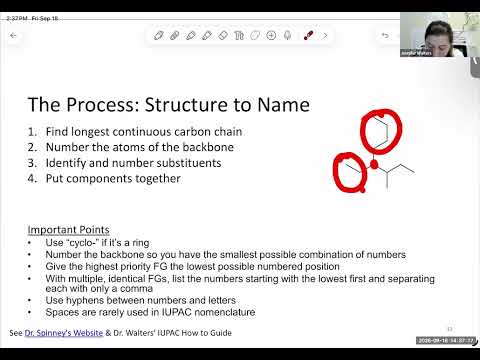 Watch on YouTube →
Overview
Dr. Jennifer Walters explains alkane and cycloalkane nomenclature by connecting carbon and hydrogen classifications to substituent names, then applying longest-chain selection, numbering, and alphabetical ordering. Worked examples show how to name branched chains, distinguish systematic from common names such as isopropyl and tert-butyl, and draw 4-ethyl-2-fluoro-1-methylcyclohexane from its name.
Key takeaways
- Classify a hydrogen by the carbon it is attached to: a hydrogen on a primary carbon is primary, while a quaternary carbon has no hydrogens.
- Choose an alkane parent by tracing the longest continuous carbon chain; the eight-carbon worked example has an octane parent and is named 4-ethyl-3-methyloctane.
- When numbering a parent chain with no primary functional group, compare the locant sets from both directions and choose the set with the lowest first point of difference.
- Combine identical substituents with multiplicative prefixes but list every location, as in 2,3,3,7-tetramethyl; alphabetize substituents by their root names.
- Number a branched substituent from the point attached to the parent chain: isopropyl is systematically 1-methylethyl, while tert-butyl is 1,1-dimethylethyl.
- Cyclo- identifies a ring parent, and halogens are named as fluoro, chloro, bromo, or iodo; 4-ethyl-2-fluoro-1-methylcyclohexane illustrates how locants map onto a six-membered ring.
Chapters
0:00
Carbon Classifications, Substituents, and Naming Components
- Classify carbons by the number of attached carbons: primary, secondary, tertiary, or quaternary; hydrogens inherit the classification of the carbon they are attached to.
- The groups CH3, CH2, and CH are also called methyl, methylene, and methine; a quaternary carbon has no attached hydrogen.
- A substituent replaces a hydrogen on the parent chain and generally takes a root plus -yl, while hydrocarbon parent names end in -ane, -ene, or -yne.
- List substituents alphabetically by their root, group identical substituents with prefixes such as di- and tri-, and separate numbers with commas and numbers from words with hyphens.
5:57
Find and Number the Longest Carbon Chain
- Trace every plausible continuous route through a branched structure without lifting the pen or doubling back; the example's longest route contains eight carbons, giving an octane parent.
- Number the parent chain from both ends and compare substituent locants in increasing order, choosing the direction with the smaller first differing number.
- In the eight-carbon example, the selected numbering places ethyl at carbon 4 and methyl at carbon 3, producing 4-ethyl-3-methyloctane.
- Use cyclo- before the parent root for a ring, as in cyclooctane; a three-carbon ring substituent is cyclopropyl.
9:07
Name Multiple Substituents and Branched Alkyl Groups
- A nine-carbon longest chain uses nonane as its parent; the example compares locant sets from opposite directions and selects the sequence beginning 2, 3, 3.
- Four one-carbon substituents are combined as 2,3,3,7-tetramethyl, with every locant retained; a two-carbon branch at carbon 5 is named 5-ethyl.
- For a branched substituent, number outward from the carbon attached to the parent chain, then identify the longest chain within that substituent; the three-carbon Y-shaped group is systematically 1-methylethyl.
- Common names covered include isopropyl, isobutyl, sec-butyl, and tert-butyl; their systematic counterparts include 1-methylethyl, 2-methylpropyl, 1-methylpropyl, and 1,1-dimethylethyl.
17:31
Draw Cyclohexane Structures from Substituent Names
- Interpret cyclohexane as a six-carbon ring with single bonds, then number continuously around the ring in either direction.
- Read each substituent's locant against the ring: methyl at carbon 1 means a one-carbon line branch, and ethyl at carbon 4 means a two-carbon branch.
- Halogen substituents use -o names: fluoro, chloro, bromo, and iodo; fluoro at carbon 2 is drawn as an F attached to that ring carbon.
- The worked name 4-ethyl-2-fluoro-1-methylcyclohexane translates into a cyclohexane ring bearing those three groups at carbons 4, 2, and 1.
Summary, takeaways, and chapters were generated by AI from the video's transcript and may contain errors. The video belongs to its creator, Dr. Jennifer Walters.