AU26 CHEM 2310 - Lecture 8 - September 17 - Quiz 3 - Alkanes and Cycloalkanes
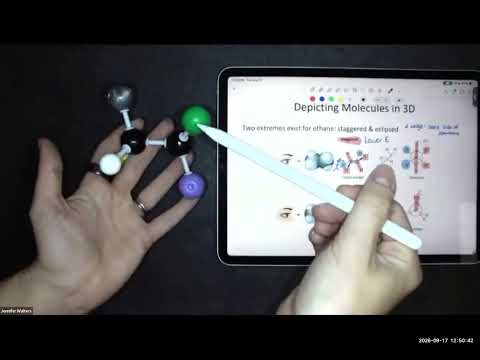 Watch on YouTube →
Overview
Dr. Jennifer Walters explains how to analyze alkane conformations using Newman projections and cyclohexane chairs, connecting molecular geometry to steric, torsional, and angle strain. She also distinguishes structural, conformational, and geometric isomers, introduces cis/trans notation for rings, and begins IUPAC naming rules for carbon chains and substituents.
Key takeaways
- Newman projections make rotation around a carbon-carbon sigma bond visible: staggered arrangements separate front and back groups by 60 degrees, while eclipsed arrangements align them.
- Butane’s anti conformation is lowest in energy because its methyl groups are 180 degrees apart; its totally eclipsed conformation is highest because the methyl groups overlap.
- Ring size determines the preferred cycloalkane shape: cyclopropane is planar, cyclobutane puckers, cyclopentane adopts an envelope, and cyclohexane prefers a chair.
- A cyclohexane chair flip exchanges axial and equatorial positions while preserving each substituent’s up/down orientation and the ring’s connectivity.
- Bulky cyclohexane substituents favor equatorial positions because axial placement creates 1,3-diaxial interactions with groups two carbons away on the same face.
- Cis/trans identity in a ring depends on whether substituents are on the same or opposite faces, not whether they are axial or equatorial.
Chapters
0:00
Lecture Setup and Review of Three-Dimensional Molecules
- Dr. Jennifer Walters opens Lecture 8 with an audio check before resuming the alkane and cycloalkane material.
- Molecular drawings use wedges and dashes to represent three-dimensional structures that cannot be fully shown in a flat diagram.
5:04
Reading Newman Projections from Wedge-Dash Structures
- A Newman projection looks directly down a carbon-carbon sigma bond, with the front carbon shown as a dot and the rear carbon as a circle.
- Rotating a wedge-dash structure into this view changes the positions of its substituents on the page, not which atoms are connected.
- When a bond is named in a direction such as C1-C2, C1 is the front carbon and C2 is the back carbon.
8:02
Staggered and Eclipsed Newman Projection Geometry
- Staggered conformations place front and back substituents 60 degrees apart; eclipsed conformations place them directly behind one another.
- Newman bonds may be drawn with a slight offset in an eclipsed conformation so the rear substituents remain visible.
- Building a model and imagining the observer looking down the C-C bond can help translate between line structures and Newman projections.
12:24
Steric Repulsion and Gauche Interactions
- Steric interactions arise when atoms or groups get close enough to repel one another, increasing molecular energy.
- In a staggered Newman projection, a gauche interaction occurs between two non-hydrogen groups separated by 60 degrees.
- A staggered conformation with two methyl groups 60 degrees apart has a gauche interaction; hydrogen-only pairs do not count.
15:44
Eclipsing Strain and Torsional Repulsion
- In an eclipsed conformation, a steric interaction occurs when at least one of the overlapping groups is not hydrogen.
- Two eclipsed hydrogens have no steric interaction under the course definition, but an all-hydrogen eclipsed conformation still has energy.
- Torsional strain comes from repulsion between eclipsing bonding electrons and occurs only in eclipsed conformations.
20:52
Rotation and the Alkane Conformational Energy Diagram
- At room temperature, molecules can rotate around carbon-carbon sigma bonds and interconvert between staggered and eclipsed conformations.
- A conformational energy diagram plots relative energy against torsional angle, with rotations commonly considered in 60-degree steps.
- For a molecule with only hydrogens around the rotating bond, all staggered states have equal energy and all eclipsed states have equal energy.
22:33
Butane: Gauche, Anti, and Totally Eclipsed States
- Butane has four carbon atoms and methyl groups on both carbons of the bond being viewed in the Newman projection.
- The staggered anti conformation places the two methyl groups 180 degrees apart and is the lowest-energy arrangement.
- A staggered arrangement with methyl groups 60 degrees apart is gauche; an eclipsed arrangement with methyl groups overlapping is totally eclipsed and highest in energy.
- Other eclipsed rotations, where a methyl overlaps a hydrogen, are eclipsed but not totally eclipsed.
29:41
Cyclopropane and Cyclobutane Ring Strain
- Cyclopropane is a planar three-carbon ring with 60-degree bond angles, far from the ideal tetrahedral angle of 109.5 degrees.
- The mismatch between an actual and ideal bond angle is angle strain; cyclopropane is highly strained and relatively easy to break.
- Cyclobutane reduces some strain by puckering instead of remaining a flat square.
34:24
Cyclopentane’s Envelope Conformation
- A five-membered cyclopentane ring adopts an envelope conformation rather than a flat pentagon.
- The raised carbon resembles the open flap of an envelope, a shape that helps relieve ring strain.
- Cyclopentane is common in nature because its relatively stable conformation offsets some of the organizational cost of forming a ring.
37:15
Cyclohexane Chair and Boat Conformations
- A six-membered cyclohexane ring most stably adopts a chair conformation, which has nearly ideal 109.5-degree bond angles and staggered bonds.
- The boat conformation is higher in energy because it introduces eclipsing interactions.
- Cyclohexane interconverts between chair conformations by moving through less stable shapes, including the boat.
43:28
Drawing Chair Rings and Tracking a Chair Flip
- A chair drawing uses three sets of parallel lines; starting with the outermost pair helps establish the ring shape.
- To track a chair flip, label the six carbons in sequence and keep the far-left and far-right carbons anchored.
- The ring atoms retain their connectivity during a chair flip, even though their positions look different on the page.
48:25
Axial and Equatorial Positions During Chair Flips
- Axial bonds point vertically up or down, while equatorial bonds project outward and are parallel to bonds three positions away on the ring.
- A chair flip swaps every axial position with an equatorial position.
- The substituent’s face does not change during the flip: an up group remains up, and a down group remains down.
57:03
Cyclohexane Substituent Stability and 1,3-Diaxial Interactions
- Large substituents are generally more stable in equatorial positions because they extend away from the ring and reduce close contacts.
- An axial non-hydrogen substituent can clash with axial groups on the same face at carbons 3 and 5 relative to its carbon.
- These clashes are called 1,3-diaxial interactions; comparing them across the two chair forms identifies the more stable conformation.
1:05:50
Structural, Conformational, and Stereoisomer Categories
- Structural, or constitutional, isomers share a molecular formula but differ in atom connectivity.
- Conformational isomers are the same molecule in different arrangements produced by rotation around a single sigma bond.
- Stereoisomers retain the same connectivity but differ in their three-dimensional arrangement; geometric isomers are a type of stereoisomer.
1:09:01
Cis and Trans Relationships in Substituted Rings
- Geometric isomers occur when rotation is restricted, including in rings and carbon-carbon double bonds.
- For ring substituents, cis means both groups are on the same face, represented by two wedges or two dashes; trans means opposite faces, represented by one wedge and one dash.
- During a cyclohexane chair flip, axial and equatorial positions can change, but up/down orientation and the cis/trans relationship do not.
- Changing a cis isomer into a trans isomer requires changing a substituent’s face, not simply flipping the chair.
1:17:13
IUPAC Naming: Parent Chains, Roots, and Substituents
- IUPAC naming provides a consistent system for identifying molecular structures across countries and languages.
- The parent backbone is the longest continuous carbon chain; the root identifies its carbon count, and the ending indicates the carbon-carbon bonding pattern.
- The standard alkane roots run from meth- through dec-, including pent- for five carbons and hex- for six.
- Substituent prefixes identify groups and their positions; Walters previews the -yl ending and notes that Me abbreviates a CH3 group.
Summary, takeaways, and chapters were generated by AI from the video's transcript and may contain errors. The video belongs to its creator, Dr. Jennifer Walters.