AU26 CHEM 2310 - Lecture 10b - September 28 - Quiz 4 - Addition Reactions
 Watch on YouTube →
Overview
Dr. Jennifer Walters reviews Quiz 4 addition reactions, distinguishing Markovnikov, anti-Markovnikov, and non-regioselective alkene reactions before explaining conjugated-system additions and Diels–Alder reactivity. She then connects alkyne acidity and reagent equivalents to product outcomes, including selective cis- or trans-alkene formation and hydration followed by tautomerization.
Key takeaways
- For a conjugated diene undergoing an intermediate-forming addition, resonance can place the incoming groups in either a 1,2- or 1,4-relationship; both products may form, with the major product depending on substrate and conditions.
- Diels–Alder reactivity depends on geometry and electron density: an electron-rich diene locked s-cis and an electron-poor dienophile favor a faster reaction.
- Diels–Alder reactions preserve the dienophile’s relative stereochemistry, so cis substituents remain cis and trans substituents remain trans in the cyclohexene product.
- One equivalent of a reagent can limit alkyne addition to one pi bond for halogenation or hydrohalogenation, while excess reagent can react across both pi bonds.
- Alkyne reductions require specific conditions to stop at an alkene: Lindlar catalyst yields cis, while sodium metal in liquid ammonia yields trans; ordinary hydrogenation proceeds to the alkane.
- Hydration of an alkyne does not leave a stable enol as the final product: Markovnikov addition tautomerizes to a ketone, while anti-Markovnikov hydration of a terminal alkyne yields an aldehyde.
Chapters
0:00
Quiz 4 Review: Regioselectivity, Alcohol Products, and Hydrogenation
- Hydroboration–oxidation gives anti-Markovnikov alcohols, while acid-catalyzed hydration and oxymercuration–demercuration give Markovnikov alcohols.
- Potassium permanganate gives a diol under cold, dilute conditions but can oxidatively cleave alkenes to carboxylic acids; hydrogenation has no regioselectivity and produces alkanes.
- Hydrogenation preserves the carbon scaffold while removing the alkene pi bond; the valid precursor among the listed choices was option C.
2:21
Conjugated Polyenes: Why Some Additions Give 1,2- and 1,4-Products
- Polyene arrangements are cumulated (adjacent pi bonds), conjugated (one sigma bond between pi systems), or isolated (more than one sigma bond between them).
- Conjugated systems can form both 1,2- and 1,4-addition products because resonance delocalizes the carbocation intermediate; 1,4-addition is often major, depending on substrate and conditions.
- Only reactions that generate intermediates—carbocation pathways and the covered anti-addition mechanisms—show this conjugate-addition behavior; concerted syn additions react at the original double bond.
7:20
Diels–Alder Reactions: S-cis Geometry, Reactivity, and Stereochemistry
- The diene is the electron-rich nucleophile and must adopt an s-cis conformation; the dienophile is the electron-poor alkene or alkyne electrophile.
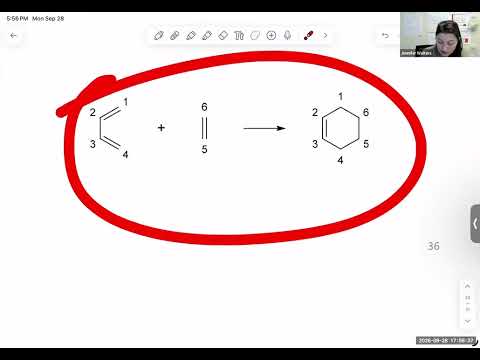
- The concerted cycloaddition forms a six-membered ring by making bonds between diene carbons 1 and 6 and dienophile carbon 5, while reorganizing three pi bonds.
- Electron-donating groups make dienes more nucleophilic, while electron-withdrawing groups make dienophiles more electrophilic; a diene locked s-cis reacts faster than one that must rotate from s-trans.
- Dienophile stereochemistry is retained: cis substituents remain cis in the ring product, and trans substituents remain trans.
16:27
Alkyne Acidity and Equivalents in Halogenation and Hydrohalogenation
- A terminal alkyne’s sp-hybridized carbon makes its C–H bond more acidic than alkene or alkane C–H bonds; strong bases such as sodium amide (NaNH₂) can deprotonate it.
- One equivalent of Br₂ adds two bromines across an alkyne’s first pi bond; two equivalents or excess Br₂ can add four bromines across both pi bonds.
- Hydrohalogenation follows Markovnikov orientation: one equivalent of HBr gives one H and one Br addition, while additional HBr can add across the remaining pi bond.
23:03
Alkyne Reduction and Hydration: Controlling Alkene Geometry and Tautomers
- Standard catalytic hydrogenation reduces an alkyne all the way to an alkane rather than stopping at an alkene.
- Lindlar’s poisoned palladium catalyst stops reduction at a cis alkene through syn hydrogen addition; sodium metal in liquid ammonia (Birch reduction) gives a trans alkene.
- Alkyne hydration forms an enol that tautomerizes: Markovnikov hydration gives a ketone, while anti-Markovnikov hydroboration–oxidation of a terminal alkyne gives an aldehyde.
26:57
Practice Problems: Diels–Alder Rates, Isotope Labels, and Propyne Products
- The fastest Diels–Alder diene in the ranking is locked s-cis and bears an electron-donating group; a dienophile is not a diene even if it contains multiple pi bonds.
- With one equivalent of DCl, deuterium acts like hydrogen chemically but tracks its position; conjugated addition can give both 1,2- and 1,4-products, which hydrogenation then saturates.
- For propyne, hydroboration–oxidation is the listed route to an aldehyde; Markovnikov hydration and oxymercuration–demercuration lead through enols to a ketone.
- Potassium permanganate gives oxidative-cleavage products, and hydrogenation gives an alkane rather than an aldehyde.
Summary, takeaways, and chapters were generated by AI from the video's transcript and may contain errors. The video belongs to its creator, Dr. Jennifer Walters.