An Interview with Gilbert Strang on Teaching Linear Algebra
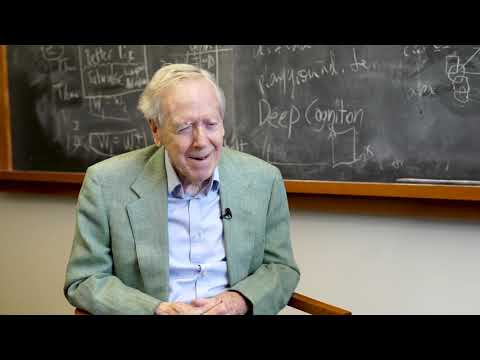 Watch on YouTube →
Overview
Gilbert Strang describes teaching MIT's 18.06 linear algebra by thinking through problems alongside students, pausing at difficult steps, and introducing ideas through symbols, meaning, and only then proof. He treats real-time problem solving, occasional dead ends, and humor as ways to make mathematics human and show students how to recover when they get stuck. Strang also emphasizes staying aware of a large class's understanding and celebrates MIT OpenCourseWare's global reach, with 18.06 lectures counted at 10 million viewers.
Key takeaways
- Strang's central teaching practice is to think through a question with students, not simply announce a result and ask them to listen.
- A useful sequence for explaining linear algebra is to present symbolic notation, clarify its meaning, and then explain why the claim is true.
- Pausing at critical steps gives students time to anticipate the next move instead of watching a proof rush past them.
- Working problems in real time, including showing how to recover from a dead end, models how students can respond when they get stuck.
- Strang uses humor and a human, conversational style to make mathematical work feel natural and approachable.
- MIT OpenCourseWare's count of 10 million viewers for 18.06 illustrates how recorded lectures can extend a class to learners worldwide.
Chapters
0:00
Gilbert Strang's 18.06 Method: Think Alongside Students
- Strang says he has no fixed teaching system; he starts from liking students and wanting to help them.
- Rather than simply presenting answers, he thinks through questions with the class and gives students time to follow each step.
- For linear algebra, he introduces ideas first as board symbols, then explains what they mean, and later addresses why they are true.
2:10
Real-Time Problem Solving, Dead Ends, and Humanizing Mathematics
- Strang pauses at critical points so students can consider what the next step should be instead of rushing through a proof.
- He acknowledges that solving problems live can lead to losing the thread or reaching a dead end, even though repeated teaching of 18.06 helps him navigate familiar material.
- Showing how he gets unstuck can help students handle their own dead ends; humor, including the phrase “Gauss-given order,” helps make math feel human.
4:07
Connecting with a Large Class and Sharing 18.06 Worldwide
- Strang decides how much detail to give by thinking the material through again and choosing the words and steps that make the reasoning clear.
- He advises instructors to stay conscious of their audience rather than focus only on mathematical notation such as A-B inverse.
- MIT OpenCourseWare counted 10 million viewers for Strang's 18.06 lectures, and he says he replies when possible to encouraging messages from around the world.
- Open access to the lectures lets people everywhere participate in the class.
Summary, takeaways, and chapters were generated by AI from the video's transcript and may contain errors. The video belongs to its creator, MIT OpenCourseWare.