9. Independence, Basis, and Dimension
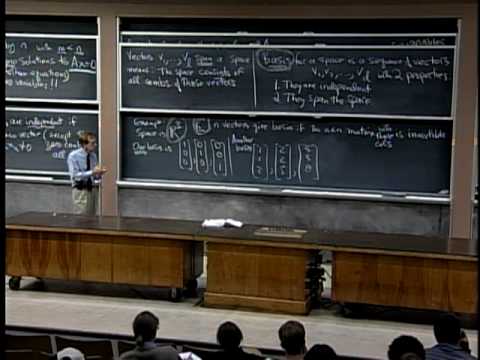 Watch on YouTube →
Overview
MIT OpenCourseWare’s linear algebra lecture connects linear independence, span, basis, and dimension to matrix elimination and null spaces. It establishes that a matrix with more columns than rows has a nonzero nullspace vector, defines independence through the equation A c = 0, and shows that a matrix’s rank is the dimension of its column space while its nullity is n - r.
Key takeaways
- For an m-by-n matrix with n > m, at least n - m variables are free in A x = 0, guaranteeing a nonzero nullspace vector and therefore dependent columns.
- A set of vectors is independent exactly when the only coefficient vector c satisfying A c = 0 is c = 0, where the vectors are the columns of A.
- A basis is both independent and spanning; for R^n, n vectors form a basis exactly when their square column matrix is invertible.
- Every basis of the same vector space has the same number of vectors, and that shared count defines the space’s dimension.
- The rank of A is the dimension of its column space, while the nullspace dimension is n - r, the count of free variables.
- Once a space’s dimension is known, any independent collection with exactly that many vectors is automatically a basis.
Chapters
0:00
More Unknowns Than Equations Guarantee a Nonzero Nullspace
- For an m-by-n matrix with n > m, row reduction can produce at most m pivot variables, so at least n - m variables are free.
- Setting a free variable to a nonzero value and solving for the pivot variables gives a nonzero solution to A x = 0.
- This nullspace fact will connect matrix elimination to linear dependence.
4:30
Linear Independence Means Only the Zero Combination Gives Zero
- Vectors v1 through vn are independent if c1v1 + ... + cnvn = 0 implies every coefficient c1 through cn is zero.
- If some nonzero coefficient vector c produces a zero combination, the vectors are dependent.
- The definition applies to a collection of vectors, not to a matrix itself.
7:00
Scalar Multiples and Zero Vectors Make Collections Dependent
- The pair v and 2v is dependent because 2v - 2v = 0 gives a nontrivial combination.
- Any collection containing the zero vector is dependent, since a nonzero coefficient on that vector and zero coefficients elsewhere gives zero.
- Two nonparallel vectors in the plane can be independent, but any three vectors in the plane must be dependent.
11:30
Test Column Independence with the Nullspace of A
- Place vectors v1 through vn into the columns of a matrix A; a relation among them is exactly a solution to A c = 0.
- The columns are independent precisely when the nullspace of A contains only the zero vector.
- Independent columns are all pivot columns, so rank r equals n; dependent columns leave free variables and give r < n.
18:00
Span Is the Set of All Linear Combinations
- Vectors span a space when every vector in that space is a linear combination of them.
- The column space of a matrix consists of all combinations of its columns, so those columns span it by definition.
- The span is the smallest space containing the chosen vectors, because any such space must contain all their combinations.
22:00
A Basis Must Be Both Independent and Spanning
- A basis is a collection of vectors with two properties: the vectors are independent and they span the space.
- The standard coordinate vectors form a basis for R^3; their column matrix is the identity, whose nullspace is zero.
- For R^3, three vectors form a basis when their 3-by-3 column matrix is invertible.
30:00
Different Bases for One Space Have the Same Size
- Many different vector collections can be bases for R^3; any invertible 3-by-3 matrix supplies one through its columns.
- Two independent vectors such as (1,1,2) and (2,2,5) span a plane and form a basis for that plane, but not for all of R^3.
- Every basis for a given space has the same number of vectors, and that number is the space’s dimension.
37:00
Pivot Columns Give a Basis for the Column Space
- In the example matrix, four columns span the column space, but the columns are dependent because some can be expressed using others.
- The first two pivot columns form a basis for the column space, and the matrix has rank 2.
- Rank is a property of the matrix, while the dimension belongs to a space: rank A equals the dimension of A’s column space.
43:00
Independent Vectors and the Right Count Form a Basis
- A basis for the example’s two-dimensional column space can use vectors other than the original pivot columns.
- Once a space’s dimension is known to be 2, any two independent vectors in that space automatically span it and form a basis.
- Independence prevents redundancy, while the dimension tells how many vectors are needed.
47:00
Nullspace Dimension Equals the Number of Free Variables
- Each free variable in A x = 0 supplies a special solution, and those special solutions form a basis for the nullspace.
- The nullspace dimension is the number of free variables, which is the number of columns n minus the rank r.
- The lecture’s example has two free variables, so its nullspace is two-dimensional and its special solutions give a two-vector basis.
Summary, takeaways, and chapters were generated by AI from the video's transcript and may contain errors. The video belongs to its creator, MIT OpenCourseWare.