8. Solving Ax = b: Row Reduced Form R
 Watch on YouTube →
Overview
The lecture develops a complete procedure for solving Ax=b: use elimination on the augmented matrix to test consistency, find a particular solution by setting free variables to zero, and generate every other solution by adding vectors from the null space. It then classifies systems by rank, distinguishing full column rank, full row rank, and square invertible cases, and shows how rank determines whether solutions are absent, unique, or infinite in number.
Key takeaways
- Eliminating the augmented matrix exposes consistency conditions: in the three-row example, row 3 equals row 1 plus row 2, requiring b3=b1+b2.
- For any consistent system, the full solution set is xp+N(A), where xp is one particular solution and N(A) is the null space.
- Setting every free variable to zero gives a convenient particular solution; each free variable can then generate a null-space special solution.
- Full column rank r=n means no free variables, so a system has either zero solutions or one unique solution.
- Full row rank r=m means no zero rows after elimination, so every right-hand side is consistent; if n>m, the n-m free variables yield infinitely many solutions.
- A square matrix with r=m=n reduces to the identity, has a trivial null space, and gives exactly one solution for every b.
Chapters
0:00
Augmented-Matrix Elimination Finds the Solvability Condition
- The example matrix has rows (1,2,2,2), (2,4,6,8), and (3,6,8,10), with row 3 equal to row 1 plus row 2.
- Appending b as a fifth column lets elimination apply the same row operations to the left- and right-hand sides.
- Elimination produces a zero row whose augmented entry is b3-b2-b1, so the system is consistent only when b3=b1+b2.
6:00
Consistency, the Column Space, and Row Dependencies
- For b=(1,5,6), the final augmented entry is zero, satisfying the row-dependency condition.
- Ax=b is solvable exactly when b lies in the column space of A, meaning b is a linear combination of A’s columns.
- Whenever a combination of A’s rows gives the zero row, the same combination of b’s entries must give zero.
11:00
Constructing a Particular Solution with Free Variables Set to Zero
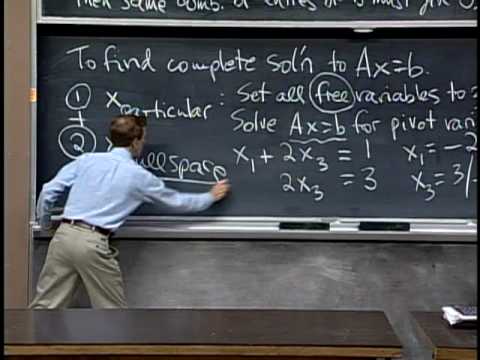
- The example has pivot columns 1 and 3, leaving x2 and x4 as free variables.
- Setting x2=x4=0 reduces the equations for b=(1,5,6) to x1+2x3=1 and 2x3=3.
- Back substitution gives the particular solution xp=(-2,0,3/2,0), which can be checked in the original system.
16:00
All Solutions Are a Particular Solution Plus the Null Space
- If Axp=b and Axn=0, then A(xp+xn)=b, so adding any null-space vector preserves the right-hand side.
- For the four-variable example, null-space special solutions are (-2,1,0,0) and (2,0,-2,1), corresponding to free variables x2 and x4.
- The complete solution is xp+c1(-2,1,0,0)+c2(2,0,-2,1), with arbitrary constants c1 and c2.
- The solution set is a shifted two-dimensional flat in R4, not a subspace through the origin.
24:00
Rank Bounds and the Consequences of Full Column Rank
- For an m-by-n matrix with rank r, the pivot count satisfies r≤m and r≤n.
- Full column rank means r=n, so every column has a pivot and there are no free variables.
- In the full-column-rank case, the null space contains only zero, and Ax=b has either no solution or exactly one.
30:00
A Tall 4-by-2 Matrix Has Unique Solutions When Consistent
- The example has columns (1,2,6,5) and (3,1,1,1), giving rank 2 and full column rank.
- Because the matrix has four rows but only two columns, an arbitrary b in R4 will generally not lie in its column space.
- For b=(4,3,7,6), the columns add to b, so the unique solution is x=(1,1).
35:00
Full Row Rank Guarantees a Solution for Every Right-Hand Side
- Full row rank means r=m, so elimination produces a pivot in every row and no zero rows.
- With no zero rows, there are no consistency restrictions on b, and Ax=b has a solution for every right-hand side.
- The number of free variables is n-r=n-m, so when n>m the solutions include infinitely many choices.
40:00
Square Full-Rank Matrices Are Invertible
- When r=m=n, the matrix is square and full rank, and its reduced row echelon form is the identity matrix.
- For the example matrix with rows (1,2) and (3,1), the null space contains only the zero vector.
- Every b is allowed and each has exactly one solution, the defining solution behavior of an invertible matrix.
43:00
Rank Classifies Zero, Unique, and Infinite Solution Cases
- If r=m=n, every b gives one solution; if r=m<n, every b gives solutions with n-m free variables.
- If r=n<m, solutions are unique when they exist, but many right-hand sides fail consistency conditions.
- If r<m and r<n, zero rows can make some systems inconsistent, while consistent systems have free variables and infinitely many solutions.
- Rank determines the possible number and structure of solutions, while the actual matrix entries determine their values.
Summary, takeaways, and chapters were generated by AI from the video's transcript and may contain errors. The video belongs to its creator, MIT OpenCourseWare.