7. Solving Ax = 0: Pivot Variables, Special Solutions
 Watch on YouTube →
Overview
The lecture turns solving Ax = 0 into an algorithm: use elimination to identify pivot columns, count the rank, assign values to free variables, and construct special solutions that span the null space. Two examples show how the method works, while reduced row echelon form exposes the structure directly: with rank r and n columns, there are n-r free variables and the null-space matrix has pivot-variable block -F and free-variable block I.
Key takeaways
- For an n-column matrix of rank r, elimination identifies r pivot variables and n-r free variables; the number of free variables determines how many special solutions span the null space.
- Assigning one free variable the value 1 and all other free variables 0 produces one special solution; every solution to Ax = 0 is a linear combination of those vectors.
- Row operations preserve the solution set of Ax = 0, so solving with echelon form or reduced row echelon form gives the same null space as solving with A.
- In reduced form [I F; 0 0], the null-space matrix has blocks [-F; I], because the pivot variables must satisfy x_p = -F x_f.
- A zero row in echelon form signals dependence among the original rows, while a skipped column with no pivot identifies a dependent column and a free variable.
Chapters
0:00
Solving Ax = 0 with Elimination on a Rectangular Matrix
- The goal is to describe every vector in the null space, turning the definition of Ax = 0 into a computational algorithm.
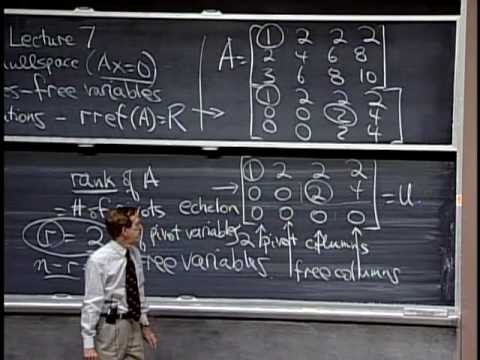
- The first example has 4 columns and 3 rows, with dependent columns and rows that elimination is expected to reveal.
- Row operations preserve the solutions to Ax = 0, even though they can change the matrix's column space.
5:30
Echelon Form Identifies Two Pivots and Rank 2
- Elimination clears entries below pivots and skips the second column when its pivot position and all entries below it are zero.
- The resulting echelon form has pivots in columns 1 and 3; its all-zero row reveals a dependent original row.
- Rank is defined here as the number of pivots, so the example matrix has rank 2.
12:00
Free Variables Produce Two Special Null-Space Solutions
- Columns 1 and 3 correspond to pivot variables x1 and x3, while columns 2 and 4 make x2 and x4 free variables.
- Setting (x2, x4) = (1, 0) and back-substituting gives (-2, 1, 0, 0), expressing that column 2 is twice column 1.
- Setting (x2, x4) = (0, 1) gives (2, 0, -2, 1), a second independent special solution.
- Every null-space vector is a linear combination of these two special solutions, one for each free variable.
18:30
Reduced Row Echelon Form Makes the Pivot Structure Explicit
- Starting from echelon form, row operations clear entries above the pivots and scale each pivot to 1.
- The resulting reduced row echelon form has an identity matrix in pivot rows 1 and 2 and pivot columns 1 and 3.
- MATLAB's reduced row echelon form command can produce the same matrix and make pivot and free columns easy to identify.
23:30
Reading Special Solutions from the Free-Column Block
- The first example's reduced system has identity block I in the pivot columns and free-column block F with entries 2, 0 and -2, 2.
- Choosing free-variable values from the identity matrix gives each special solution; the corresponding pivot-variable values are the negatives of the entries in F.
- Row operations from A to U to R preserve the solution set, so all three systems have the same null space.
29:00
Block Form Gives the Null-Space Matrix Formula
- When pivot columns are grouped first, a typical reduced matrix has the block structure [I F; 0 0], with r pivot rows and n-r free columns.
- The null-space matrix N, whose columns are the special solutions, has pivot block -F and free-variable block I.
- The formula follows from solving x_p + F x_f = 0, giving x_p = -F x_f; setting x_f to the identity generates all special solutions.
33:00
Transpose Example Reveals a Third Column Dependency
- The second example uses the transpose of the earlier matrix, with 4 rows and 3 columns.
- Its third column is the sum of its first two, so elimination is expected to find two pivots and one free variable.
- Elimination proceeds past an initially zero pivot position by exchanging rows, then reaches rank 2 with the third column free.
38:00
One Free Variable Produces a One-Dimensional Null Space
- Setting the sole free variable x3 to 1 and back-substituting gives the special solution (-1, -1, 1).
- The vector verifies the column relation: negative column 1 minus column 2 plus column 3 equals zero.
- The full null space is the line of all multiples c(-1, -1, 1); a basis request needs only the vector, while a full null-space description includes c.
- Reduced row echelon form again shows the free block and yields the special solution through the -F and I construction.
Summary, takeaways, and chapters were generated by AI from the video's transcript and may contain errors. The video belongs to its creator, MIT OpenCourseWare.