6.3 Factor Special Products --Lesson 22--FA26
 Watch on YouTube →
Overview
Rachel Soyk teaches how to factor perfect-square trinomials, differences of squares, and sums or differences of cubes through 12 worked examples. The central method is to remove any GCF first, identify the relevant pattern from square or cube roots and signs, then factor completely; Soyk recommends writing the cube formulas on paper flashcards for exam review.
Key takeaways
- For a perfect-square trinomial, the first and last terms must have square roots whose product doubled matches the middle term; the sign of that middle term selects (a + b)² or (a − b)².
- Always extract a GCF before applying a special-product formula: 100x²y − 80xy + 16y becomes 4y(5x − 2)² only after factoring out 4y.
- A difference of squares factors as (a + b)(a − b), and the resulting factors may need further factoring; 16x⁴ − 81 becomes (4x² + 9)(2x + 3)(2x − 3).
- After removing a GCF, a² + b² is prime over the real numbers, while a² − b² factors into conjugates.
- The sum-of-cubes formula is (a + b)(a² − ab + b²), whereas the difference-of-cubes formula is (a − b)(a² + ab + b²); the trinomial sign pattern is a reliable way to distinguish them.
- Complete factoring requires checking every resulting factor: in 6yx³ + 48y⁴, factoring out 6y exposes a sum of cubes and yields 6y(x + 2y)(x² − 2xy + 4y²).
Chapters
0:00
Section 6.3 Objectives and Algebra Warm-Ups
- Rachel Soyk introduces three targets: perfect-square trinomials, differences of squares, and sums or differences of cubes.
- The exponent warm-up simplifies (3x²)³ to 27x⁶ by cubing the coefficient and multiplying the exponents.
- The warm-ups revisit conjugate products, where middle terms cancel, and expand (m + 4)² to m² + 8m + 16.
3:16
Recognizing Perfect-Square Trinomials
- Check whether the first and last terms are perfect squares, then take their square roots as the binomial terms.
- Double the product of those roots and compare it with the middle term; its sign determines whether the factor is a sum or difference.
- For 9x² + 12x + 4, the roots 3x and 2 produce middle term 12x, so the factorization is (3x + 2)².
7:35
Perfect-Square Patterns with Signs, Variables, and GCFs
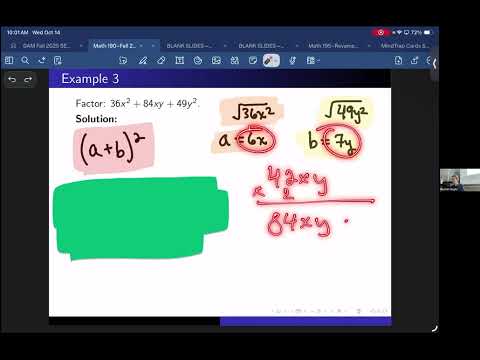
- The examples factor 81y² − 72y + 16 as (9y − 4)² and 36x² + 84xy + 49y² as (6x + 7y)².
- For expressions with multiple variables, use the square root of each end term—for example, 36x² and 49y² yield 6x and 7y.
- Soyk stresses extracting a GCF before testing the pattern: 100x²y − 80xy + 16y becomes 4y(25x² − 20x + 4), then 4y(5x − 2)².
15:24
Difference of Squares and the Prime Sum-of-Squares Rule
- Conjugates factor a² − b² as (a + b)(a − b), with the opposite-sign middle terms canceling.
- The example 64y² − 1 factors into (8y + 1)(8y − 1); likewise, 144x² − 49y² becomes (12x + 7y)(12x − 7y).
- After removing any GCF, a² + b² does not factor into real binomials, so a sum of squares is prime in this factoring context.
20:05
Factoring Differences of Squares More Than Once
- Soyk factors out the GCF 3y² from 48x⁴y² − 243y², leaving 16x⁴ − 81.
- The remaining expression becomes (4x² + 9)(4x² − 9); the sum of squares stays prime, but the difference factors again.
- The complete result is 3y²(4x² + 9)(2x + 3)(2x − 3), illustrating why each factor must be checked before stopping.
- The four-term expression x² − 6x + 9 − y² first becomes (x − 3)² − y², then factors as (x − 3 + y)(x − 3 − y).
28:00
Sum and Difference of Cubes: Formulas and Sign Patterns
- For a³ + b³, use (a + b)(a² − ab + b²); the trinomial signs alternate plus, minus, plus.
- For a³ − b³, use (a − b)(a² + ab + b²); all signs in the trinomial are positive.
- Find a and b by taking cube roots of the original terms, and write the formulas down before substituting to reduce sign errors.
30:18
Applying Cube Formulas to Numerical and Variable Terms
- The sum x³ + 64 uses a = x and b = 4, giving (x + 4)(x² − 4x + 16).
- The difference 27u³ − 125v³ uses cube roots 3u and 5v, giving (3u − 5v)(9u² + 15uv + 25v²).
- Both examples follow the same process: identify the sign pattern, take cube roots, and substitute into the matching formula.
35:03
Cube Examples with GCFs and Algebraic Simplification
- For 6yx³ + 48y⁴, factor out 6y first, then apply the sum-of-cubes formula to x³ + 8y³.
- The complete factorization is 6y(x + 2y)(x² − 2xy + 4y²).
- The difference (x + 5)³ − 64x³ factors as (5 − 3x)(21x² + 30x + 25) after expanding and combining like terms.
- Soyk closes by reviewing all four patterns—perfect-square trinomials, difference of squares, sum of cubes, and difference of cubes—and recommends paper flashcards.
Summary, takeaways, and chapters were generated by AI from the video's transcript and may contain errors. The video belongs to its creator, Rachel Soyk.