6.2 Factor Trinomials --Lesson 21--FA26
 Watch on YouTube →
Overview
Rachel Soyk teaches three approaches to factoring trinomials: matching factor pairs for monic quadratics, the AC method with factor-by-grouping for nonmonic quadratics, and substitution for quartic or shifted expressions. Worked examples show how signs, greatest common factors, and variables affect the factor pairs, while the lesson also identifies prime trinomials and connects polynomial degree to the maximum number of turning points.
Key takeaways
- For a monic trinomial x² + bx + c, factor c and choose the pair whose sum is b; the pair supplies the constants in the two binomial factors.
- The AC method factors ax² + bx + c by finding two numbers with product ac and sum b, splitting bx, then grouping to create a shared binomial.
- Always remove a common factor before using AC: 10y² − 55y + 70 becomes 5(2y² − 11y + 14), which factors to 5(y − 2)(2y − 7).
- For two-variable trinomials such as r² − 8rs − 9s², treat the second variable as part of the constant and split its squared power across the factor pair.
- Substitution can reduce expressions such as x⁴ − 4x² − 5 to a quadratic by setting u = x²; factor in u, then substitute the original expression back.
- A polynomial of degree n has at most n − 1 turning points, so a degree-4 polynomial can have up to 3.
Chapters
0:00
Factoring Warm-Up: Factor Pairs of 72 and FOIL
- Rachel Soyk reviews factor-pair listing with 72, from 1 × 72 through 8 × 9.
- FOIL expands (3y + 4)(2y + 5) into 6y² + 15y + 8y + 20.
- Combining the like middle terms gives the trinomial 6y² + 23y + 20.
3:04
Monic Trinomials: Find Factor Pairs That Sum to the Middle Coefficient
- For x² + bx + c, find factor pairs of c whose sum is b; the pair becomes the constants in (x + m)(x + n).
- For x² + 5x + 6, the pair 2 and 3 produces (x + 2)(x + 3).
- For x² + 11x + 24, the pair 3 and 8 produces (x + 3)(x + 8).
6:10
Signs and Descending Order in Monic Trinomial Factoring
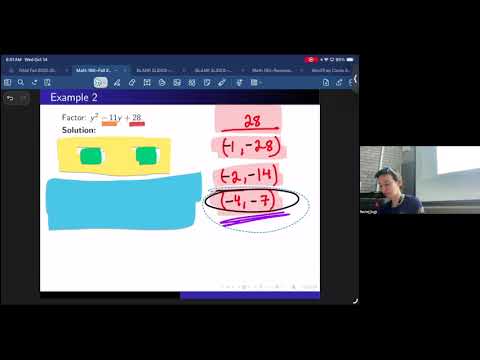
- For y² − 11y + 28, both factors must be negative; −4 and −7 give (y − 4)(y − 7).
- Reorder 2x + x² − 48 as x² + 2x − 48 before identifying factor pairs.
- For x² + 2x − 48, −6 and +8 multiply to −48 and sum to 2, giving (x − 6)(x + 8).
- Soyk recommends checking a completed factorization by multiplying the binomials with FOIL.
13:50
AC Method: Split the Middle Term and Factor by Grouping
- For ax² + bx + c, place a × c at the top of an X and b at the bottom; find a factor pair of ac that sums to b.
- For 6x² + 7x + 2, ac = 12, and 3 and 4 sum to 7, so rewrite 7x as 3x + 4x.
- Grouping 6x² + 3x + 4x + 2 gives 3x(2x + 1) + 2(2x + 1).
- Pulling out the shared binomial yields (2x + 1)(3x + 2).
20:55
Factor Out the GCF Before Applying AC
- Before using AC, check whether all terms share a greatest common factor; 10y² − 55y + 70 has a GCF of 5.
- After taking out 5, factor 2y² − 11y + 14 using ac = 28 and the pair −4, −7.
- Split −11y into −4y − 7y; grouping gives 2y(y − 2) − 7(y − 2).
- The fully factored result is 5(y − 2)(2y − 7).
26:05
Two-Variable Trinomials and Recognizing a Prime Example
- In r² − 8rs − 9s², treat s as part of the constant: c = −9s² and b = −8s.
- Splitting −9s² into s and −9s gives a sum of −8s, so the factorization is (r + s)(r − 9s).
- For u² − 9uv − 12v², test factor pairs of −12v² that sum to −9v; the listed pairs do not work.
- Because none of the possible factor pairs produce the required middle term, u² − 9uv − 12v² is prime over the integers.
36:05
Substitution Turns a Quartic into a Factorable Quadratic
- When a quartic repeats a squared expression, substitute a new variable to reduce it to a quadratic form.
- For x⁴ − 4x² − 5, let u = x²; then u² − 4u − 5 factors as (u − 5)(u + 1).
- Replace u with x² to obtain (x² − 5)(x² + 1), the factorization in the original variable.
- Soyk notes that x² − 5 can further factor over the reals as (x + √5)(x − √5), while x² + 1 remains prime over the reals.
42:07
Substitute a Repeated Binomial, Then Convert Back to x
- For (x − 2)² + 7(x − 2) + 12, the repeated expression suggests setting u = x − 2.
- The substituted quadratic u² + 7u + 12 factors using 3 and 4 as (u + 3)(u + 4).
- Substitute x − 2 back for u and simplify: (x − 2 + 3)(x − 2 + 4) = (x + 1)(x + 2).
44:41
Polynomial Degree and the Maximum Number of Turning Points
- Soyk connects polynomial degree to graph shape: a quadratic can have up to 1 turning point, while a cubic can have up to 2.
- A degree-4 polynomial can have up to 3 turning points; in general, degree n allows at most n − 1.
- The degree-and-turning-point relationship is previewed as useful background for later work with multiplicities and calculus.
Summary, takeaways, and chapters were generated by AI from the video's transcript and may contain errors. The video belongs to its creator, Rachel Soyk.