6:2 Conservation of Mass - Streamline Accelerations and Reynolds' Tranport Theorem
 Watch on YouTube →
Overview
Derek Elsworth develops a control-volume approach to conservation of mass, connecting streamline acceleration and vector dot products to Reynolds transport theorem. He derives the mass balance using outward normals and signed flow rates, then applies it to two cases: compressing air into a fixed-volume tire and filling a bucket whose control volume rises with the water surface.
Key takeaways
- The material derivative connects a fluid particle's time-based acceleration to spatial changes in velocity; along a streamline, the tangential contribution is velocity times the velocity gradient along distance.
- Curved streamlines require a normal acceleration component of speed squared divided by radius, in addition to acceleration caused by changing speed along the streamline.
- The outward-normal dot product provides a consistent boundary-flow sign convention: entering mass is negative, leaving mass is positive, and flow parallel to a boundary contributes zero.
- For a control volume, conservation of mass can be written as the rate of change of density-volume plus the sum of signed mass flow rates across the boundary equalling zero.
- In a fixed-volume tire, incoming air raises density; in a bucket control volume attached to the free surface, incoming water increases volume and height while density stays approximately constant.
Chapters
0:00
Skydiving and Jetpack Footage as Fluid-Flow Hooks
- Opening clips show a skydiver and a jetpack concept for reaching patients in remote terrain.
- Elsworth questions whether the skydiving footage is real and uses the fluid-motion imagery to lead into the lecture.
3:50
Control Volumes and Three Reference-Frame Choices
- The lecture recaps control volumes enclosed by control surfaces and distinguishes static, moving-but-nondeforming, and moving-and-deforming cases.
- A bucket filling with water illustrates mass accumulation as inflow exceeds outflow.
- Elsworth reminds students to choose varied presentation topics and have group topics ready by week seven.
6:54
Material Derivative: Relating Local Velocity Change to Acceleration
- Acceleration measured while following a moving body is expressed as a time rate of velocity change, while a spatial velocity gradient gives a complementary description.
- For one-dimensional flow, the convective contribution is velocity multiplied by the spatial velocity gradient, linking changes along a path to acceleration.
- The material or substantial derivative combines time-based and space-based descriptions of a fluid particle's changing properties.
10:16
Streamline and Centripetal Acceleration Components
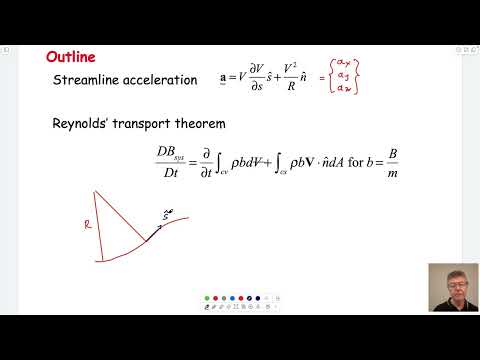
- Along a streamline, tangential acceleration is expressed as velocity times the change in speed with distance, while curvature produces a normal component proportional to speed squared over radius.
- Elsworth relates the normal term to centripetal acceleration, as when an object moves around a circle on a string.
- Unit vectors along the streamline and toward the center of curvature can be resolved into x, y, and z components to obtain Cartesian acceleration components.
19:10
Dot Products and Outward Normals Set Flow Signs
- For a control surface, the velocity dot the outward unit normal selects the velocity component crossing the boundary.
- The dot product is negative for flow entering the control volume and positive for flow leaving it.
- A velocity parallel to a surface has zero normal component, so it contributes no flow across that face.
- Volumetric flow rate is velocity times area in cubic metres per second; multiplying by density gives mass flow rate in kilograms per second.
29:29
Reynolds Transport Theorem Connects System and Control-Volume Balances
- Reynolds transport theorem relates changes in a system quantity to accumulation inside a control volume and transfer across its control surface.
- For mass, inflow and outflow differences become accumulation; equal mass rates entering and leaving mean no net accumulation.
- Elsworth previews applying the same theorem to mass, momentum, and energy in weeks six, seven, and eight.
34:17
Deriving the Control-Volume Conservation-of-Mass Equation
- For mass, the extensive property is mass and its intensive counterpart is mass divided by mass, which equals one.
- The resulting balance is the time rate of change of density times volume plus the sum of signed mass flow rates across the faces, equal to zero.
- Using the product rule separates accumulation into volume times density change and density times volume change.
38:22
Interpreting Mass Accumulation and Boundary-Flow Signs
- An inlet contributes a negative mass flow rate and an outlet contributes a positive one under the outward-normal convention.
- A net mass gain can raise density inside a fixed-volume region or increase the control-volume size while density stays constant.
- The tire and rising-water examples illustrate these two distinct accumulation mechanisms.
47:01
Fixed-Volume Tire Example: Air Inflow Raises Density
- Air enters a sealed tire through an inlet with density, velocity, and area defining the incoming mass rate; there is no outlet.
- Because the tire's control volume is fixed, its volume-change term is zero, so the inflow is balanced by an increase in air density.
- Integrating the balance over time relates the final density to the initial density, tire volume, inlet area, inlet velocity, and pumping duration.
50:44
Rising Bucket Example and the Mass-Balance Sign Rules
- A bucket's control volume is attached to the rising free surface, so its volume increases while water density remains approximately constant.
- With no flow crossing the moving top boundary, inlet flow determines the increase in water height through the bucket's cross-sectional area.
- The practical sign rules are negative for inflow, positive for outflow, and positive for increasing density or control-volume size.
Summary, takeaways, and chapters were generated by AI from the video's transcript and may contain errors. The video belongs to its creator, Derek Elsworth.