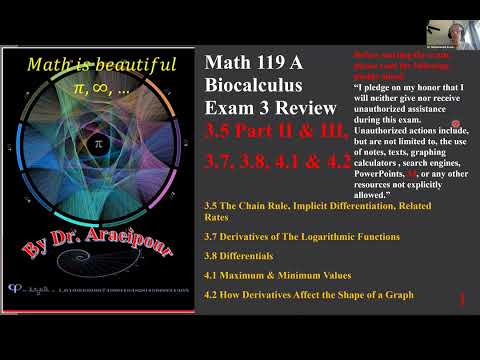
2026 Fall Exam 3 Review 3.5_3.7_3.8_4.1_4.2 Derivative Apps
Overview
Professor Ara Araeipour reviews calculus topics from sections 3.5 through 4.2, connecting chain rule, implicit differentiation, logarithmic derivatives, differentials, extrema, curve sketching, and related rates. Worked examples include tangent lines, approximating cube root of 63.5, finding absolute extrema on a closed interval, analyzing a cubic, and solving circle, balloon, and ladder rate problems.
Key takeaways
- For implicit equations, differentiate both sides while treating y as a function of x, then collect and factor all y′ terms before solving.
- A tangent line requires both a point on the curve and the derivative evaluated at that point; for x² + 2xy - y² + x = 2 at (1, 2), the slope is 7/2.
- Differentials estimate function changes with dy = f′(x)dx, while the exact change is Δy = f(x + Δx) - f(x); the two become closer for smaller increments.
- To find absolute extrema on a closed interval, compare function values at both endpoints and every in-interval point where f′ is zero or undefined.
- In related-rate problems, first write an equation connecting the changing quantities, differentiate with respect to time, and then substitute the known measurements and rates.
- For curve sketching, first derivative sign changes identify increasing and decreasing intervals and local extrema; second derivative sign changes identify concavity and possible inflection points.
Chapters
- The review covers sections 3.5 through 4.2, including chain rule, implicit differentiation, related rates, logarithms, differentials, and graph shape.
- The derivative definition is the limit of [f(x+h) - f(x)]/h as h approaches zero.
- Araeipour distinguishes the curve change Δy = f(x + Δx) - f(x) from the tangent-line change dy = f′(x)dx.
- A logarithm represents an exponent: y = log_b(x) means b^y = x, with b positive and not equal to 1.
- The product, quotient, and power rules give log_b(xy) = log_b(x) + log_b(y), log_b(x/y) = log_b(x) - log_b(y), and log_b(x^n) = n log_b(x).
- Natural logarithm means base e; change of base can be written log_b(x) = ln(x)/ln(b).
- The derivative rules are d/dx[ln(g(x))] = g′(x)/g(x) and d/dx[log_b(g(x))] = g′(x)/(g(x)ln(b)); ln(x) crosses the x-axis at x = 1.
- For an equation involving (2x + y)^4, differentiation produces 4(2x + y)^3(2 + y′), showing how the chain rule accounts for y depending on x.
- For sin(y) + 2x^3y^2 = 1, implicit differentiation gives cos(y)y′ + 6x^2y^2 + 4x^3yy′ = 0.
- Collect all y′ terms on one side, factor out y′, and divide by the remaining coefficient to solve.
- For x² + 2xy - y² + x = 2, differentiate each term implicitly and use the product rule on 2xy.
- Solving for y′ gives y′ = (-2x - 2y - 1)/(2x - 2y); at (1, 2), the tangent slope is 7/2.
- Using point-slope form, y - 2 = (7/2)(x - 1), which simplifies to y = (7/2)x - 3/2.
- For xe^y + 4x = y³, differentiate with respect to t because the requested derivative is dy/dt.
- The product rule gives x′e^y + xe^y y′ + 4x′ = 3y²y′.
- Substituting x′ = 2, x = -1, and y = 0 reduces the equation to 2 - y′ + 8 = 0, so dy/dt = 10.
- For 2x ln(3x²), use the product rule and chain rule; the derivative simplifies to 2 ln(3x²) + 4.
- Rewrite ln(5x/(x² + 5)) as ln(5) + ln(x) - ln(x² + 5) before differentiating, avoiding a quotient-rule calculation inside the logarithm.
- For y = x²/(x - 8), the quotient rule gives dy/dx = (x² - 16x)/(x - 8)², so dy is that expression multiplied by dx.
- For f(x) = x²/(x - 8) at x = 4 with dx = Δx = 0.2, the differential estimate is dy = -0.6.
- The actual change is Δy = f(4.2) - f(4), approximately -0.6421.
- The approximation dy becomes closer to Δy as the increment shrinks, such as when Δx changes from 0.2 to 0.1 or 0.01.
- Choose f(x) = x^(1/3) and the nearby easy input x = 64, where f(64) = 4.
- Since Δx = 63.5 - 64 = -0.5 and f′(64) = 1/48, the differential estimate is 4 - 0.5/48 = 3 95/96.
- The tangent line at (64, 4) is L(x) = x/48 + 8/3; evaluating it at 63.5 gives the same approximation.
- The approximation works well because the input change of 0.5 is small relative to 64.
- For f(x) = (x² - 1)³ on [-1, 2], continuity is guaranteed because f is a polynomial.
- Differentiate to get f′(x) = 6x(x² - 1)²; critical numbers are x = -1, 0, and 1, with -1 also an endpoint.
- Compare function values at endpoints and critical numbers: f(-1) = 0, f(0) = -1, f(1) = 0, and f(2) = 27.
- The absolute minimum is -1 at x = 0, and the absolute maximum is 27 at x = 2.
- For circular ripples, A = πr² and dr/dt = 3/2 ft/s; at r = 4 ft, dA/dt = 2πr(dr/dt) = 12π ft²/s.
- For a spherical balloon, V = (4/3)πr³; losing air at 8 cm³/min means dV/dt = -8.
- At r = 20 cm, the relation dV/dt = 4πr²(dr/dt) gives dr/dt = -1/(200π) cm/min.
- A negative rate indicates decrease; describe the balloon radius as decreasing at 1/(200π) cm/min rather than giving a negative decrease rate.
- For f(x) = -x³ + x² + x, the x-intercepts are 0 and (1 ± √5)/2, found by factoring out -x and solving the remaining quadratic.
- The derivative factors as f′(x) = -(3x + 1)(x - 1), giving a local minimum at (-1/3, -5/27) and a local maximum at (1, 1).
- The function decreases on (-∞, -1/3) and (1, ∞), and increases on (-1/3, 1).
- Since f″(x) = -6x + 2 changes sign at x = 1/3, the inflection point is (1/3, 11/27); the cubic's end behavior goes from quadrant II toward quadrant IV.
- A 20-ft ladder forms a right triangle with base x and height y, so x² + y² = 400.
- The base moves away at dx/dt = 2 ft/min; when x = 12 ft, the Pythagorean relation gives y = 16 ft.
- Differentiating yields 2x(dx/dt) + 2y(dy/dt) = 0, so dy/dt = -3/2 ft/min.
- The negative sign means the ladder's height is decreasing at 3/2 ft/min while the base moves outward.
- Let θ be the angle between the 20-ft ladder and the ground; cosine relates it to the base through cos(θ) = x/20.
- Differentiate with respect to time to obtain -sin(θ)(dθ/dt) = (1/20)(dx/dt).
- At x = 12 ft, the height is 16 ft, so sin(θ) = 16/20; with dx/dt = 2 ft/min, dθ/dt = -1/8 rad/min.
- The angle is decreasing at 1/8 radian per minute; calculus angle rates use radians unless degrees are explicitly specified.
Transcript excerpt
0:04 Good morning, class. Here's the exam three review covering from section 3.5 to 4.2. The chain rule, implicit differentiation, related rates, derivatives of the log, differentials, maximum and minimum, how derivatives affect the shape of a graph. Here's a pledge before starting this exam or any other exam, we should go with the following. I pledge on my honor that I will neither give nor receive unauthorized assistance during this exam. Unauthorized action include, but are not limited to, the use of notes, text, graphic calculators, search engines, PowerPoints, AI, or any other resources not explicitly allowed. Differentiation formulas, let's quickly remind everybody of
0:52 the definition. F prime is limit of f of x plus h minus f of x over h as h approaches zero. The meaning of e, the power rule, trigonometric functions, product rule, quotient rule, chain rule, differentiation of exponentials, differentiation of logs, and now delta y, which is this distance, which is rise along the curve is f of x plus delta x minus f of x, and d y, which is this distance, rise along the tangent line, is f prime of x dx. dx and delta x are identical,
1:42 and linearization refers to finding the equation of a tangent line. I highly recommend you stick with the point-slope to find it. It's very easy. You don't have to memorize that. But even if you do, just make sure you solve for y, or more specific, L of X, put it in slope-intercept form. That is important. So, having said that, let's remind everybody what is a log. Of course, the base must be positive, and it can't be one, and the exponent is the log. In other words, log simply represents an exponent. So, if we look at the exponential format, X equals B to the power of Y, or the
This is the start of the transcript. Save this video free for the whole transcript, searchable and time-coded.
In this course
Related notes
Summary, takeaways, and chapters were generated by AI from the video's transcript and may contain errors. The video belongs to its creator, Professor Ara Araeipour.