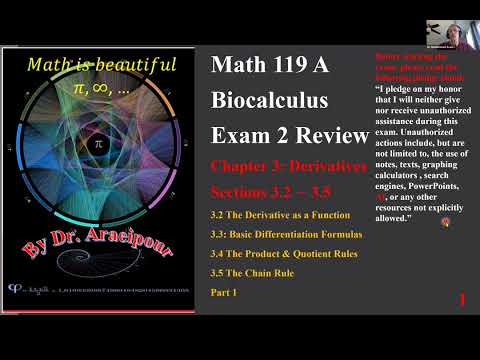
2026 Fall Exam 2 Review Derivatives 3.2 - 3.5
 Watch on YouTube →
Overview
Professor Ara Araeipour reviews calculus Sections 3.2–3.5, connecting the derivative definition and core rules—power, product, quotient, and chain—to worked examples and graph interpretation. Applications include population growth, animal growth, and glass recycling, with emphasis on units, simplifying rational expressions before differentiating, and choosing between a composite function and Leibniz notation.
Key takeaways
- For rational functions, simplify first whenever possible: factoring and canceling a shared factor can avoid a longer quotient-rule calculation, as with (2x²+9x+9)/(x+3)=2x+3.
- The chain rule tracks how an outer quantity changes through an intermediate variable: dL/dt=(dL/dW)(dW/dt) for animal growth and dG/dt=(dG/dP)(dP/dt) for recycling.
- Derivative graphs encode the original function’s behavior: local extrema become zeros of f', increasing intervals give positive values, and decreasing intervals give negative values.
- A piecewise-linear function has a piecewise-constant derivative equal to each segment’s slope, but sharp corners create points where the derivative is undefined.
- Application answers require units: the population model gives about 118.751 million people per year in 2050, while the glass-recycling model gives 0.48 tons per year at year four.
- Leibniz notation and direct composite-function differentiation are equivalent, but differentiating through an intermediate variable is often simpler when substitution creates a complicated expression.
Chapters
0:00
Derivative Definitions and the Section 3.2–3.5 Formula Toolkit
- Distinguishes average rate of change from instantaneous rate, defined through limits such as f'(a) = lim[h→0] (f(a+h)−f(a))/h.
- Gives the tangent-line equation y−f(a)=f'(a)(x−a) and introduces Leibniz notation dy/dx.
- Reviews power, constant, exponential, and trigonometric derivatives, including (sin x)'=cos x and (cos x)'=−sin x.
- States the product rule, quotient rule, and chain rule, including the extended power rule for [g(x)]^n.
3:29
Simplifying Powers and Differentiating Exponential and Trigonometric Compositions
- Simplifies (2x^5)/(9x^9) to (2/9)x^−4 before applying the power rule, obtaining −8/(9x^5).
- Derives the rule for b^x by rewriting it as e^(x ln b), so its derivative is b^x ln b.
- Differentiates 5^(sin x) as 5^(sin x) ln(5) cos x.
- Uses the chain rule on cos²x, cos(x²), and sin²(8x), obtaining 16 sin(8x)cos(8x) for the last example.
9:28
Product Rule Examples with Exponentials and Factored Answers
- Differentiates h(x)=x·3^x using the product rule and the factor ln(3) for the non-e exponential base.
- Shows that h'(x)=3^x(1+x ln 3) after factoring the derivative of x·3^x.
- Applies the product rule to x^4e^(2x), then factors the result as 2x^3e^(2x)(2+x).
- For 9x(x−1)^4, factors out 9(x−1)^3 to obtain 9(x−1)^3(5x−1).
15:48
Quotient Rule, Rational Simplification, and Algebraic Cleanup
- Differentiates a quotient involving (4x/(2x−9))^3 by applying the chain rule outside the quotient rule, then simplifies the algebra.
- Uses the quotient rule on cos(5t)/(5t), simplifying to −[5t sin(5t)+cos(5t)]/(5t²).
- Factors 2x²+9x+9 as (x+3)(2x+3), cancels the shared x+3, and differentiates the simplified function as 2.
- Emphasizes checking whether a rational expression can be simplified before using the quotient rule.
22:33
Population and Tasmanian Devil Growth Rates with Units
- For P(t)=8200e^(0.011t) million people, finds P'(t)=90.2e^(0.011t) and evaluates at t=25 for about 118.751 million people per year.
- Converts the population-rate units explicitly, interpreting the result as approximately 118,751,100 people per year in 2050.
- Models Tasmanian devil length as L(W)=2.265W^2.543 millimeters and weight as W(t)=0.125+0.18t kilograms.
- Uses dL/dt=(dL/dW)(dW/dt); at age 30 weeks, W=5.525 kg and the length changes at about 14.4912 millimeters per week.
29:29
Sketching Derivative Graphs from Extrema and Line Segments
- Maps local peaks and valleys of f to zeros of f', and maps intervals where f decreases or increases to negative or positive derivative values.
- Sketches f' by tracking the sign of the slope across the original curve’s increasing and decreasing sections.
- For a piecewise-linear graph, calculates each segment’s slope and represents f' as a horizontal line at that slope.
- Marks holes in the derivative at sharp corners, where the original piecewise-linear function is not differentiable.
33:49
Tangent Lines and Product, Quotient, and Negative-Power Practice
- Finds the tangent line to f(x)=x²−3x−1 at x=4: the point is (4,3), the slope is 5, and the equation is y=5x−17.
- Rewrites √x·(x+5) as x^(1/2)(x+5), applies the product rule, and obtains (3/2)√x+5/(2√x).
- Differentiates √x·e^x and factors the result as e^x(1+2x)/(2√x).
- Uses the quotient rule for e^x/(1+x), yielding xe^x/(1+x)², and handles 1/(7x²−x⁴) by rewriting it as a negative power.
40:43
Choosing Rules for Nested Powers and Rational Functions
- Differentiates 5x(3x−2)^4 with the product and chain rules, then factors the result as 5(3x−2)^3(15x−2).
- Demonstrates that keeping a constant factor such as 5 outside the product can make the rule application clearer.
- Applies the quotient rule to x/(2x−1)^4 and simplifies the derivative to (−6x−1)/(2x−1)^5.
- Rewrites 4/(x²+3)^(1/2) as a negative power and obtains −4x/(x²+3)^(3/2), avoiding an unnecessary quotient rule.
50:07
Simplifying Expressions and Differentiating Exponential Functions
- Simplifies a rational expression to (x+4)^6 before differentiating, giving 6(x+4)^5.
- Differentiates cos((3t)^4) by retaining the inner argument and multiplying by its derivative, 12t³.
- Reviews the exponential rules: e^(g(x)) differentiates to e^(g(x))g'(x), while b^(g(x)) adds the factor ln(b).
- Applies those rules to examples involving e^(10x), e^(tan x), 3^x, and 5^(30x²), whose derivative includes 60x ln(5).
51:44
Siberian Tiger Growth: Related Rates with Two Equivalent Methods
- Models tiger length as L(W)=0.25W^2.6 millimeters and weight as W(t)=3+0.21t kilograms.
- At 100 days, calculates W=24 kg and estimates the tiger’s length at roughly 1,000 millimeters.
- Uses the chain rule dL/dt=(dL/dW)(dW/dt), producing 0.1365W^1.6 and then evaluating at W=24.
- Also substitutes W(t) into L(W) first, showing that differentiating the composite function gives the same rate but can be less convenient.
55:29
Glass Recycling: Chain Rule and Rate at Year Four
- Models recycled glass as G(P)=√(0.5P²+7) tons and population as P(t)=4.4+0.1t² thousand people.
- At t=4, finds P=6 thousand and G=5 tons.
- Calculates dG/dt=(dG/dP)(dP/dt); substituting P=6 and t=4 gives an increasing rate of 0.48 tons per year.
- Compares Leibniz notation with substituting P(t) into G(P), recommending the chain-rule route when the composite expression becomes cumbersome.
Summary, takeaways, and chapters were generated by AI from the video's transcript and may contain errors. The video belongs to its creator, Professor Ara Araeipour.