2026 Fall Exam 1 Review Limits & Derivatives 1.6, 2.1 to 2.5, 3.1
 Watch on YouTube →
Overview
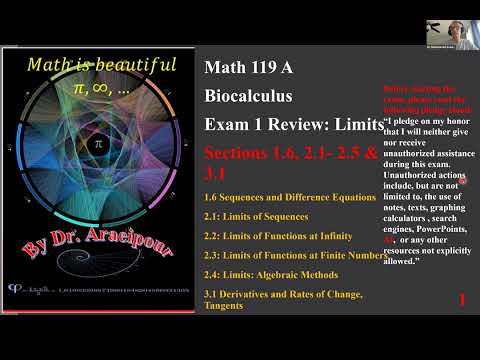
Ara Araeipour reviews exam topics from sequences through introductory derivatives, including explicit and recursive sequence rules, sequence limits, and geometric-series methods for repeating decimals. The review then develops limit techniques for functions at infinity and finite points, one-sided limits and continuity, before applying the difference quotient to slopes and to average and instantaneous velocity.
Key takeaways
- A sequence's general term can be assembled from independent patterns: an alternating factor, an arithmetic component, and a geometric component.
- The infinite geometric-series formula converts repeating decimals into fractions; for example, 0.\overline{46}=46/99 and 3.1\overline{6}=19/6.
- Repeated dosing with 100 mg every 8 hours and 30% carryover follows Q_(n+1)=100+0.3Q_n and approaches a steady amount of 1000/7 mg.
- When direct substitution gives an indeterminate form, choose an algebraic technique suited to the expression: factor rational expressions, use a conjugate for radicals, or clear a complex fraction with its LCD.
- A two-sided limit exists only when the left- and right-hand limits agree; continuity additionally requires that this shared limit equal the function's value.
- The derivative is the limit of average rates of change: for s(t)=2t²-5t+40, average velocity from 2 to 4 seconds is 14 ft/s, while instantaneous velocity at 4 seconds is 11 ft/s.
Chapters
- Build a general term by separating an alternating sign, an arithmetic numerator, and a geometric denominator.
- Use (-1)^(n-1) for a sequence that begins positive and alternates signs.
- Check a proposed rule by substituting early indices such as n=1 and n=2.
- Find the first five terms of an explicit sequence by substituting n=1, 2, 3, and subsequent indices.
- For a recurrence such as a_(n+2)=a_(n+1)+2a_n, calculate each term from the two previous terms.
- Use the given initial terms, such as a_1=1 and a_2=2, before applying the recurrence.
- For r^n as n approaches infinity, the limit is 0 when |r|<1, 1 when r=1, and unbounded when r>1.
- Use the negative-exponent rule to rewrite 2^(-n) as 1/2^n, which tends to zero.
- For rational expressions with n approaching infinity, divide numerator and denominator by the denominator's highest power of n.
- Represent 0.\overline{46} as a geometric series with first term 46/100 and common ratio 1/100, giving 46/99.
- For 3.1\overline{6}, separate the nonrepeating 3.1 from the repeating 0.0666... portion.
- Apply the infinite geometric sum formula a_1/(1-r); the repeating-decimal example simplifies to 19/6.
- A 100 mg dose is taken every 8 hours, with 30% of the previous amount remaining before the next dose.
- Model the amount after each dose with Q_(n+1)=100+0.3Q_n and initial amount Q_0=0.
- The closed form is Q_n=100(1-0.3^n)/0.7, so the long-run amount approaches 1000/7 mg, about 142.857 mg.
- For rational functions that produce infinity over infinity, divide by the highest-power term in the denominator.
- For expressions such as √(x²+1)-x, multiply by the conjugate to remove the subtraction of large quantities.
- For nonpolynomial fractions, compare dominant growth rather than referring to a polynomial degree.
- Track signs when a denominator tends to zero or negative infinity, since the result may be positive or negative infinity.
- Use the graph's left- and right-hand behavior to decide whether a two-sided limit exists at a marked x-value.
- Distinguish a function's value at a point from the height the graph approaches near that point.
- Check the side of approach at vertical boundaries and asymptotes, including graph features marked around x=5 and x=-3.
- When substitution gives 0/0 in a rational expression, factor numerator and denominator and cancel shared factors before substituting again.
- For a square-root difference, multiply by the conjugate to transform the numerator into a difference of squares.
- For complex fractions that give 0/0, multiply the numerator and denominator by the least common denominator.
- For x/(x-6), the limit as x approaches 6 is positive infinity from the right and negative infinity from the left.
- The average rate of change between x=a and x=b is [f(b)-f(a)]/(b-a), the slope of the secant line.
- Define the derivative at a with the limit as h approaches 0 of [f(a+h)-f(a)]/h.
- For f(x)=x² at x=1, expanding and canceling h leaves 2+h, whose limit is 2.
- For s(t)=2t²-5t+40, positions at t=4 and t=2 are 52 ft and 38 ft, giving an average velocity of 14 ft/s.
- The difference quotient at t=4 gives an instantaneous velocity of 11 ft/s; include units when reporting rates.
- To test continuity of a piecewise function at x=-2, compare its function value with the left- and right-hand limits.
- The two one-sided limits from the example's separate formulas differ, so the two-sided limit does not exist and the function is not continuous there.
Transcript excerpt
0:04 Good morning class. Here's exam one review covering from section 1.1 to 3.1. Sequence and difference equations. Limits of sequences. Limits of functions at infinity. Limits of functions of finite numbers. Limits and methods. Derivatives and rates of uh here's the page. Uh before studying the exam, please read the following page. I pledge my honor that I will give receive assistance to read this exam unauthorized actions include but are not limited to the use of notes texting research power any other resource says not explicitly here's one example that comes from exam review we want to find the general term and to do so we notice a little bit
0:51 complicated there are three parts to it a sign numerator and a denominator the reason I the sign because it alternates positive negative positive negative. Therefore, it's going to be like this and each one we're going to find out. And for the alternating side, we have one of the two. All you have to do just replace the n with one. This becomes one and this becomes -1 to the^ 0 is 1. And because this is positive, this is the one. numerators we add four. It's an arithmetic sequence with the first term being six, b being four, and we're going to use the a sub 1 + n - 1. We plug in we combine it into 4 n + the
1:48 denominator. We notice we multiply by three which makes it a geometric sequence. The first term is three. So is r and a7 r n to the power minus one. When we multiply it according to this we just add the exponents becomes p / n. This is the answer. And of course you must check for example if I replace the n with one this becomes -1^0 which is 1
This is the start of the transcript. Save this video free for the whole transcript, searchable and time-coded.
Related notes
Summary, takeaways, and chapters were generated by AI from the video's transcript and may contain errors. The video belongs to its creator, Professor Ara Araeipour.