19. Determinant Formulas and Cofactors
 Watch on YouTube →
Overview
The lecture derives the determinant from its defining properties, first expanding 2×2 and 3×3 cases into signed products and then generalizing to a sum of n! terms indexed by permutations. It defines cofactors as signed determinants of (n−1)×(n−1) submatrices, uses them to expand determinants along rows or columns, and derives the recurrence A_n = A_(n−1) − A_(n−2) for tridiagonal matrices of ones, whose determinants repeat with period six.
Key takeaways
- The determinant of an n×n matrix is a signed sum of n! products, each selecting one entry from every row and every column.
- A cofactor Cᵢⱼ equals (−1)^(i+j) times the determinant obtained by deleting row i and column j.
- Cofactor expansion along any row or column reduces an n×n determinant to determinants of size n−1, and sparse rows or columns can make the expansion especially efficient.
- The 4×4 sparse example has only two nonzero permutation terms, +1 and −1, so its determinant is 0 and its rows satisfy row 1 − row 2 + row 3 − row 4 = 0.
- For tridiagonal matrices with 1s on the main and adjacent diagonals, determinants obey det(A_n) = det(A_(n−1)) − det(A_(n−2)) and repeat every six terms.
Chapters
0:00
Deriving the 2×2 Determinant from the Three Properties
- The determinant of the identity matrix is 1, and swapping its rows changes the determinant to −1.
- Linearity in each row splits a matrix with entries a, b, c, d into four simpler determinants.
- Terms with a zero column vanish; the surviving diagonal and swapped-row terms give ad − bc.
6:00
Finding the Six Signed Products in a 3×3 Determinant
- Splitting each of three rows into three single-entry vectors produces 3³ = 27 terms, but only terms using one entry from every row and column survive.
- Each surviving term corresponds to a permutation of columns 1, 2, and 3, giving 3! = 6 products.
- The sign of each product is determined by the parity of row exchanges needed to restore the columns to order; the resulting formula has three positive and three negative terms.
- Diagonal direction shortcuts that work for the 3×3 case do not generalize reliably, since the counter-diagonal term in a 4×4 case is positive.
16:40
The General Determinant Formula: A Signed Sum over Permutations
- For an n×n matrix, choose one entry from each row while using every column exactly once; there are n! such choices.
- Each term is a product of entries a_i,σ(i), multiplied by the sign of the column permutation σ.
- For the identity matrix, only the identity permutation contributes a nonzero term, so the formula gives determinant 1.
- The formula is explicit but can be expensive to calculate directly, since the number of terms grows factorially.
22:30
A Sparse 4×4 Example: Two Nonzero Terms Cancel
- The 4×4 determinant formula contains 24 terms, but zeros in the example matrix eliminate 22 of them.
- The two surviving products are each 1: one has positive sign and the other negative sign, so the determinant is 0.
- The zero determinant signals singularity; the rows satisfy row 1 − row 2 + row 3 − row 4 = 0.
- Elimination or finding a row or column dependence can verify singularity without evaluating all 24 permutation terms.
28:45
Grouping the 3×3 Formula by Entries in the First Row
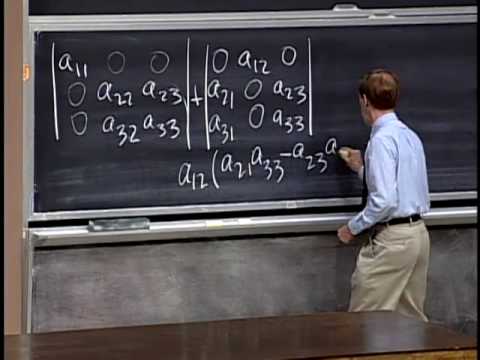
- Collecting the six 3×3 permutation terms according to their first-row entry groups the determinant into three contributions.
- The terms containing a₁₁ combine into a₁₁(a₂₂a₃₃ − a₂₃a₃₂), the determinant left after deleting row 1 and column 1.
- Grouping terms containing a₁₂ or a₁₃ produces the corresponding remaining 2×2 determinants, with their signs preserved.
- Each first-row entry is multiplied by a signed determinant of the submatrix left after removing its row and column.
30:00
Cofactors: Signed Minors of Size n−1
- For entry aᵢⱼ, remove row i and column j; the determinant of the remaining (n−1)×(n−1) matrix is its minor.
- The cofactor Cᵢⱼ is the minor multiplied by (−1)^(i+j), incorporating the sign required by the permutation formula.
- Cofactor signs form a checkerboard pattern: row 1 begins positive, row 2 begins negative, and signs alternate across each row.
- For a 3×3 determinant, the cofactor of a₁₂ is −(a₂₁a₃₃ − a₂₃a₃₁), while the cofactors of a₁₁ and a₁₃ have positive signs.
35:30
Cofactor Expansion Along Any Row or Column
- Expanding along row 1 gives det(A) = a₁₁C₁₁ + a₁₂C₁₂ + … + a₁ₙC₁ₙ.
- The same expansion works along any row or column, reducing an n×n determinant to smaller determinants.
- For a 2×2 matrix, expansion along the first row gives ad + b(−c), recovering ad − bc.
- Cofactor expansion can recursively reduce a determinant to 1×1 cases, while the pivot formula computes it as the product of pivots after elimination.
44:30
Using Cofactors on Tridiagonal Matrices of Ones
- Define A_n as the n×n tridiagonal matrix with 1s on the main diagonal and adjacent diagonals, and 0s elsewhere.
- The first cases are det(A₁) = 1, det(A₂) = 0, and det(A₃) = −1.
- For A₃, subtracting row 3 from row 2 creates zeros that make a cofactor expansion straightforward; the resulting determinant is −1.
- Expanding A₄ along its first row leaves determinants of A₃ and A₂, with signs that give det(A₄) = det(A₃) − det(A₂).
50:30
The Recurrence Produces a Period-Six Determinant Sequence
- For every n, the tridiagonal determinants satisfy det(A_n) = det(A_(n−1)) − det(A_(n−2)).
- Starting from det(A₁) = 1 and det(A₂) = 0, the sequence begins 1, 0, −1, −1, 0, 1, 1.
- The values repeat with period six, so det(A₆₁) = det(A₁) = 1.
- The recurrence comes from cofactor expansion and the zeros in the tridiagonal structure, avoiding a full n! permutation calculation.
Summary, takeaways, and chapters were generated by AI from the video's transcript and may contain errors. The video belongs to its creator, MIT OpenCourseWare.