11. Matrix Spaces; Rank 1; Small World Graphs
 Watch on YouTube →
Overview
Matrix spaces obey the same basis, dimension, intersection, and sum rules as ordinary vector spaces: for 3×3 matrices, the full space has dimension 9, symmetric and upper triangular subspaces each have dimension 6, and their intersection has dimension 3. The lecture connects solution spaces of differential equations to null spaces, represents rank-one matrices as outer products, applies the four fundamental subspaces to a 1×4 matrix, and introduces friendship and website graphs to motivate small-world distances and six degrees of separation.
Key takeaways
- The 3×3 matrix space has dimension 9, while its symmetric and upper triangular subspaces each have dimension 6; their 3-dimensional intersection explains why their sum has dimension 9.
- For any two subspaces S and U, dim(S) + dim(U) = dim(S ∩ U) + dim(S + U), illustrated by 6 + 6 = 3 + 9 for 3×3 matrices.
- The solutions of y'' + y = 0 form a 2-dimensional vector space with basis cos(x) and sin(x), showing that vector spaces can consist of functions rather than coordinate columns.
- Every rank-one matrix has an outer-product form uvᵀ; adding rank-one matrices can build higher-rank matrices, but the rank-one set is not closed under addition.
- For A = [1, 1, 1, 1], the equation Ax = 0 defines a 3-dimensional subspace of R⁴, consistent with nullity = number of columns minus rank.
- Social friendships and website links can be modeled as graph edges, where short paths and shortcuts explain the small-world idea of connections in roughly six steps.
Chapters
0:00
3×3 Matrix Space as a Nine-Dimensional Vector Space
- The space M of all 3×3 matrices is a vector space because matrix addition and scalar multiplication stay within M.
- Matrix multiplication is not part of the vector space operations discussed here.
- Nine independent entries specify any 3×3 matrix, so dim(M) = 9.
- The standard basis contains nine matrices, each with a 1 in one entry and zeros elsewhere.
5:00
Dimensions of Symmetric and Upper Triangular Matrices
- The symmetric 3×3 matrices have dimension 6: three diagonal entries and three independent entries above the diagonal determine the rest.
- The upper triangular 3×3 matrices also have dimension 6 because their three diagonal and three above-diagonal entries are free.
- Symmetric matrices form a subspace under addition and scalar multiplication, even though multiplying two symmetric matrices need not produce a symmetric matrix.
- The standard basis for all 3×3 matrices does not itself provide a basis for the symmetric subspace.
8:03
Intersections, Sums, and the Subspace Dimension Formula
- A 3×3 matrix that is both symmetric and upper triangular must be diagonal, so the intersection has dimension 3.
- The union of the symmetric and upper triangular subspaces is generally not a subspace, because adding one matrix from each may leave the union.
- Their sum, formed by adding any symmetric matrix to any upper triangular matrix, gives the entire 3×3 matrix space.
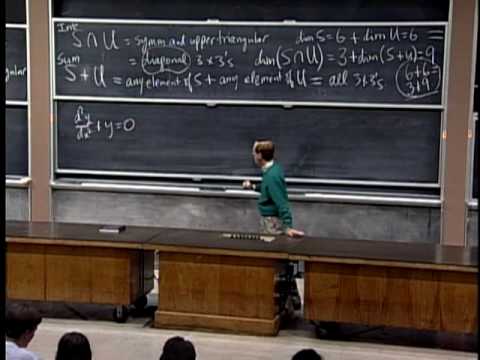
- The dimensions satisfy dim(S) + dim(U) = dim(S ∩ U) + dim(S + U), or 6 + 6 = 3 + 9.
14:37
Second-Order Differential Equations as Two-Dimensional Vector Spaces
- For y'' + y = 0, both cos(x) and sin(x) are solutions, and every real solution is a linear combination of them.
- The solution space has basis {cos(x), sin(x)} and dimension 2.
- The solution set is a vector space of functions because solutions can be added and multiplied by scalars.
- Finding a basis for the solution space connects linear algebra to solving linear differential equations.
20:00
Rank-One Matrices as Column-by-Row Outer Products
- A 2×3 matrix with rows [1, 4, 5] and [2, 8, 10] has rank 1 because its second row is twice its first.
- Its column space and row space each have dimension 1, equal to the matrix rank.
- The matrix factors as [1, 2]ᵀ[1, 4, 5], a 2×1 column times a 1×3 row.
- Every rank-one matrix can be written as uvᵀ, and a rank-four matrix can be assembled from four rank-one matrices.
25:29
Why Rank-One and Fixed-Rank Matrices Are Not Subspaces
- Adding two rank-one matrices generally produces a rank-two matrix, so the set of rank-one matrices is not a subspace.
- For 5×17 matrices, the rank can be at most 5, even though the general bound rank(A + B) ≤ rank(A) + rank(B) applies.
- Adding two rank-four 5×17 matrices can produce a matrix of rank 5, so the rank-four set is not closed under addition.
- Including the zero matrix alone does not make a fixed-rank collection a subspace; closure under addition is also required.
28:50
Four Fundamental Subspaces for a 1×4 Matrix
- The vectors in R⁴ whose entries sum to zero form the null space of A = [1, 1, 1, 1].
- Since rank(A) = 1 and A has 4 columns, rank-nullity gives a three-dimensional null space.
- A null-space basis is {[-1, 1, 0, 0], [-1, 0, 1, 0], [-1, 0, 0, 1]}, obtained by assigning values to the three free variables.
- The row space has dimension 1, the column space is all of R¹ with dimension 1, and the left null space contains only zero and has dimension 0.
39:04
Graphs as Nodes, Edges, and Adjacency Data
- A graph consists of nodes connected by edges; the example has 5 nodes and 6 edges.
- A graph can model a class by treating each person as a node and each friendship as an edge.
- The lecture previews a matrix representation of a graph, planned for the next lecture.
- The same model applies to the World Wide Web, with websites as nodes and links as edges.
41:43
Small-World Distances and Six Degrees of Separation
- Distance in a friendship graph is the number of edges in the shortest path between two people.
- The six-degrees-of-separation idea describes how people in a large social network may be connected through only a small number of intermediaries.
- The lecture proposes asking how far apart the most distant people in a national friendship graph might be.
- Shortcuts can dramatically reduce path lengths, motivating linear-algebraic analysis of social networks and the web.
Summary, takeaways, and chapters were generated by AI from the video's transcript and may contain errors. The video belongs to its creator, MIT OpenCourseWare.