102126 L1 Chemistry 221 Video Lecture
 Watch on YouTube →
Overview
Michael Russell connects electronegativity and bond polarity to Lewis structures, showing how valence-electron counts, bonding pairs, lone pairs, and octets guide molecular drawings. Worked examples include HCl, NH3, sulfite ion, CO2, and N2O, with double and triple bonds introduced as ways to complete octets when single bonds are insufficient.
Key takeaways
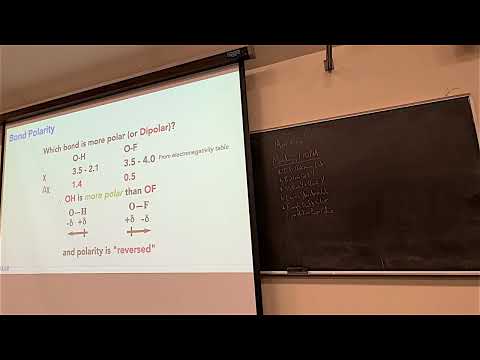
- Electronegativity generally increases up and to the right on the periodic table, with fluorine highest; bond polarity depends on the difference between the two bonded atoms, not simply on one atom's electronegativity.
- For the main-group elements covered, the A-group number supplies the valence-electron count used to build Lewis structures, while the remaining electrons are treated as core electrons.
- A practical Lewis-structure workflow is to count valence electrons, adjust for ionic charge, choose a central atom, connect surrounding atoms with single bonds, and distribute remaining pairs to satisfy octets.
- The common four-pair octet check applies to many central atoms in these examples, but hydrogen is stable with one pair and second-period nitrogen cannot have five pairs.
- When single bonds and completed outer-atom octets leave carbon short of an octet in CO2, oxygen lone pairs can form additional shared pairs, producing two C=O double bonds.
- A double bond is composed of one sigma bond and one pi bond, while a triple bond has one sigma bond and two pi bonds.
Chapters
0:00
Class Presentation Draft Requirements and Upcoming Chemistry Work
- The Monday rough draft needs the class presentation cover sheet, at least two typed pages about the assigned element, and one peer-reviewed science abstract with its citation.
- Michael Russell recommends citing sources, using paragraphs and basic punctuation, and keeping spacing at 1.5 or less.
- The upcoming class work includes Lewis structures, geometry, quiz four, and a Lewis structures lab.
5:01
Electronegativity Trends Explain Element Order in Compounds
- Electronegativity measures an atom's pull on shared electrons; fluorine is highest, and the trend generally increases up and to the right on the periodic table.
- Oxygen is listed after carbon in CO2 because it is more electronegative; the more electronegative element is written last in the naming convention discussed.
- For an increasing-electronegativity sequence, Russell compares aluminum, boron, oxygen, and fluorine, placing them in that order.
14:58
Lewis Structures Map Electrons in Molecules
- Lewis structures show where a molecule's valence electrons are distributed as bonding pairs and lone pairs.
- A bonding pair contains two shared electrons between atoms; a lone pair contains two electrons located on one atom.
- The diagrams help chemists reason about electron distribution and anticipate how molecules such as H2O and CH4 may react.
17:02
Find Valence Electrons from Main-Group Numbers
- For the main-group elements covered, the A-group number gives the number of valence electrons used in Lewis structures.
- Carbon is in group 4A, so it has four valence electrons and two core electrons out of six total.
- Fluorine and chlorine are in group 7A, giving each seven valence electrons; phosphorus in group 5A has five.
22:05
HCl Shows the Difference Between Bonds and Lone Pairs
- The Lewis structure for HCl uses a line for the H-Cl bonding pair and six dots for chlorine's three lone pairs.
- Each line represents two shared electrons, usually one contributed by each bonded atom, while dots represent unshared electrons.
- Russell's working convention is lines for bonding pairs and dots for lone pairs; most lone pairs contain two electrons.
28:14
Build NH3 by Counting and Placing Electron Pairs
- NH3 has eight valence electrons: five from nitrogen and one from each of three hydrogen atoms, or four electron pairs total.
- Nitrogen is the central atom because hydrogen cannot be central; Russell's general cues are that the central atom is often listed first and is usually less electronegative.
- Three N-H sigma bonds use three pairs, and the remaining pair becomes nitrogen's lone pair, giving nitrogen an octet while each hydrogen has one bond.
35:54
Check Candidate Lewis Structures with the Octet Rule
- A common stability check is four electron pairs around a central atom, counting both bonding pairs and lone pairs.
- The NH3 drawing without nitrogen's lone pair is incomplete, while a phosphorus structure with three bonds and one lone pair satisfies the four-pair heuristic.
- Hydrogen is an exception to the octet rule and is stable with one bonding pair; lone pairs take more space than bonding pairs.
37:36
Count Electrons and Draw the Sulfite Ion, SO3 2-
- Sulfur is placed in the center of SO3 2- because it is less electronegative than oxygen; both elements contribute six valence electrons per atom.
- The neutral atoms contribute 24 valence electrons, and the 2- charge adds two more, for 26 electrons or 13 pairs.
- Three S-O single bonds use three pairs; lone pairs fill the oxygen octets first, and the final pair goes on sulfur to complete its octet.
- The ion can be enclosed in brackets with a 2- charge; Russell notes that a later formal-charge treatment will favor a structure with one double bond.
43:30
Use CO2 Double Bonds to Complete Carbon's Octet
- CO2 has 16 valence electrons: four from carbon and six from each of two oxygen atoms.
- After drawing two C-O single bonds and filling oxygen octets, carbon has only two pairs around it, so the initial structure fails the octet check.
- Converting one lone pair from each oxygen into a shared pair creates O=C=O, giving carbon and both oxygens four pairs.
- Each double bond contains one sigma bond and one pi bond; the sigma bond is drawn first.
48:30
N2O Structures Must Respect Second-Period Octets
- Russell compares proposed Lewis structures for dinitrogen monoxide, N2O, and checks the central nitrogen's number of electron pairs.
- A central nitrogen with five pairs is rejected because second-period elements such as nitrogen do not expand beyond four pairs in the rule used here.
- A triple bond consists of one sigma bond and two pi bonds, while a double bond consists of one sigma and one pi bond.
Summary, takeaways, and chapters were generated by AI from the video's transcript and may contain errors. The video belongs to its creator, Michael Russell.