101626 L1 Chemistry 221 Video Lecture
 Watch on YouTube →
Overview
Michael Russell reviews the upcoming Chemistry 221 midterm and develops quantum mechanics tools for describing electron behavior, including de Broglie wavelengths, the four quantum numbers, orbital notation, and node counts. He applies Aufbau filling, periodic-table blocks, orbital box diagrams, and ion electron configurations to chlorine, tin, phosphide, and transition-metal ions, emphasizing that 4s electrons are removed before 3d electrons when forming many transition-metal cations.
Key takeaways
- Valid quantum numbers must satisfy mₛ=±½, n=1, 2, 3…, l=0 through n−1, and mₗ=−l through +l in integer steps.
- Orbital letters encode l values—s=0, p=1, d=2, f=3—so nℓ notation such as 3p directly specifies the principal level and subshell.
- Node counts follow two compact rules: spherical nodes equal n−l−1 and planar nodes equal l; consequently, a 4p orbital has two spherical nodes.
- Tin’s configuration is [Kr] 5s² 4d¹⁰ 5p², while neutral chlorine’s is [Ne] 3s² 3p⁵; noble-gas shorthand compresses filled inner shells.
- When many transition metals form cations, electrons are removed from the highest principal quantum number first, so 4s electrons leave before 3d electrons.
- Unpaired electrons determine paramagnetic behavior in the orbital-box model; however, chromium is an Aufbau exception, with a ground-state configuration of [Ar] 3d⁵ 4s¹.
Chapters
0:00
Midterm Format, Exam Prep, and Lab Requirements
- The Monday midterm is scheduled for 1:10 p.m. and lasts about 90 minutes, with 12 multiple-choice questions and 4 short answers.
- Multiple-choice answers need no shown work; short-answer calculations should include the setup and mathematical steps.
- Exam Prep 1 and the hydrogen spectrum lab are due Monday; bring a calculator and goggles for the unknown-compound identification lab.
2:50
De Broglie Wavelengths Connect Particles to Wave Behavior
- Louis de Broglie proposed that particles, including electrons, have wavelengths, extending wave-particle ideas beyond light and water waves.
- Use mass in kilograms in the de Broglie calculation; the result is in meters and can be converted to nanometers.
- Electron wavelengths are small but observable at atomic scales, helping explain why electron orbitals are described with wave behavior.
5:32
Checking Valid Sets of the Four Quantum Numbers
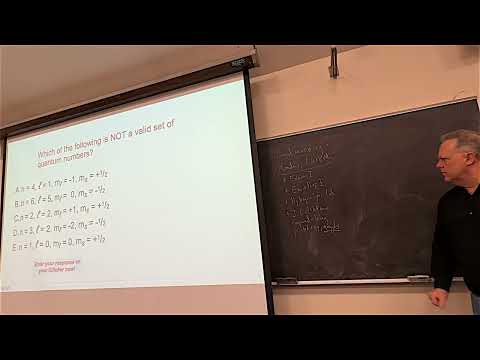
- The four quantum numbers are n, l, mₗ, and mₛ; mₛ can only be +½ or −½, while n is a positive whole number.
- For a given n, l ranges from 0 to n−1; for a given l, mₗ ranges in integer steps from −l to +l.
- For example, n=4 allows l=0, 1, 2, or 3, while n=2 cannot be paired with l=2.
11:21
Reading nℓ Orbital Notation and the s–p–d–f Labels
- In notation such as 3p or 4d, the leading number is n and the letter represents l: s=0, p=1, d=2, and f=3.
- Thus 3p means n=3 and l=1, while 4d means n=4 and l=2; an orbital such as 1p is not allowed because l must be less than n.
- The magnetic quantum number mₗ distinguishes orbital orientations, such as the three orientations associated with a p subshell.
16:11
Calculating Spherical and Planar Nodes from n and l
- The number of spherical (radial) nodes is n−l−1, while the number of planar (angular) nodes is l.
- For 2p, n=2 and l=1, so the spherical-node count is 0; 3p has 1 and 4p has 2.
- Nodes are regions where the wavefunction is zero, so they mark boundaries in an orbital’s electron-probability pattern.
20:49
Building Chlorine’s Electron Configuration with Aufbau Rules
- Neutral chlorine has 17 electrons, matching its atomic number; its full configuration is 1s² 2s² 2p⁶ 3s² 3p⁵.
- The Aufbau diagram gives the filling order, including 4s before 3d; subshell capacities are 2 electrons for s, 6 for p, and 10 for d.
- The periodic table offers an alternate route: the s- and p-block periods indicate the principal level, while d-block subshell labels use the period number minus one.
29:56
Tin’s 50 Electrons and Noble-Gas Shorthand
- Tin (Sn) has atomic number 50 and the configuration [Kr] 5s² 4d¹⁰ 5p².
- After the 36-electron krypton core, filling 5s² and 4d¹⁰ reaches 48 electrons, and 5p² completes tin’s total of 50.
- Noble-gas shorthand replaces the inner configuration with the preceding noble gas; periodic-table position also identifies tin as a period-5 p-block element with 5p².
35:40
Orbital Box Diagrams, Hund’s Rule, and Phosphide
- In orbital box notation, each arrow represents an electron; neon-core sulfur is [Ne] 3s² 3p⁴, with the three p orbitals shown separately.
- Hund’s rule places one electron in each equal-energy orbital before pairing; unpaired electrons make a species paramagnetic, while fully paired electrons make it diamagnetic.
- Phosphorus gains three electrons to form phosphide, completing 3p⁶ and producing the argon configuration, [Ar].
41:25
Transition-Metal Cations, Electron Removal, and Magnetism
- For cobalt, [Ar] 4s² 3d⁷, forming Co²⁺ removes the two electrons with n=4 first, leaving [Ar] 3d⁷; Co³⁺ then has [Ar] 3d⁶.
- Nickel is described as [Ar] 4s² 3d⁸, so Ni²⁺ loses the 4s electrons and becomes [Ar] 3d⁸.
- Russell identifies Cr²⁺ as the most paramagnetic among the compared ions because it has four unpaired 3d electrons; the transcript gives neutral chromium’s configuration incorrectly as [Ar] 4s² 3d⁴, whereas its ground state is [Ar] 3d⁵ 4s¹.
Summary, takeaways, and chapters were generated by AI from the video's transcript and may contain errors. The video belongs to its creator, Michael Russell.