101526 L2 Chemistry 221 Video Lecture Part II
 Watch on YouTube →
Overview
Michael Russell develops the connection between quantum theory and practical chemistry calculations, showing how to convert molar photon energy to wavelength and how de Broglie relates particle mass and velocity to wavelength. He then applies quantum-number rules, orbital notation, node counting, and Aufbau filling to determine chlorine’s electron configuration and tin’s noble-gas configuration.
Key takeaways
- To convert a molar photon energy such as 182.3 kJ/mol to wavelength, first divide by Avogadro’s number to obtain joules per photon, then apply λ = hc/E; the result is approximately 655–656 nm.
- The de Broglie wavelength λ = h/(mv) requires SI units; the worked electron example gives 6.06 × 10⁻¹² m, or 6.06 × 10⁻³ nm.
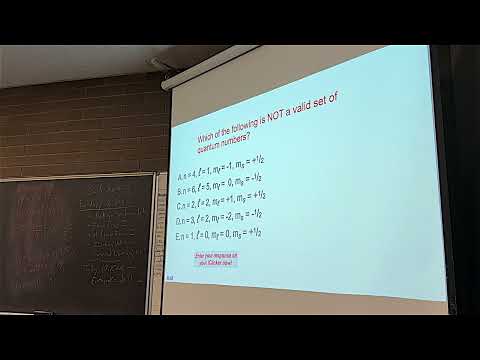
- A valid quantum-number set must satisfy n ≥ 1, 0 ≤ l ≤ n − 1, −l ≤ m_l ≤ +l, and m_s = ±½.
- Orbital notation combines the principal quantum number with the letter for l: for example, n = 3 and l = 1 correspond to 3p.
- Spherical nodes equal n − l − 1, so a 4p orbital has two spherical nodes; planar nodes are determined by l.
- Aufbau filling gives chlorine as 1s² 2s² 2p⁶ 3s² 3p⁵ and tin as [Kr] 5s² 4d¹⁰ 5p².
Chapters
0:00
Earthquake Drill Logistics and the Photon-Wavelength Problem
- Michael Russell reviews the planned earthquake drill and the class evacuation route to the parking lot beside Kane.
- The chemistry problem gives an energy transition of 182.3 kJ/mol and asks for the corresponding wavelength in nanometers.
- The proposed method is to convert energy per mole to energy per photon, then use the photon energy–wavelength relationship.
6:07
Converting 182.3 kJ/mol into a Photon Wavelength
- Convert kilojoules to joules and divide the energy per mole by Avogadro’s number, 6.022 × 10²³, to get joules per photon.
- Rearrange E = hc/λ to λ = hc/E, using Planck’s constant and the speed of light.
- The calculation gives a wavelength of roughly 655–656 nm after converting meters to nanometers.
- Avogadro’s number can count photons as well as atoms or other units, provided the counted entity is specified.
9:21
De Broglie’s Wavelength for Matter Particles
- The de Broglie equation, λ = h/(mv), assigns a wavelength to a particle with mass m and velocity v.
- Mass must be expressed in kilograms and velocity in meters per second for the SI-unit calculation.
- Wavelengths for everyday objects are too small to measure, while electron wavelengths can be experimentally observed.
- The example uses an electron’s mass and speed to calculate its matter-wave wavelength.
15:42
Calculating an Electron’s de Broglie Wavelength
- The example requires converting the electron mass from grams to kilograms before using λ = h/(mv).
- The computed wavelength is 6.06 × 10⁻¹² meters, equivalent to 6.06 × 10⁻³ nanometers.
- Russell connects electron wave behavior to diffraction, where electrons produce ripple-like patterns after passing through or behind a screen.
- The result illustrates why de Broglie’s matter-wave proposal was significant: particles such as electrons exhibit measurable wave properties.
17:37
Testing Whether Quantum-Number Sets Are Valid
- The four quantum numbers are n, l, m_l, and m_s; Russell recommends checking m_s first because it can only be +½ or −½.
- The principal quantum number n must be a positive integer, while l ranges from 0 to n − 1.
- The magnetic quantum number m_l takes integer values from −l to +l, including zero.
- Applying these rules identifies an invalid set when l equals n, since l cannot exceed n − 1.
22:25
Translating n and l into Orbital Notation
- Orbital letters encode l values: s = 0, p = 1, d = 2, and f = 3.
- For n = 3 and l = 1, the orbital designation is 3p; the magnetic quantum number does not change that notation.
- The leading number in an orbital label is n, while the letter identifies the subshell associated with l.
- This notation links quantum-number descriptions to subshells used in electron configurations.
25:26
Counting Spherical and Planar Nodes in Orbitals
- Spherical (radial) nodes are calculated as n − l − 1; planar (angular) nodes are determined by l.
- The examples show 1s, 2p, and 3d each have zero spherical nodes, while 3p has one.
- For 4p, n = 4 and l = 1, so 4 − 1 − 1 = 2 spherical nodes.
- Nodes represent regions of zero electron density, which matters when considering how electron density contributes to bonding.
31:16
Building Chlorine’s Electron Configuration with the Aufbau Order
- Neutral chlorine has atomic number 17, so it contains 17 electrons.
- The Aufbau diagram orders subshell filling, and the capacities are s², p⁶, d¹⁰, and f¹⁴.
- Filling 1s, 2s, 2p, 3s, and then 3p gives chlorine’s configuration: 1s² 2s² 2p⁶ 3s² 3p⁵.
- The same result can be checked by counting superscripts, reading the periodic table’s blocks, or using noble-gas shorthand: [Ne] 3s² 3p⁵.
40:41
Deriving Tin’s Configuration from the Krypton Core
- Tin has atomic number 50, placing it after krypton (36) and before xenon (54), so its shorthand configuration begins with [Kr].
- After [Kr], electrons fill 5s² and 4d¹⁰ before entering the 5p subshell.
- Tin is the second element in the 5p block, giving the configuration [Kr] 5s² 4d¹⁰ 5p².
- Russell also checks the result against the periodic table’s period, block, and position within the p block.
Summary, takeaways, and chapters were generated by AI from the video's transcript and may contain errors. The video belongs to its creator, Michael Russell.