101426 L1 Chemistry 221 Video Lecture
 Watch on YouTube →
Overview
Michael Russell reviews material from Chemistry 221 chapters 1 through 3 ahead of a midterm with 12 multiple-choice and four short-answer questions. The review works through metric-prefix conversions, atomic structure and isotopes, weighted average atomic mass, Bohr-model emission transitions, energy-to-wavelength conversions, and the de Broglie wavelength of an electron.
Key takeaways
- A neutral iron-58 atom has 26 protons, 26 electrons, and 32 neutrons, found from atomic number 26 and mass number 58.
- Sr²⁺ has 38 protons and 36 electrons: its positive charge comes from losing two electrons, not from changing its proton count.
- Average atomic mass is a weighted mean of isotope masses and abundances; the example’s 72, 73, and 74 isotopes average to about 72.8 amu.
- Five Bohr energy levels allow 10 downward emission transitions, while the visible hydrogen lines discussed in lab end at n = 2.
- Because E = hν, a larger transition energy gap means a higher-frequency photon; the 5→1 transition has the largest gap among those considered.
- For 182.3 kJ/mol of photons, converting to energy per photon with Avogadro’s number and applying λ = hc/E yields a wavelength of 656.3 nm.
Chapters
0:00
Midterm Format, Exam Prep, and Required Materials
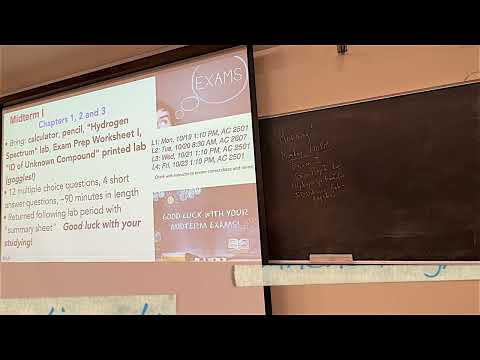
- The first midterm covers chapters 1, 2, and 3 and is scheduled for the following Monday at 1:10.
- The exam has 12 multiple-choice questions and four short-answer questions; students should show setups and steps for short answers.
- Exam Prep 1 asks students to show detailed work for about five questions, and a sample midterm with answers is available online and in the course companion.
- Students should bring a calculator, the completed hydrogen spectrum lab, a printed unknown-compound identification, and goggles.
3:40
Ordering Centimeters, Millimeters, and Meters by Size
- Convert each length to meters to compare quantities expressed with different metric prefixes.
- Use 1 cm = 10⁻² m and 1 mm = 10⁻³ m, equivalent to 100 cm and 1,000 mm per meter.
- The example orders 9 cm (0.09 m), 0.125 m, 215 mm (0.215 m), and 2.3 m from smallest to largest.
10:00
Finding Protons, Neutrons, and Electrons in Iron-58
- Iron has atomic number 26, so every iron atom has 26 protons.
- A neutral iron-58 atom has 26 electrons, matching its 26 protons.
- The mass number 58 equals protons plus neutrons, so iron-58 has 58 − 26 = 32 neutrons.
- In isotope notation, the mass number goes at the upper left of Fe and the atomic number at the lower left.
15:05
Why a Strontium Ion Has a 2+ Charge
- Strontium’s atomic number is 38, so Sr²⁺ retains 38 protons.
- A 2+ charge means strontium has lost two electrons, leaving 36 electrons.
- Those 36 electrons match krypton’s electron count, giving Sr²⁺ a noble-gas electron configuration without changing its identity as strontium.
19:15
Estimating Average Atomic Mass from Isotope Abundances
- For isotopes with mass numbers 72, 73, and 74, the example abundances are 54.5%, 15.6%, and 29.9%.
- The weighted-average method multiplies each mass by its decimal abundance: 0.545 × 72 + 0.156 × 73 + 0.299 × 74.
- The result is about 72.8 amu; because isotope 72 is most abundant, the average lies closer to 72 than to 73 or 74.
- A number-line estimate can check the calculation before or after using the weighted sum.
25:50
Counting Bohr-Model Emission Lines from Levels 1 Through 5
- Emission occurs when an electron moves from a higher principal energy level to a lower one and releases energy.
- With levels n = 1 through n = 5, the possible downward transitions total 4 + 3 + 2 + 1 = 10 emission lines.
- The hydrogen spectrum lab focused on visible transitions ending at n = 2, including 3→2, 4→2, 5→2, and 6→2.
33:25
Comparing Transition Energy Gaps and Photon Frequencies
- Photon energy follows E = hν, so the largest energy gap produces the highest frequency.
- Among transitions from n = 5, the 5→1 drop has the largest energy gap and therefore the highest frequency.
- The 5→4 transition has the smallest gap among the discussed transitions because Bohr energy levels become closer together at higher n.
36:39
Converting 182.3 kJ per Mole into a Photon Wavelength
- Convert 182.3 kJ/mol to joules per mole, then divide by Avogadro’s number, 6.022 × 10²³, to get energy per photon.
- Use λ = hc/E with Planck’s constant 6.626 × 10⁻³⁴ J·s and the speed of light 2.998 × 10⁸ m/s.
- Convert the wavelength from meters to nanometers; the example gives 656.3 nm.
- A lab shortcut can convert kJ/mol directly to nanometers, but the full unit-by-unit method shows where the conversion factors come from.
46:23
Applying the de Broglie Equation to an Electron
- The de Broglie relation λ = h/(mv) calculates a particle’s wavelength from its mass and speed.
- Unlike the photon relation, this equation describes matter waves; electron wavelengths can be significant in atomic-scale phenomena.
- The example emphasizes checking units and converting the calculated wavelength from meters to the requested unit, such as nanometers; Russell identifies answer D.
Summary, takeaways, and chapters were generated by AI from the video's transcript and may contain errors. The video belongs to its creator, Michael Russell.