101226 L1 Chemistry 221 Video Lecture
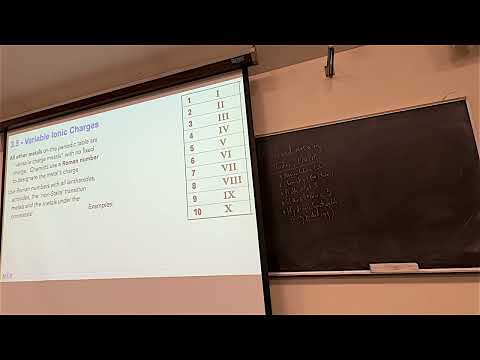 Watch on YouTube →
Overview
Michael Russell reviews Chapter 3 chemistry nomenclature, explaining how periodic-table groups determine common ion charges, how Roman numerals identify variable-charge metals, and how to balance ionic formulas and name molecular compounds. He also introduces acids, bases, and hydrated salts, then outlines the upcoming midterm and reviews density-by-displacement and temperature conversions.
Key takeaways
- A Roman numeral in an ionic compound’s name specifies the metal’s charge, as in iron(III) fluoride, FeF₃; the numeral is omitted from the chemical formula.
- Ionic formulas must have zero net charge: one Ca²⁺ requires two Br⁻ ions, while one Mg²⁺ requires two nitrate ions, producing Mg(NO₃)₂.
- For common oxyanions, the -ite form usually has one fewer oxygen than the corresponding -ate form without changing the charge, as with SO₃²⁻ sulfite and SO₄²⁻ sulfate.
- Greek prefixes are used for compounds of two nonmetals, not ionic compounds; the second element receives a prefix and an -ide ending, as in dinitrogen tetroxide, N₂O₄.
- Water displacement determines an irregular solid’s volume by subtracting initial from final liquid volume; the lecture’s 33.2 g sample displaces 12.3 mL and has density about 2.70 g/cm³.
- Temperature comparisons across scales require conversion to a common unit: use K − 273.15 for Celsius and (°F − 32) ÷ 1.8 for Fahrenheit-to-Celsius.
Chapters
0:00
Fixed Charges from Periodic-Table Groups
- For nonmetals, the lecture uses group number minus 8 to determine the common negative charge; chlorine becomes chloride with a −1 charge.
- Group 1A metals such as lithium, sodium, and potassium form +1 ions; group 2A metals such as magnesium, calcium, and barium form +2 ions.
- The fixed-charge metals highlighted on the periodic-table stairs include aluminum, gallium, and indium at +3, along with zinc and cadmium at +2 and silver at +1.
4:00
Roman Numerals Identify Variable-Charge Metals
- Many transition metals and other metals have variable charges, so their charge must be specified or inferred from the compound formula.
- A Roman numeral in a compound name gives the metal’s charge: iron(II) means Fe²⁺ and iron(III) means Fe³⁺.
- Older names such as ferrous and ferric are not accepted in this class; Roman numerals make the charge explicit.
6:04
Recognizing and Memorizing Polyatomic Ions
- A polyatomic ion is a group of atoms with an overall charge; common examples include nitrate, sulfate, hydroxide, and ammonium.
- The -ite form generally has one fewer oxygen than its -ate counterpart while keeping the same charge, as in sulfate SO₄²⁻ and sulfite SO₃²⁻.
- Adding hydrogen, which contributes +1, changes a polyatomic ion’s net charge; ammonium, NH₄⁺, is the main positive polyatomic ion introduced.
- Russell recommends becoming familiar with the lab’s ion list and offers the mnemonic “Nick the camel brat ate icky clam for supper in Phoenix” as an optional way to recall common -ate ions.
12:32
Balancing Ionic Formulas and Using Parentheses
- An ionic compound must be neutral: total positive charge from cations must balance total negative charge from anions.
- Sodium chloride pairs Na⁺ with Cl⁻ in a 1:1 ratio; calcium bromide requires one Ca²⁺ for every two Br⁻ ions, giving CaBr₂.
- Cations are written first and anions second, and Greek prefixes are not used for ionic compounds.
- Use parentheses around a polyatomic ion only when more than one copy is needed: magnesium nitrate is Mg(NO₃)₂, while potassium nitrate is KNO₃.
17:20
Naming Variable-Metal Salts and Polyatomic Cations
- In FeF₃, three F⁻ ions balance Fe³⁺, so the name is iron(III) fluoride; Roman numerals appear in names, not formulas.
- Aluminum oxide uses no Roman numeral because aluminum is treated as a fixed-charge +3 metal; oxide is O²⁻.
- Manganese(IV) sulfate requires two SO₄²⁻ ions, giving Mn(SO₄)₂, with parentheses marking the repeated sulfate ion.
- Polyatomic ions can also be cations: ammonium chloride combines NH₄⁺ and Cl⁻ to form NH₄Cl.
20:17
Naming Nonmetal Compounds with Greek Prefixes
- Greek prefixes apply to compounds made of two nonmetals and indicate atom counts; the second element takes a prefix and an -ide ending.
- The first element gets a prefix only when more than one atom is present; nitrogen monoxide is NO, while dinitrogen monoxide is N₂O.
- Examples include sulfur hexafluoride, diphosphorus pentoxide (P₂O₅), and dinitrogen tetroxide (N₂O₄).
23:03
Acids, Metal Hydroxide Bases, and Hydrated Salts
- An acid formula typically places H first; the lecture distinguishes aqueous hydrofluoric acid, HF(aq), from hydrogen fluoride in the gas phase.
- Bases are introduced as metal hydroxides, such as sodium hydroxide; their basic behavior is associated with dissolving in water.
- Hydrated ionic compounds contain waters of hydration and use a Greek prefix plus “hydrate,” as in copper(II) sulfate pentahydrate.
- Heating a hydrate can drive off its water and leave an anhydrous salt; the lecture contrasts blue hydrated copper sulfate with its dry form.
28:01
Why Accurate Chemical Formulas Matter
- Russell uses historical mercury-chlorine compounds to illustrate that a small formula difference can correspond to a major difference in properties and toxicity.
- The water-versus-hydrogen-peroxide example distinguishes H₂O from H₂O₂ and emphasizes that adding one oxygen changes the substance.
- Accurate formulas and names are essential because similar-looking compounds can behave very differently.
30:56
Chemistry 221 Midterm Format and Preparation
- The first midterm covers Chapters 1–3 and is scheduled for the following Monday; Russell describes a 90-minute exam with 12 multiple-choice and four short-answer questions.
- Short-answer work must show setups and reasoning, since a final answer alone will not earn full credit.
- Students should complete the exam-prep worksheet, review the sample midterm in the course companion or online, and bring a calculator and writing materials.
- The hydrogen spectrum lab is due on exam day, and the subsequent unknown-compound lab requires goggles.
38:18
Finding Density from Water Displacement
- The review problem gives a metal sample with mass 33.2 g and measures water rising from 10.0 mL to 22.3 mL.
- Subtracting the initial volume from the final volume gives a sample volume of 12.3 mL; 1 mL equals 1 cm³.
- Dividing 33.2 g by 12.3 cm³ gives a density of about 2.70 g/cm³, which identifies the closest matching metal choice.
44:54
Converting Kelvin and Fahrenheit to Compare Temperatures
- To compare temperatures in different scales, convert Kelvin and Fahrenheit values to Celsius first.
- Convert Kelvin to Celsius by subtracting 273.15; convert Fahrenheit to Celsius by subtracting 32 and dividing by 1.8.
- The reviewed values are approximately −17°C from Kelvin and 7.2°C from Fahrenheit, while 29°C is the warmest value.
Summary, takeaways, and chapters were generated by AI from the video's transcript and may contain errors. The video belongs to its creator, Michael Russell.