100926 Lecture Video
 Watch on YouTube →
Overview
Tim Johann explains how enzymes lower activation barriers through transition-state stabilization, acid–base catalysis, covalent catalysis, and metal assistance, then develops serine proteases as the central example. He connects their catalytic triad and peptide-bond hydrolysis mechanism to blood clotting and digestion, while using acetylcholinesterase and zinc-containing carbonic anhydrase to illustrate other enzyme strategies.
Key takeaways
- Enzymes accelerate reactions by stabilizing the transition state and lowering activation energy; excessive stabilization of the ground-state substrate can make catalysis less effective.
- Serine proteases hydrolyze peptide bonds through two stages: serine forms a covalent acyl-enzyme intermediate, then water attacks to release the second product and restore the enzyme.
- The serine–histidine–aspartate catalytic triad divides catalytic work: serine attacks the substrate, histidine shuttles protons, and aspartate tunes histidine's charge and pKa.
- Active-site chemistry explains how different enzymes use distinct strategies: acetylcholinesterase uses covalent and acid–base catalysis, while carbonic anhydrase uses zinc to generate a reactive hydroxide.
- Protease cleavage specificity comes largely from the binding pocket beside the catalytic site: chymotrypsin favors bulky aromatic residues, trypsin favors lysine and arginine, and elastase favors small residues.
- Rivaroxaban inhibits clotting factor Xa, whereas warfarin disrupts vitamin K recycling; both reduce clot formation through different points in the clotting system.
Chapters
0:00
Lab, Report, and Exam Announcements
- Next week's lab measures lactate dehydrogenase activity in protein fractions; UV absorbance at 280 nm alone cannot identify the enzyme because NADH and NAD+ also absorb there.
- The lab report is due Thursday at 11:59 p.m.; Tim Johann lists office hours Monday and Wednesday from 1–2 p.m. and a Thursday Teams help session from 8–9 p.m.
- The upcoming lab-report quiz covers plasma mapping, and students are reminded to review comments on returned reports and prepare for a notebook quiz.
2:56
Chronic Thromboembolic Pulmonary Hypertension and PTE Surgery
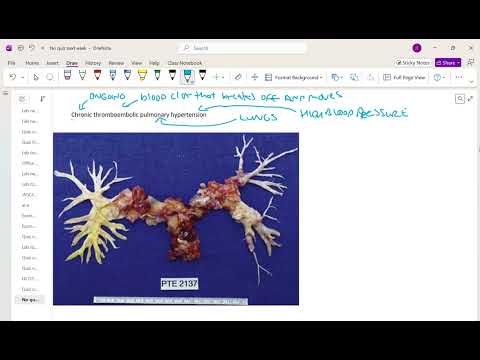
- Chronic thromboembolic pulmonary hypertension can follow a clot that travels from a site such as the leg to the lungs, where clots may accumulate and harden.
- Pulmonary thromboendarterectomy (PTE) removes obstructive material through major surgery involving a heart-lung machine and repeated periods of stopping the heart.
- Tim Johann describes his father's severe loss of lung capacity and later successful surgery, using the case to introduce the medical importance of proteases.
7:10
Serine Proteases in Blood Clotting and Clot-Prevention Drugs
- A protease hydrolyzes peptide bonds, typically adding water across the bond to produce a carboxylic acid and an amine.
- The clotting cascade activates serine proteases in sequence, including factors XII, XI, IX, and X; activated thrombin then converts fibrinogen into fibrin that forms the clot mesh.
- Rivaroxaban (Xarelto) inhibits factor Xa, while warfarin interferes with vitamin K recycling and the activation of vitamin-K-dependent clotting factors.
- Clotting must be balanced: insufficient clotting risks bleeding, while excessive clotting can obstruct vessels or lead to dangerous emboli.
15:12
Transition-State Stabilization and Three Enzyme-Catalysis Strategies
- Effective enzymes bind and stabilize a substrate's transition state, lowering the activation energy compared with the uncatalyzed reaction.
- Binding the ground-state substrate too strongly can instead raise the energy needed to reach the transition state and impede the reaction.
- Three complementary strategies are acid–base catalysis, covalent catalysis, and metal-assisted catalysis; a single enzyme can combine more than one.
20:00
Acetylcholinesterase Resets Acetylcholine Signaling
- At a synapse, acetylcholine released from vesicles binds receptors on the next neuron and opens ion channels, propagating the signal.
- Acetylcholinesterase breaks down acetylcholine so the receptor can close; some nerve agents disrupt this shutdown and can cause persistent signaling and paralysis.
- A histidine residue first acts as a base to activate an enzyme serine, which attacks the acetylcholine ester and forms a covalent acyl-enzyme intermediate.
- Water then attacks the intermediate, with histidine again transferring protons, releasing acetate and regenerating the enzyme.
28:00
Zinc-Assisted Catalysis in Carbonic Anhydrase
- Carbonic anhydrase accelerates the carbon dioxide–bicarbonate buffer reaction needed to transport carbon dioxide in blood.
- Three histidines coordinate a zinc ion in the active site; zinc makes a bound water more likely to lose a proton.
- The resulting hydroxide acts as a strong nucleophile, attacking carbon dioxide and enabling rapid bicarbonate formation.
32:14
The Serine Protease Catalytic Triad: Serine, Histidine, and Aspartate
- Serine proteases position serine, histidine, and aspartate together in a catalytic triad.
- Serine acts as the nucleophile, while histidine transfers protons as both a base and an acid during the reaction.
- Negatively charged aspartate stabilizes positively charged histidine and shifts its pKa; the lecture notes that a protein environment can shift histidine's pKa from about 6 to 12.
36:36
Serine Protease Peptide-Bond Hydrolysis: Acylation and Deacylation
- In the first stage, histidine removes a proton from serine, enabling serine to attack the peptide carbonyl and form a covalent enzyme–substrate intermediate.
- The carbonyl reforms, the peptide bond breaks, and histidine donates a proton to the departing peptide fragment.
- In the second stage, water enters the active site; histidine activates it, and hydroxide attacks the acyl-enzyme intermediate.
- The remaining peptide fragment leaves as serine is restored, regenerating the serine–histidine–aspartate triad for another catalytic cycle.
41:36
How Chymotrypsin, Trypsin, and Elastase Select Cleavage Sites
- Serine proteases share the same peptide-bond hydrolysis chemistry, but a substrate-binding pocket next to the catalytic site determines which residues they recognize.
- Chymotrypsin favors cleavage next to bulky aromatic residues such as phenylalanine, tyrosine, and tryptophan because its pocket accommodates large side chains.
- Trypsin's negatively charged aspartate-containing pocket attracts positively charged lysine or arginine side chains.
- Elastase has a restricted pocket suited to small residues such as alanine and glycine; digestive proteases can cut at many matching sites rather than one unique position.
Summary, takeaways, and chapters were generated by AI from the video's transcript and may contain errors. The video belongs to its creator, Tim Johann.