10. The Four Fundamental Subspaces
 Watch on YouTube →
Overview
The lecture corrects a mistaken claim about three vectors in R^3, then develops the four fundamental subspaces of an m by n matrix A: its column space, null space, row space, and left null space. Using row reduction, it connects their dimensions to rank r, gives methods for finding bases, and closes by treating 3 by 3 matrices as vectors in a vector space.
Key takeaways
- For an m by n matrix of rank r, the four fundamental subspaces are C(A) and N(Aᵀ) in R^m, plus C(Aᵀ) and N(A) in R^n.
- The row space and column space both have dimension r; pivot columns of the original A give a column-space basis, while nonzero rows of its reduced form give a row-space basis.
- Special solutions to Ax = 0, one for each free variable, form a basis for N(A), so its dimension is n-r.
- The left null space N(Aᵀ) consists of vectors y satisfying yᵀA = 0, and has dimension m-r.
- Appending the identity to A and applying the same row operations yields EA = R; rows of E corresponding to zero rows of R encode dependencies among A's rows.
- The space of all 3 by 3 matrices has subspaces including upper triangular, symmetric, and diagonal matrices; the diagonal subspace has dimension 3.
Chapters
0:00
Correcting the R^3 Example with Dependent Rows
- The proposed vectors (1,1,2), (2,2,5), and (3,3,8) are not independent, correcting the previous lecture's mistaken example.
- The matrix formed from those vectors as columns has two identical rows, so its rank is at most 2 and its three columns cannot be independent.
- The error illustrates how row dependence can reveal column dependence through the equality of row rank and column rank.
4:21
Defining the Four Fundamental Subspaces and Their Ambient Spaces
- The four spaces are the column space C(A), null space N(A), row space C(Aᵀ), and left null space N(Aᵀ).
- For an m by n matrix A, C(A) and N(Aᵀ) lie in R^m, while N(A) and C(Aᵀ) lie in R^n.
- The row space consists of combinations of A's rows; writing it as C(Aᵀ) lets the rows be handled as column vectors.
8:28
Column-Space Bases and the Shared Rank
- The column space has dimension r, the rank of A, and a basis comes from the pivot columns of the original matrix A.
- The row space also has dimension r, so row and column rank are equal.
- In the corrected R^3 example, two independent rows imply rank 2, which rules out three independent columns.
12:28
Null-Space Bases and the Rank-Nullity Count
- Row-reducing A to reduced row echelon form reveals pivot and free variables for solving Ax = 0.
- Setting each free variable to 1 in turn, with the other free variables set to 0, produces special solutions that form a basis for N(A).
- There are n-r free variables, so dim N(A) = n-r; together with the row-space dimension r, the total is n.
21:09
Finding a Row-Space Basis from the Reduced Matrix
- Elementary row operations change the column space but preserve the row space, because each new row is a combination of the original rows.
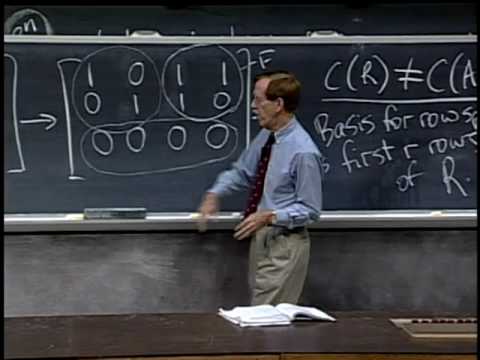
- For the example matrix, reduction produces pivot rows (1,0,1,1) and (0,1,1,0), which form a basis for the row space.
- The nonzero rows of the reduced matrix provide r independent spanning vectors; reversing the row operations shows the original rows lie in the same row space.
29:48
Why N(Aᵀ) Is Called the Left Null Space
- A vector y belongs to the left null space when Aᵀy = 0.
- Transposing that equation gives yᵀA = 0, showing that y acts as a row vector multiplying A from the left.
- The left null space lies in R^m and has dimension m-r.
33:26
Tracking Row Operations to Find a Left-Null-Space Basis
- Appending the m by m identity matrix to A and applying the same row operations gives a matrix E such that EA = R.
- For the 3-row example of rank 2, the last row of E records the dependent-row combination and supplies a basis vector for the one-dimensional left null space.
- Keeping track of E finds left-null-space vectors without separately row-reducing Aᵀ.
42:10
How the Four Subspace Dimensions Pair Across Rⁿ and Rᵐ
- In R^n, the row space has dimension r and the null space has dimension n-r, so their dimensions sum to n.
- In R^m, the column space has dimension r and the left null space has dimension m-r, so their dimensions sum to m.
- The paired dimensions follow from applying pivot-variable and free-variable counting to A and Aᵀ.
43:14
Three-by-Three Matrices as Vectors and Subspaces
- The set of all 3 by 3 matrices forms a vector space under matrix addition and scalar multiplication, without needing matrix multiplication.
- Upper triangular matrices and symmetric matrices are subspaces of this matrix space; their intersection consists of diagonal matrices.
- The diagonal 3 by 3 matrices have dimension 3, with a basis given by matrices having a single 1 in each respective diagonal position.
Summary, takeaways, and chapters were generated by AI from the video's transcript and may contain errors. The video belongs to its creator, MIT OpenCourseWare.