1. The Geometry of Linear Equations
 Watch on YouTube →
Overview
Gilbert Strang introduces linear systems through three complementary views: equations as rows, coefficient vectors as columns, and the matrix equation Ax = b. With 2-by-2 and 3-by-3 examples, he shows that solving a system means finding a linear combination of A's columns that produces b, and connects whether every b is reachable to invertibility and dependence among the columns.
Key takeaways
- A linear system Ax = b asks for a linear combination of A's columns, with the entries of x serving as the coefficients that must produce b.
- In the 2-by-2 example, [2, -1] + 2[-1, 2] = [0, 3], so the column combination gives the solution x = [1, 2].
- In the 3-by-3 example, the right-hand side equals A's third column, making x = [0, 0, 1] an immediate solution.
- A square matrix can solve Ax = b for every right-hand side only when its columns span the whole space; dependent columns confine possible results to a lower-dimensional subspace.
- Matrix-vector multiplication can be understood either as a combination of columns or as row-by-row dot products, and both methods produce the same result.
Chapters
0:00
Linear Algebra's Core Problem: Writing Systems as Ax = b
- Gilbert Strang frames MIT course 18.06 around the fundamental problem of solving systems of linear equations.
- For two equations and two unknowns, he writes the coefficient matrix as A, the unknowns as vector x, and the right-hand sides as vector b.
- The example system 2x - y = 0 and -x + 2y = 3 becomes Ax = b with A = [[2, -1], [-1, 2]] and b = [0, 3].
4:20
The Row Picture: Two Equations Become Intersecting Lines
- Each equation in the 2-by-2 system describes a line in the xy-plane: 2x - y = 0 passes through the origin, while -x + 2y = 3 does not.
- Points (0, 0) and (1, 2) lie on the first line; points (-3, 0) and (-1, 1) lie on the second.
- The lines intersect at (1, 2), which satisfies both equations and is therefore the system's solution.
8:40
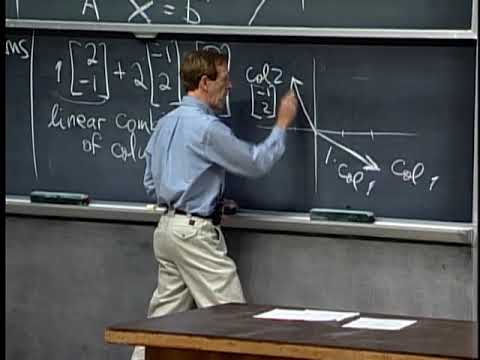
The Column Picture: A Linear Combination Produces b
- The columns of A are [2, -1] and [-1, 2], so Ax = b asks for coefficients x and y that combine those vectors into [0, 3].
- Using x = 1 and y = 2 gives [2, -1] + 2[-1, 2] = [0, 3].
- Strang identifies linear combinations of matrix columns as a central operation and notes that these two columns' combinations fill the entire plane.
15:25
Three Equations in Three Unknowns: Rows Become Planes
- Strang sets up a 3-by-3 system with A = [[2, -1, 0], [-1, 2, -1], [0, -3, 4]] and b = [0, -1, 4].
- Each linear equation describes a plane in three-dimensional xyz space; two planes generally intersect in a line.
- When the three planes meet at one point, that common point solves all three equations, although the row picture becomes harder to interpret visually.
22:00
Three-Dimensional Columns Reveal Solutions Directly
- The columns of the example matrix are [2, -1, 0], [-1, 2, -3], and [0, -1, 4].
- Because b = [0, -1, 4] is exactly the third column, the solution is x = [0, 0, 1].
- Changing b to the sum of the first two columns, [1, 1, -3], gives the immediate solution x = [1, 1, 0].
28:00
Invertibility Depends on Whether Columns Reach Every b
- The question 'Can Ax = b be solved for every b?' is equivalent to asking whether the columns' linear combinations fill the full space.
- If three columns in three dimensions all lie in one plane, their combinations stay in that plane, leaving most possible right-hand sides unreachable.
- Such a matrix is singular and not invertible; dependent columns, such as a third column equal to the sum of the first two, create this failure.
- In nine dimensions, nine independent columns can span the space, while duplicated columns can restrict combinations to a lower-dimensional subspace.
35:20
Matrix-Vector Multiplication as Column Combinations
- For A = [[2, 5], [1, 3]] and x = [1, 2], the column calculation takes one copy of [2, 1] plus two copies of [5, 3], yielding [12, 7].
- The same result comes from row dot products: 2(1) + 5(2) = 12 and 1(1) + 3(2) = 7.
- Strang emphasizes the column interpretation of Ax and previews elimination as the systematic method for finding solutions and detecting when none exist.
Summary, takeaways, and chapters were generated by AI from the video's transcript and may contain errors. The video belongs to its creator, MIT OpenCourseWare.