ZOO*3700 - Lecture 06- PWBB I - Mating and Molting
 Watch on YouTube →
Overview
Alex Smith uses mating and molting to show how arthropods balance reproductive success, survival, and growth. Examples include Hawaiian Teleogryllus oceanicus crickets evolving quieter “purring” calls after the parasitoid fly Ormia ochracea arrived in 1993, peacock spiders’ super-black display scales, pheromone tracking, snail love darts, and hormone-controlled molting. The lecture connects these adaptations to the costs of growing inside a rigid cuticle and to the contrasting ametabolous, hemimetabolous, and holometabolous insect life cycles.
Key takeaways
- Male Teleogryllus oceanicus calls attract both mates and predators: after the parasitoid fly Ormia ochracea reached Hawaii in 1993, crickets evolved quieter purring calls that retained some mate-attraction value while reducing fly attraction.
- Peacock spider courtship combines movement, color, and vibration; super-black scales reflecting about 0.5% of light increase the apparent contrast of neighboring display colors.
- Female moth pheromone plumes let males locate mates by flying upwind and casting through the plume, while specialized antennae support chemical detection.
- Arthropod molting trades growth for temporary vulnerability: animals may be unable to feed or move normally, and their cuticle-lined respiratory surfaces are also affected.
- Ecdysone-driven molting pathways can shape behavior as well as cuticle replacement; parasitoid stress can induce orb-weaver spiders to build defective webs before the wasp emerges.
- Holometabolous development separates larval and adult forms through a pupal transition, potentially reducing competition for resources between life stages.
Chapters
0:00
Mating Strategies and the Trade-Offs of Calling
- The lecture frames mating and molting as examples of life-history trade-offs: energy invested in one function cannot be spent on another.
- Courtship strategies include serenades, dances, nuptial gifts, mate guarding, and pheromones.
- Male cricket calls can attract distant females, but their sound can also reveal the caller’s location to predators.
5:00
Teleogryllus oceanicus Crickets Evolve Purring Calls
- The parasitoid fly Ormia ochracea, introduced to Hawaii in 1993, tracks male Teleogryllus oceanicus by following their calls.
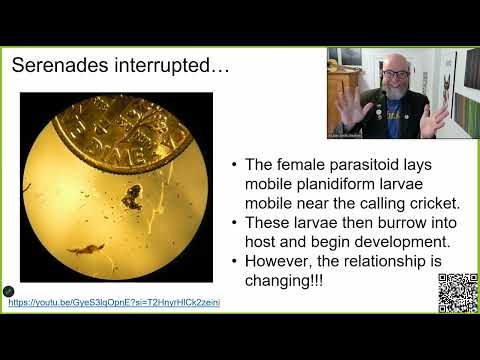
- Female flies lay mobile larvae on calling crickets; the larvae burrow into the host and develop inside it, eventually killing it.
- Hawaiian crickets evolved a quieter “purring” call that still attracts females but attracts fewer parasitoid flies than the ancestral call.
- When the fly began responding to other cricket species, those species faced new pressure as potential hosts—evidence of a rapidly changing evolutionary arms race.
12:00
Peacock Spider Courtship Combines Color, Motion, and Vibration
- Male peacock spiders use colorful displays, arm-waving, and substrate vibrations produced by drumming their legs to attract females.
- Super-black scales reflect only about 0.5% of incident light, making nearby red, blue, and white markings appear more vivid by contrast.
- The elaborate display may carry costs, including increased predation risk and investment in specialized scales.
17:00
Nuptial Gifts, Moth Pheromones, and Cuttlefish Mate Guarding
- Male dance flies offer captured prey as a nutritional gift while mating, giving the female food as well as access to sperm.
- Female saturniid moths release pheromones before dawn; males orient upwind and use tight turns, or “casting,” to follow the plume to the female.
- Moth antennae detect chemical signals, while differences in flight ability can reflect reproductive and locomotor trade-offs between sexes.
- After mating, male cuttlefish may guard females; rivals can trigger aggressive encounters involving color changes and ink release.
24:00
Flatworm Hypodermic Insemination and Snail Love Darts
- Hermaphroditic flatworms may use penis fencing to inject sperm through a partner’s body wall; the recipient then bears the greater cost of producing eggs.
- Flatworm encounters can end in reciprocal insemination, with both partners subsequently producing eggs.
- In some land snails, species-specific love darts deliver compounds that reduce the recipient’s sperm-digesting defenses and improve sperm transfer.
- Nursery web spiders offer prey wrapped in silk; the gift can reduce the risk of being eaten by the female during or after mating.
31:35
Arthropod Cuticle: Waterproofing, Protection, and Specialized Surfaces
- The procuticle includes exocuticle, mesocuticle, and endocuticle, while the thin epicuticle contains waxes and lipids that help limit water loss.
- Chitin and protein provide strength and rigidity; some aquatic arthropods also incorporate compounds such as calcium.
- Cuticle surfaces can bear specialized hairs, scales, and sensory structures involved in chemical or mechanical reception.
- A rigid, articulated exoskeleton protects arthropods but prevents continuous growth, making molting necessary.
38:00
Molting Makes Arthropods Temporarily Vulnerable
- During molting, molting fluid separates the old cuticle before it splits along ecdysial lines and the animal emerges.
- Arthropods may stop feeding and moving while the new cuticle hardens, leaving them exposed to predators.
- The respiratory surfaces of insects’ tracheae and crustaceans’ gills are cuticle-lined, so molting also disrupts the surfaces used for breathing.
- Crustaceans can recover valuable minerals, including calcium, by consuming their shed cuticle.
42:00
Hormones Link Environmental Signals to Molting Behavior
- Environmental cues such as day length, body strain, or stress can be processed by the nervous system and stimulate prothoracicotropic hormone release.
- Prothoracicotropic hormone acts on the prothoracic glands, which produce ecdysone, a steroid hormone involved in cuticle separation and molting.
- Parasitoid wasps can stress orb-weaver spiders and reduce their nutrition, altering steroid levels and inducing premolt behavior.
- Parasitized spiders may build defective webs before dying, allowing the developing wasp to emerge; molting-related hormonal pathways can therefore affect behavior as well as growth.
46:30
Ametabolous, Hemimetabolous, and Holometabolous Development
- Ametabolous insects grow through molts without major changes in body form, so young and adults often use similar resources.
- Hemimetabolous insects develop through nymphal stages that gradually become more adult-like.
- Holometabolous insects—including butterflies, beetles, bees, and flies—undergo larval development, a pupal stage, and a major transformation into adults.
- Distinct larval and adult forms can reduce competition by allowing life stages to use different environments or resources; changes in ecdysone and juvenile hormone regulate these transitions.
50:30
Course Wrap-Up, Video Assignment, and Outdoor Lab
- The next lecture continues the “problems with being big” theme by turning to respiration.
- Students are asked to submit the invertebrate assignment as a YouTube link rather than uploading the video to Dropbox.
- The outdoor lab in Dairy Bush will involve floral sampling and pollinator counts; students should bring water, sunscreen, paper, and something to write with.
Summary, takeaways, and chapters were generated by AI from the video's transcript and may contain errors. The video belongs to its creator, Alex Smith.