ZOO*3700 - Lecture 02 - Plankton I
 Watch on YouTube →
Overview
Alex Smith introduces plankton as organisms that live part or all of their lives suspended in water, and distinguishes ecological categories such as phytoplankton, zooplankton, holoplankton, meroplankton, planktotrophic, and lecithotrophic larvae. The lecture explains how plankton cope with low-Reynolds-number physics and contribute to global ecosystems, highlighting copepods’ role between flow regimes, Antarctic krill’s contribution to carbon sequestration, and the conservation risks of removing plastic from neuston-rich ocean gyres.
Key takeaways
- Plankton categories describe ecological function and life history, not ancestry: an organism can be phytoplankton or zooplankton, and holoplankton or meroplankton, depending on its traits and life cycle.
- A pelagic larval stage can disperse marine invertebrates and connect separated populations, but currents can also carry larvae away from suitable settlement sites.
- At low Reynolds numbers, viscous forces dominate; plankton therefore benefit from cilia, appendage strokes, body contractions, and buoyancy adaptations rather than relying on momentum or propeller-like movement.
- Copepods around 1 millimeter sit near the transition between viscous and inertial flow regimes, helping transfer energy between smaller plankton and larger consumers.
- Antarctic krill contribute to carbon sequestration by converting phytoplankton carbon into sinking fecal pellets and other organic material; reduced krill biomass can weaken this biological pump.
- Plastic gyres overlap with neuston-rich surface habitats, so cleanup methods that remove debris without protecting organisms such as Velella can damage important ocean food-web links.
Chapters
0:00
Plankton’s Role and the Lecture’s Learning Goals
- Alex Smith frames plankton as potentially the “little things that run the world” and previews two lectures on plankton.
- The learning goals include distinguishing plankton life-history categories, analyzing adaptations to planktonic conditions, and evaluating plankton’s global importance.
- Course Link learning outcomes and Google Scholar searches are suggested for exploring lecture topics and recent research.
4:54
Defining Plankton, Phytoplankton, and Zooplankton
- Plankton derives from the Greek for “wanderer” and describes organisms suspended in the water column, unlike benthic organisms or nekton that swim effectively against currents.
- Phytoplankton and zooplankton are functional categories for photosynthetic and heterotrophic plankton, not strict taxonomic groups.
- Some protists combine photosynthesis and heterotrophy, and plankton includes many difficult-to-identify larval stages from different animal phyla.
9:27
Holoplankton and Meroplankton Across Animal Lineages
- Holoplankton spend their entire life cycle in the plankton; examples include copepods, ctenophores, pyrosomes, and some mollusks.
- Meroplankton spend only part of their life cycle in the plankton, often as larvae before settling into a benthic adult stage.
- Abalone larvae illustrate a meroplanktonic pathway from planktonic trochophore and veliger stages to benthic life.
- Meroplanktonic larvae—including echinoderm pluteus and sea-star bipinnaria larvae—occur across diverse animal lineages.
13:17
Evolutionary Shifts Between Benthic and Pelagic Life
- Planktonic and benthic stages can be gained, retained, or lost across evolutionary lineages; they are life-history traits rather than taxonomic labels.
- Many cnidarians retain a benthic polyp stage, while siphonophores have lost the benthic stage and live entirely in the plankton.
- The lecture invites hypotheses for transitions to holoplankton, including access to new food sources, reduced competition or predation, and greater dispersal.
- The usual pattern of benthic adults and pelagic larvae has exceptions, including cnidarian life cycles with a benthic intermediate stage.
22:00
Planktotrophic and Lecithotrophic Larval Strategies
- Planktotrophic larvae feed while developing and often remain pelagic longer; lecithotrophic larvae rely on parental yolk reserves and tend to have shorter planktonic durations.
- Lecithotrophic larvae generally develop from larger, lipid-rich eggs, while planktotrophic larvae tend to come from smaller eggs and can be produced in greater numbers.
- Longer pelagic development can increase dispersal, colonization, and connections between separated populations, but currents may carry larvae to unsuitable habitats.
- Nearly 70% of temperate marine invertebrates have some pelagic developmental stage, which can reduce competition with adults and help populations recover from local habitat loss.
28:11
Reynolds Number and the Viscous World of Plankton
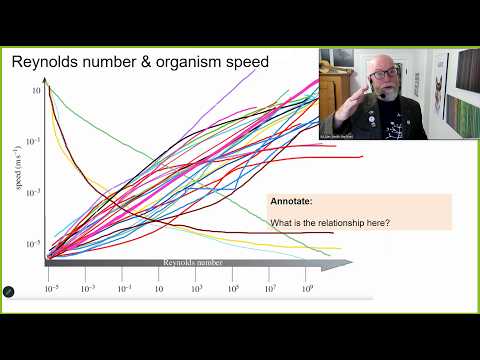
- The Reynolds number is a unitless ratio of inertial to viscous forces, influenced by fluid density, velocity, organism size, and dynamic viscosity.
- At low Reynolds numbers, as experienced by small plankton, viscous forces dominate and flow is largely laminar; larger organisms experience more inertial, turbulent flow.
- Small plankton move through a world likened to humans swimming through honey or roofing tar, where momentum-based movement is ineffective.
- Swimming speed generally increases with Reynolds number, and body size helps determine whether an organism experiences viscous or inertial conditions.
39:27
Movement and Buoyancy Adaptations at Low Reynolds Numbers
- Plankton cannot rely on propellers or the same streamlined, momentum-driven movement used by larger organisms; cilia, flagella, and power-recovery strokes are effective alternatives.
- Copepods and other arthropods use jointed appendages, while some plankton use whole-body contractions or jet-like pulses.
- Increasing surface area, reducing body volume, using lipid stores or gas floats, and regulating ions can slow sinking and help maintain position in the water column.
- A copepod near 1 millimeter lies close to the transition between viscous and inertial regimes, helping connect organisms at different trophic levels.
42:27
Planktonic Feeding: Ambush, Currents, and Mucus Nets
- Feeding strategies include passive or active ambush, as in chaetognaths, which wait and capture copepods with rapid strikes.
- Krill and choanoflagellates generate feeding currents to gather food from surrounding water.
- Planktonic mollusks can use mucus strands or nets to concentrate dilute food while also increasing drag and slowing sinking.
- Cilia-driven feeding currents work through viscous interactions, rather than relying primarily on inertial flow.
45:50
Antarctic Krill and the Ocean’s Biological Carbon Pump
- Phytoplankton fix carbon dioxide in the photic zone, and Antarctic krill consume them and produce fecal pellets that sink as marine snow.
- The biological pump transfers carbon to deep water, where limited mixing with warmer surface waters can keep it sequestered for hundreds of years.
- The lecture highlights the Southern Ocean as a carbon-sequestration hotspot despite having less plankton diversity than some other regions.
- Reduced krill abundance from fishing could mean fewer fecal pellets, carcasses, and molts sinking to depth, weakening this carbon pathway.
49:10
Neuston Ecosystems, Plastic Gyres, and Cleanup Risks
- The neuston includes diverse organisms, such as the blue-bottle jellyfish Velella, that live at the ocean surface and link widely separated ecosystems.
- Neuston organisms provide prey for larger animals, including loggerhead turtles and albatrosses.
- The currents that concentrate plastic in the Great Pacific Garbage Patch also concentrate neuston, so removing debris indiscriminately can harm these ecological connectors.
- The lecture closes by previewing later discussion of plankton defenses, including bioluminescence, and recommends preparing for plankton-focused lab work.
Summary, takeaways, and chapters were generated by AI from the video's transcript and may contain errors. The video belongs to its creator, Alex Smith.