ZOO*3700 F26 - Lecture 01.5 - How to prepare for case studies and the lecture final
 Watch on YouTube →
Overview
Alex Smith explains how Bloom’s taxonomy frames ZOO*3700’s weekly case studies: students should move beyond remembering lecture material to appraising, synthesizing, and interpreting unfamiliar examples. He connects this approach to accessible course design, recommends collaborative question-writing using Google Scholar and Google Images, and gives practical strategies for analyzing figures and completing the open-book assessments.
Key takeaways
- Case studies target Bloom’s higher-order skills—applying, analyzing, and creating—so students should practice interpreting new evidence rather than only memorizing lecture content.
- Writing questions from lecture objectives and unfamiliar research figures exercises synthesis and appraisal; collaborating in groups of three or four can produce 9–12 shared practice questions.
- The holoplanktonic mollusk example shows how to convert figures into testable claims by comparing seasonal diversity and abundance and relating near-shore patterns to temperature and salinity.
- The assessments are designed as low-risk practice for the final: 12 weekly case studies are planned, the lowest is dropped, and each is worth a little under 2% of the grade.
- To reduce mistakes when interpreting figures, enlarge the image, annotate observations, and read each question aloud before deciding what trend the evidence should show.
- Extra assessment time is not required for a strong result; Smith reports no relationship between time spent and grade, so students who have finished confidently can move on.
Chapters
0:00
Bloom’s Taxonomy, Transferable Skills, and Accessible Assessment Design
- Bloom’s taxonomy progresses from remembering and understanding to applying, analyzing, and creating; case studies emphasize the higher-level skills.
- Alex Smith describes recording lectures, providing YouTube transcripts, and allowing open-book, open-internet evaluations as universal design for learning choices.
- Weekly case studies are low stakes: 12 are planned, the lowest score is dropped, and each remaining assessment is worth a little under 2% of the final grade.
- The case-study window runs from Thursday at 9:00 a.m. to Monday at 9:30 a.m.; assessments provide more than double the standard time.
4:15
Use Peer-Written Questions to Practice Scientific Interpretation
- Reviewing notes or rewatching lectures is a useful start, but Smith recommends creating questions to practice synthesis, appraisal, and interpretation.
- Use posted lecture outlines and learning objectives to guide Google Scholar or Google Images searches for new examples, figures, maps, and phylogenies.
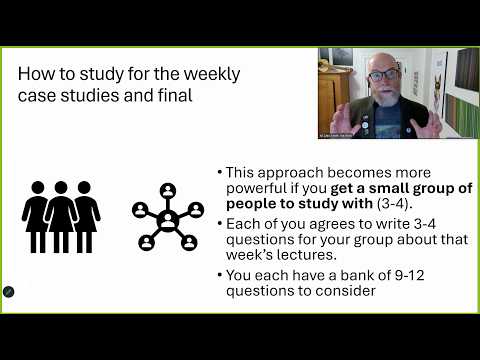
- In groups of three or four, each student can write three or four weekly questions; sharing them builds a pool of roughly 9–12 questions for practice.
- Create multiple-choice or multi-select questions with both supported and unsupported statements, turning lecture principles into practice with unfamiliar evidence.
8:06
Analyze Research Figures and Apply Practical Case-Study Strategies
- Smith models question-writing with a study of holoplanktonic mollusk assemblages in the northwestern South China Sea, using maps of temperature, salinity, chlorophyll, diversity, and abundance.
- The example distinguishes seasonal patterns: diversity is not significantly different between summer and winter, while abundance is; maps also support comparisons of near-shore and offshore conditions.
- During assessments, enlarge figures on a second monitor, annotate them with a physical notepad or screen markup, and read questions aloud to catch wording and predict expected trends.
- The extra time is optional: Smith notes no relationship between using more time and earning a higher grade, and recommends moving on once an answer is secure.
Summary, takeaways, and chapters were generated by AI from the video's transcript and may contain errors. The video belongs to its creator, Alex Smith.