Wound Healing, BIO105 Introductory Biology, David Champlin, USM
 Watch on YouTube →
Overview
David Champlin uses wound healing to connect cell communication with cell-cycle control: platelet-derived growth factor (PDGF) binds a receptor on skin cells, activates kinase signaling, and promotes cell division beneath a scab. He explains how signal transduction converts receptor binding into cellular responses, including protein phosphorylation, and surveys other receptor types while noting the estimated importance of G-protein-coupled receptor pathways in medicine.
Key takeaways
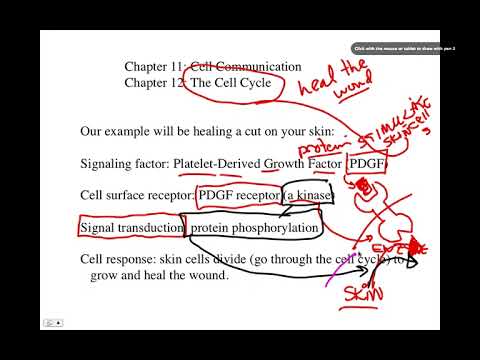
- During wound healing, PDGF binds its receptor on skin cells and stimulates them to advance through the cell cycle and divide.
- Signal transduction converts an extracellular signal into an intracellular response; the response may be cell division or another change in cell activity.
- Kinases use ATP to phosphorylate specific target proteins, and the added phosphate can switch those proteins on or off.
- Receptors do not all signal the same way: PDGF receptors have kinase activity, while other receptor types open channels or activate G proteins.
- Champlin reports that the body has about 500 kinases and that phosphorylation regulates up to 30% of its proteins.
- G-protein-coupled receptor pathways are medically significant; Champlin cites an estimate that about 40% of medicines act by affecting them.
Chapters
0:00
Wound Healing: PDGF Signals Skin Cells to Divide
- After a cut, signaling factors help skin cells grow quickly beneath the scab and heal the wound.
- Signaling factors are molecules released by a source cell that carry information to a target cell; hormones are one example.
- In the wound-healing example, platelet-derived growth factor (PDGF) binds a specific PDGF receptor on a skin cell.
5:00
PDGF Receptor Kinase Activity and Cell-Cycle Control
- The PDGF receptor acts as both a binding site and an enzyme; its kinase activity amplifies the signal inside the target cell.
- Kinases use ATP to add phosphate groups to target proteins, switching their activity on or off and directing the cell toward division.
- This signal-transduction pathway links cell communication in chapter 11 with mitosis and cell-cycle control in chapter 12; meiosis is treated separately in chapter 13.
10:00
Receptor Types, Second Messengers, and Kinase Significance
- The PDGF receptor is a receptor tyrosine kinase, which phosphorylates tyrosine residues on target proteins; other receptors can open channels or activate G proteins.
- Cytoplasmic second messengers can carry a signal from the primary messenger into the cell and help produce a cellular response.
- Champlin cites an estimate that about 40% of medicines affect G-protein-coupled receptor pathways.
- The body has about 500 kinases, and phosphorylation can regulate as many as 30% of its proteins.
Summary, takeaways, and chapters were generated by AI from the video's transcript and may contain errors. The video belongs to its creator, The New Evolution for Everyone.