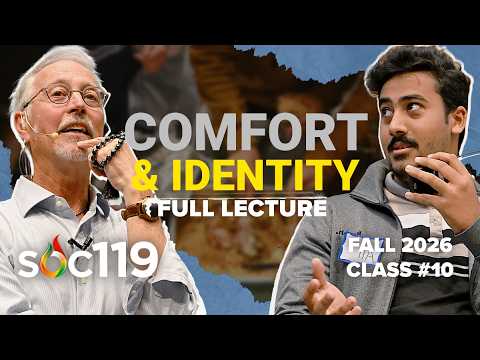
Why Your Favorite Meal Isn't About Taste | Sociology of Comfort Food | 26FA Class #10 Full Lecture
 Watch on YouTube →
Overview
SOC 119 uses a tasting session featuring Ghanaian jollof, Arab kabsa, Russian kapusta, and Korean kimchi to show that comfort food is shaped less by flavor than by memory, family routines, cultural identity, and the feeling of home. Sam, Laurie, and students connect those foods to shared meals, religious dietary practices such as halal, and practical histories of preserving affordable food through harsh winters.
Key takeaways
- Comfort food is usually defined by memory, repetition, and relationships: Nana and Davina associate Ghanaian jollof with everyday meals prepared by their mother and grandmother as well as celebrations.
- Foods that look similar can carry distinct regional identities: jollof and kabsa both center on rice and meat, but families distinguish versions by rice, spices, toppings, and preparation.
- Respectful discussion of dietary rules can turn a potentially awkward food exchange into cultural learning; Ali explains halal restrictions, and classmates discuss how to accommodate them.
- Fermentation is both cultural practice and practical food preservation: kapusta and kimchi preserve cabbage for regions with cold winters, while students also discuss potential benefits of fermented foods.
- Repeated staples can ground people in a culture even when they are not elaborate dishes, as shown by Korean kimchi, Ecuadorian mote, bread, and grain porridges.
- Food practices can communicate closeness beyond the dish itself: Tej’s hand-eating demonstration and accounts of feeding others show how sharing a carefully prepared bite can express friendship.
Chapters
0:00
Laurie Introduces World in Conversation and Group Facilitation
- Laurie describes World in Conversation as an undergraduate center that grew out of SOC 119 students wanting to talk.
- The center trains facilitators to understand groups as a fundamental unit of social life.
- Laurie says facilitator recruitment will take place in October and notes that alumni credit the experience with career and graduate-school opportunities.
3:20
Laurie Frames Comfort Food as a Feeling of Home
- Laurie asks students to recall foods that make them feel they belong or are in a familiar, safe place.
- She describes looking for sweets while traveling, while noting that another culture’s chicken soup cannot fully replace one’s own comfort food.
- Knowing how a familiar dish is made and what goes into it can help make a new place feel like home.
6:50
Bibigo’s KCON LA Connection Inspires a Food Class
- Sam traces the class idea to a conference in Los Angeles for KCON LA, where he and Laurie encountered Bibigo, a brand under Korean corporation CJ.
- Bibigo sent the class several boxes of food, prompting Sam and Laurie to organize a tasting.
- Students introduce themselves by sharing where they or their families are from before discussing dishes.
8:50
Ghanaian Jollof Connects West African History and Family Meals
- Nana and Davina explain that jollof is associated with the Wolof Empire and is made across West African countries including Ghana, Nigeria, Senegal, and Gambia.
- The Ghanaian version served in class uses jasmine rice and chicken; other versions may use parboiled or basmati rice, fish, goat, and different spices.
- The sisters describe jollof as everyday food and a fixture at birthdays, weddings, and other gatherings, recalling their mother and grandmother preparing it.
- They say rice type, seasoning, color, and flavor help distinguish national and regional versions.
15:50
Arab Kabsa Brings Families Together Around One Shared Dish
- Ali describes kabsa as a dish shared across Arab countries, with variations in spices, toppings, and meats.
- He recalls eating it with his cousin at his grandparents’ home and associates it with celebrations and family gatherings.
- Kabsa is affordable, makes enough for many people, and can be prepared with chicken, goat, or camel.
- The discussion draws a comparison between kabsa and jollof as rice-centered dishes that bring people together.
25:10
Halal Dietary Rules Turn a Food Invitation into Cultural Dialogue
- When Ali declines to eat chicken that is not halal, he explains that halal meat must be slaughtered according to specific religious rules.
- Students discuss how to respond without treating a dietary restriction as a personal rejection or making the interaction awkward.
- One student says she prepares meatless food for her Muslim friend, while others emphasize that explaining the restriction makes accommodation possible.
- Laurie connects small everyday differences—including food and bathroom practices—to whether people feel comfortable forming relationships.
30:40
Student Tasters Compare Jollof, Kabsa, and Their Own Comfort Foods
- Students describe the jollof and kabsa as flavorful but different in seasoning, rice, and chicken; reactions to the jollof’s spiciness vary.
- One taster prefers the jollof rice with the kabsa chicken, while another says the dishes could fit into a familiar family dinner.
- A Gujarati student names dal, bhat, and shak—lentils, rice, and curry—as a personal comfort-food combination.
- Other students mention Christmas dinners, mashed potatoes, meatloaf, and chicken noodle soup as foods tied to home.
37:30
Russian Kapusta and Korean Kimchi Introduce Fermented Cabbage
- Elliot introduces kapusta, Russian fermented cabbage made with salt and sliced carrots and kept in jars for weeks.
- Jerry, who grew up in Seoul, explains that Korean meals commonly include at least one kind of kimchi.
- The class turns from chicken and rice to cabbage-based foods, comparing Russian and Korean fermentation traditions.
- Elliot says his family keeps many jars in the basement fridge, while Jerry recalls kimchi as a familiar taste of home.
40:20
Kapusta Links Family Routine to Affordability and Soviet-Era Scarcity
- Elliot says kapusta appeared at nearly every family dinner, although he disliked it after being made to eat it as a child.
- His mother and grandmother ate it regularly during the period surrounding the Soviet Union’s collapse.
- Sam points out that culturally important foods often emerge from making affordable dishes with ingredients people can obtain.
- The homemade cabbage’s smell prompts a student to say it smells like home.
45:50
Kimchi’s Daily Role and Fermentation’s Practical History
- Jerry says kimchi was part of almost every lunch or dinner while he lived in Korea for about 20 years, but is more expensive for him to buy in the United States.
- He has heard that kimchi contains beneficial bacteria and can support digestion; his family generally treats it as good food without discussing health benefits at every meal.
- Sam connects fermented cabbage to cold regions with long winters, short growing seasons, and the need to preserve vegetables and nutrients such as vitamin C.
- Students compare Korean fermentation containers with the reusable jars Elliot’s family uses for kapusta.
50:50
Students Taste Kapusta and Spicy Kimchi
- A nutrition major says fermented foods can contribute beneficial bacteria to the gut microbiome, where they help compete with harmful bacteria.
- Students compare kapusta with sauerkraut; one finds it refreshing, while another says it resembles a familiar fermented cabbage dish.
- The kimchi tastes spicier than the earlier rice dishes to some tasters, but others from Ghana and Gujarat find it mild.
- Students note that kimchi has many varieties, including milder options such as water kimchi.
55:50
Comfort Comes from Repeated Meals, Memory, and Cultural Staples
- Sam argues that comfort food is primarily about the memories and meanings attached to food, not a dish’s particular flavor or spice level.
- Kimchi can feel grounding because it appears at nearly every Korean meal; Sam compares it with mote, or hominy, eaten at every meal during his time in Ecuador’s Andes.
- Bread and grain porridges such as oatmeal and Korean rice porridge recur across cultures as familiar staples.
- Foods reserved for holidays may be significant without functioning as everyday comfort foods because repetition and routine help create comfort.
1:00:50
Eating with Hands and Feeding Others Make Meals Intimate
- Tej demonstrates eating rice with the hand: four fingers gather and shape the food, while the thumb pushes it toward the lips.
- He describes etiquette that keeps fingers out of the mouth and brings the food to the lips rather than throwing it in.
- Sam connects the demonstration to South Indian meals served on banana leaves and to Ethiopian injera meals where people may feed one another.
- Preparing a carefully combined bite for another person is presented as an intimate expression of friendship and care.
Summary, takeaways, and chapters were generated by AI from the video's transcript and may contain errors. The video belongs to its creator, SOC 119.