Why neuroscience keeps rediscovering Freud | Mark Solms
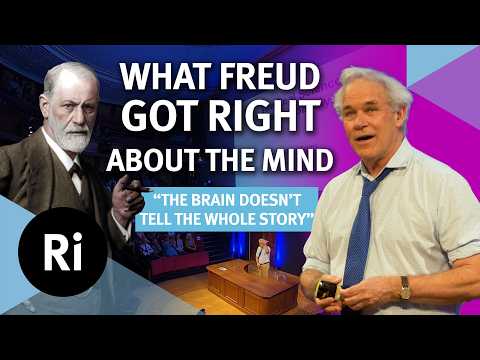 Watch on YouTube →
Overview
Mark Solms argues that modern neuroscience repeatedly rediscovers fundamental concepts pioneered by Sigmund Freud in his neuroscientific works, which are largely untranslated into English. Solms details how Freud's early research on the nervous system, his functionalist approach to understanding mental processes (e.g., language disorders), and his insights into multiple memory systems, the unconscious mind, critical developmental periods, embodied cognition, and the role of pleasure-seeking drives, all prefigure current mainstream ideas in cognitive neuroscience, often attributed to later researchers like Tolman, Putnam, and Friston.
Key takeaways
- Sigmund Freud's extensive neuroscientific work from 1877-1900, largely untranslated, laid the groundwork for many modern neuroscience concepts.
- Freud pioneered functionalism in understanding mental processes and disorders, arguing for the analysis of psychological functions over pure anatomy.
- Concepts like multiple memory systems (conscious, preconscious, unconscious) and the existence of an unconscious mind, now mainstream, were first articulated by Freud.
- Freud's work on critical developmental periods, embodied cognition, and the motivation by pleasure predates their rediscovery and popularization in contemporary cognitive neuroscience.
- While Freud's drive classification and definition of sexuality contained errors, his emphasis on pleasure-seeking and the subjective experience of feelings remains vital for understanding the mind.
- Modern neuroscience, particularly cognitive and affective neuroscience, is increasingly recognizing and re-integrating Freud's foundational ideas, often independently rediscovered.
Chapters
- Sigmund Freud published over 200 neuroscientific and neurological titles between 1877 and 1900.
- These works are largely untranslated into English, obscuring Freud's deep immersion in neuroscience.
- Freud's early research focused on the structure of the neuron and nerve fibers.
- Freud studied nerve cell structure in invertebrates (crayfish, lamprey) and traced connections in the spinal cord and brainstem.
- He analyzed fetal brains to understand early neural organization.
- Freud traced the origin of the vestibular cochlear nerve and studied movement disorders like cerebral palsies.
- Freud's 1891 book on language mechanisms argued against purely anatomical/physiological explanations.
- He proposed language disorders should be analyzed in terms of psychological functions.
- This functional approach paved the way for studying 'hysteria' (functional neurological disorders) where no structural brain damage is evident.
- Freud described functional neurological disorders as having a 'lesion of an idea' rather than a structural brain lesion.
- He argued deeper mental functions are not understood by basic neural elements but by functional rearrangements.
- The relationship of mental functions to neural elements is compared to a poem's relationship to the alphabet.
- Freud's concept of studying underlying functional organization is central to modern cognitive neuroscience.
- This functionalist approach, attributed to Hilary Putnam in the 1950s, was pioneered by Freud in the 1890s.
- Neuroscience today studies functional systems (memory, perception, executive) rather than just neurons.
- Freud approached the 'hard problem of consciousness' by starting with subjective experience, not just neural mechanisms.
- He argued that disorders without brain lesions (like hysteria) must be accessed via the patient's subjective experience.
- Modern neuroscience is increasingly incorporating subjectivity, a path Freud pioneered.
- Freud proposed multiple memory systems in 1896, where memories are transcribed dynamically into different forms.
- He identified conscious, preconscious, and unconscious memory systems, paralleling modern short-term, declarative long-term, and non-declarative long-term memory.
- Freud's 1900 assertion that the mind is not synonymous with consciousness, and that unconscious mental functions exist, is now mainstream cognitive neuroscience.
- Freud's concept of critical periods in development, exemplified by infantile amnesia, is now a standard neuroscience principle.
- He argued humans are embodied creatures with drives and urges, a concept central to embodied cognition.
- Freud's ideas on drives, including sexuality and the pursuit of pleasure, are foundational to understanding motivation.
- Freud's idea that we repeat satisfying experiences and avoid noxious ones aligns with Thorndike's 'law of effect'.
- This concept is echoed in modern 'predictive processing' paradigms, with Karl Friston titling a paper 'All Thinking is Wishful Thinking'.
- Freud's emphasis on feelings and psychical reality is crucial for a complete understanding of the mind.
Summary, takeaways, and chapters were generated by AI from the video's transcript and may contain errors. The video belongs to its creator, The Royal Institution.