Why Laplace transforms are so useful
 Watch on YouTube →
Overview
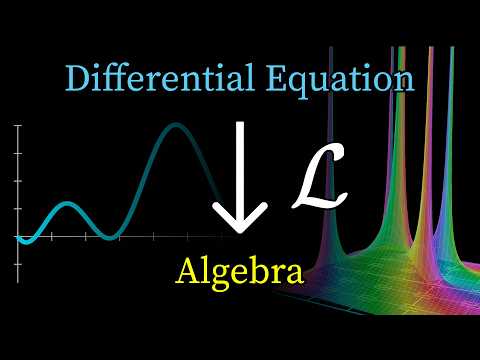
3Blue1Brown explains the utility of Laplace transforms for analyzing dynamic systems by converting differential equations into algebraic problems. The core idea is that the Laplace transform of a derivative becomes multiplication by 's' in the s-domain, simplifying analysis. This is demonstrated through a mass-on-a-spring example, showing how poles in the transformed function reveal system dynamics like oscillation and decay, and how the transform's properties inherently handle initial conditions.
Key takeaways
- Laplace transforms convert differential equations into algebraic equations by transforming differentiation into multiplication by 's' in the s-domain.
- Poles in the Laplace transform of a system's solution directly indicate the system's natural frequencies, decay rates, and oscillatory behavior.
- The Laplace transform property for derivatives, L{f'(t)} = sF(s) - f(0), inherently incorporates initial conditions into the transformed equation.
- The initial, irregular behavior in dynamic systems arises from the superposition of the system's natural response (decaying over time) and the steady-state response driven by external forces.
- The transform of an exponential function e^(at) is 1/(s-a), with a pole at 'a' in the s-plane, directly linking exponential components to specific pole locations.
- Understanding the s-plane, where poles represent exponential components and imaginary axes represent pure oscillation, provides intuition for system dynamics.
Chapters
0:00
Introduction to Dynamic Systems and Laplace Transforms
- A mass-on-a-spring simulation demonstrates a system with natural oscillation and an external driving force.
- The initial behavior is irregular before settling into a rhythm, posing an analytical challenge.
- Laplace transforms are introduced as a powerful tool for studying such dynamic systems and differential equations.
1:50
Recap: Exponential Functions and the S-Plane
- Functions of the form e^(st) are explored, where 's' is a complex number.
- The s-plane visualizes possible values of 's', with imaginary parts indicating oscillation and real parts indicating growth/decay.
- Laplace transforms break down functions into exponential pieces, with poles in the transformed function corresponding to these pieces.
6:42
The Derivative Property and Transforming Differential Equations
- The Laplace transform of a derivative f'(t) is s*F(s) - f(0), converting differentiation into multiplication by 's' and incorporating initial conditions.
- This property transforms differential equations into algebraic equations in the s-domain.
- The simple harmonic oscillator with an external force is used as an example to demonstrate this transformation process.
23:05
Analyzing System Dynamics and Explaining the Derivative Property
- Poles in the transformed function reveal system dynamics: negative real parts indicate decay, imaginary parts indicate oscillation.
- The initial irregular behavior (startup trajectory) is explained by the superposition of natural system modes and the forced response.
- Three explanations for the derivative property are discussed: an elementary example with exponentials, integration by parts, and a more general approach involving inverse transforms.
Summary, takeaways, and chapters were generated by AI from the video's transcript and may contain errors. The video belongs to its creator, 3Blue1Brown.