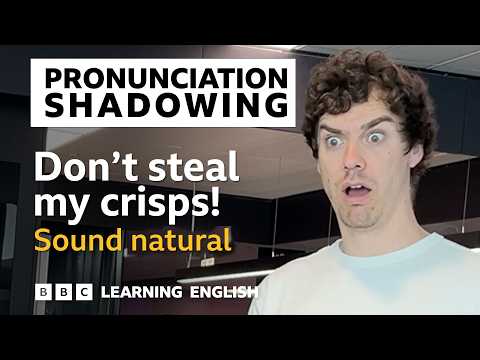
👄 Who stole my crisps?! Pronunciation Shadowing
 Watch on YouTube →
Overview
BBC Learning English uses an awkward office mix-up over a packet of crisps to teach shadowing: learners repeat a story almost in real time while practicing natural connected speech. The lesson focuses on the schwa /ə/, the often-dropped /h/ in unstressed pronouns such as “him” and “he,” and “and” reduced to /ən/, then applies all three in a full-story shadowing exercise.
Key takeaways
- Shadowing builds fluency, pronunciation, and listening by having learners repeat spoken English almost simultaneously rather than waiting until a sentence ends.
- The schwa /ə/ commonly replaces vowels in unstressed words such as “to,” “of,” and “for”; “of” can reduce further in phrases like “a cup of tea.”
- The /h/ in unstressed “him,” “he,” and “her” is often dropped after a consonant, producing connected forms such as “send ’im” and “but ’e.”
- “And” often reduces to /ən/ in connected speech because its /d/ is omitted, as in “packet ’n stood up.”
- The crisps story’s twist comes when the worker finds her own packet still under the table, revealing that she had been eating the man’s crisps.
- Recording and replaying the full shadowed story helps learners identify where their schwa, dropped /h/, and reduced “and” sound less natural.
Chapters
0:00
Shadowing the Office Crisps Story and Hearing the Schwa
- Shadowing means listening carefully and repeating almost at the same time, like an echo; BBC Learning English introduces it through an office story about crisps.
- The story begins with a hungry worker buying a packet of crisps for about a pound, leaving it on a table, and returning to find a man eating them.
- Words such as “was,” “about,” “the,” and “to” often contain the unstressed vowel /ə/, called the schwa—the most common vowel sound in spoken English.
- Practice phrases include “I was feeling hungry,” “for about a pound,” and “a packet of crisps”; in natural speech, “of” may reduce to /ə/.
3:38
Dropping /h/ in “Him,” “He,” and Other Unstressed Words
- The story continues as the worker tries to signal the man by taking handfuls of crisps, but he keeps eating.
- In connected speech, /h/ is often omitted from short pronouns such as “him,” “he,” and “her,” especially after a consonant sound.
- The lesson contrasts careful forms like “him” with connected forms such as “send ’im a message” and “a man ’ad sat down.”
- Learners repeat the phrases “Send ’im a message,” “A man ’ad sat down,” and “But ’e still continued” to practice the reductions.
5:53
Reducing “And” to /ən/ and Shadowing the Full Story
- The worker finishes the crisps, then discovers the packet she bought earlier still under the table and realizes she has eaten someone else’s food.
- In connected speech, “and” often loses its /d/ and sounds like /ən/, as in “scrunched up the empty packet ’n stood up to leave.”
- Practice sentences combine the reductions, including “I put them on the table and went to make myself a cup of tea” and “I picked up my bag and saw the packet.”
- The full story is shadowed again from 7:04; learners are encouraged to record themselves, listen for improvements, and use the downloadable audio for practice.
Summary, takeaways, and chapters were generated by AI from the video's transcript and may contain errors. The video belongs to its creator, BBC Learning English.