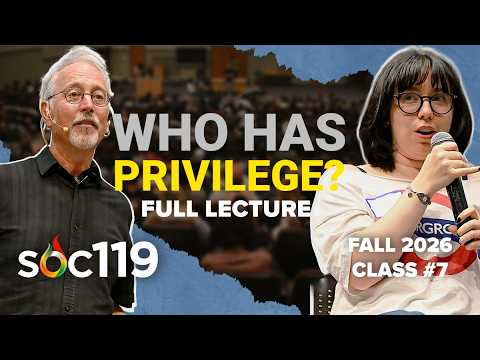
Who Has "Privilege"? | Cheating at Life | 26FA Class #07 Full Lecture
 Watch on YouTube →
Overview
SOC 119 uses a classroom conversation among Clara, Shahraiz, Connor, and Hennessy to frame privilege as an unearned head start: family resources, staff, travel, and networks can shape opportunities before anyone chooses how hard to work. The discussion contrasts those advantages with shared values such as integrity and effort, while stressing that individual ambition does not make competition structurally equal; it closes by distinguishing attainable personal goals from the pressure to pursue extreme wealth or status.
Key takeaways
- Privilege can be understood as an unearned head start: children inherit family resources, education, location, and networks before they can choose how hard to work.
- The class’s examples make class differences concrete: some households rely on au pairs or employ 20–30 workers, while Connor and Hennessy describe making simple meals and sharing cleaning chores.
- Individual drive and structural advantage can coexist: students may be equally motivated, yet connections and family resources can make it easier for some applicants to access internships and prestigious careers.
- Personal experiences challenge class stereotypes: Clara and Shahraiz describe meaningful friendships and close family relationships in affluent circles rather than universal shallowness or family distance.
- A realistic account of mobility should distinguish possibility from probability: upward mobility can happen, but people with fewer resources may compete against peers who begin with substantial advantages.
- Success need not mean extreme wealth; the discussion treats building a desired business, supporting a family, and living with integrity as meaningful accomplishments.
Chapters
0:00
Cheating at Life: Defining Privilege Through Unearned Advantages
- SOC 119 introduces the class topic, “Cheating at Life,” and revisits the idea that receiving something unearned can resemble cheating.
- An example of a professor granting attendance credit to a friend’s son illustrates favoritism as an unfair advantage.
- A story about a police officer letting a group of white teenagers follow him home after drinking prompts a later reflection on racial privilege.
8:00
Setting Up a Conversation Across Social Class
- The class pairs Clara and Shahraiz with Connor and Hennessy to compare experiences associated with upper-class and less affluent backgrounds.
- SOC 119 asks students to explore daily life and social class without naming family members or treating one person’s family as representative.
- The exercise emphasizes asking questions because students may not know what life looks like outside their own social circles.
9:30
Dinner, Au Pairs, and Household Staff
- Shahraiz describes weekday meals prepared by household staff, including cooks; Connor says an au pair made dinner when he was younger.
- An au pair is explained as a live-in caregiver who looks after children, while Connor later recalls his father taking over dinner.
- Connor’s question about staff leads Shahraiz to describe households with three workers in his case and, in some joint-family homes, 20–30 workers.
11:40
Sports, Travel, and the Scale of Household Labor
- Shahraiz lists soccer, horse riding, and golf among childhood activities, alongside international trips every other year and domestic travel in alternating years.
- He says some large joint-family households employ guards, gardeners, cleaners, drivers, childcare workers, and multiple cooks.
- Connor reacts to the contrast with his own experience, finding the idea of routinely encountering household staff difficult to imagine.
14:20
Cooking, Cleaning, and Family Time in Connor and Hennessy’s Homes
- Connor recalls simple meals such as pasta, Eggos with peanut butter, and PB&J, with family dinner often delayed until his working parents returned around 8 or 9 p.m.
- Hennessy describes relying on an older sister for care and eating frozen dinners, Pop-Tarts, or spaghetti that lasted a week or more.
- Both describe doing household chores themselves: Hennessy shared a weekly chore calendar, while Connor cleaned on Sundays.
17:00
Summer Camps, Private Jets, and Unequal Travel Exposure
- Clara recalls summer camps, ballet, and knowing people with summer homes; Shahraiz describes friends and acquaintances who owned private jets.
- Shahraiz says private-jet travel was visible among royal-family and business families in Dubai, while Hennessy had treated such things as jokes from TV or movies.
- Connor had never traveled internationally, and Hennessy had flown only once, on Spirit Airlines to Texas.
22:00
What Each Group Missed and Stereotypes About Wealth
- When asked what they missed, Clara says her parents’ demanding work schedules sometimes meant less family time, despite greater material resources.
- Shahraiz says he can understand household chores but not fully appreciate the time and labor they require for people who do them daily.
- Clara and Shahraiz challenge stereotypes that upper-class people are shallow or distant from family, describing meaningful friendships and strong family ties.
29:37
Advantages Beyond Income: Location, Disability, and Mental Health
- In response to a question about factors beyond socioeconomic status, students identify where someone lives and the people around them.
- Clara notes that growing up in Washington, D.C., can mean more internships and exposure to people from different places than a smaller town.
- Hennessy adds that disability and mental illness can affect opportunities, while Connor emphasizes mindset and persistence.
31:30
Ambition Meets Unequal Competition and Family Connections
- Connor initially frames his main competition as himself, but acknowledges that students with stronger networks may have easier access to internships.
- Hennessy describes adapting to unequal opportunities and focusing on what she can accomplish with the circumstances she faces.
- Shahraiz says networking opportunities in the United States can be more open than in Pakistan, where connections may depend more heavily on family and friends.
38:00
How Inherited Networks Shape Access to Prestigious Careers
- Clara observes that applicants with parental connections may be more likely to get through the door, even if interviews later focus on individual qualifications.
- SOC 119 contrasts a barber’s limited professional network with the connections available to students whose families can arrange introductions and opportunities.
- The class uses finance degrees and competition with Harvard, Princeton, and the University of Pennsylvania to show that equal effort does not mean equal starting points.
43:50
Integrity, Family Success, and the Ethics of Nepotism
- Shahraiz says he has seen relatives and friends with fewer resources waste opportunities through inaction, reinforcing his belief in personal effort.
- Clara describes her mother and stepfather’s success through honest work, support, and family care; Connor praises his father for building a barbershop and providing for the family.
- In a hypothetical prestigious law-firm scenario, Connor says he would prefer earning a position on merit, while Shahraiz argues that people commonly use shortcuts when they are available.
53:30
Why “I Can Be Anything” Meets Unequal Odds
- The discussion distinguishes individual potential from statistical likelihood: people from lower-income backgrounds can move upward, but face competitors who may start far ahead.
- Clara says ability and drive do not erase unequal access to resources; the odds can be stacked against someone without making success impossible.
- SOC 119 rejects the idea that reaching the same workplace creates a permanently level playing field, since family resources and networks can continue to matter.
57:00
Acknowledging Privilege While Choosing a Personal Definition of Success
- Shahraiz says awareness of people higher on the economic ladder keeps his own advantages in perspective; Clara notes that some privileged peers may rarely consider affordability or class differences.
- Hennessy describes holding two thoughts at once: effort matters, while forces outside one’s control can constrain outcomes.
- The class closes by reframing success around personal goals, such as Connor’s father building a barbershop, rather than measuring achievement by owning two private jets.
Summary, takeaways, and chapters were generated by AI from the video's transcript and may contain errors. The video belongs to its creator, SOC 119.