What was Euclid really doing? | Guest video by Ben Syversen
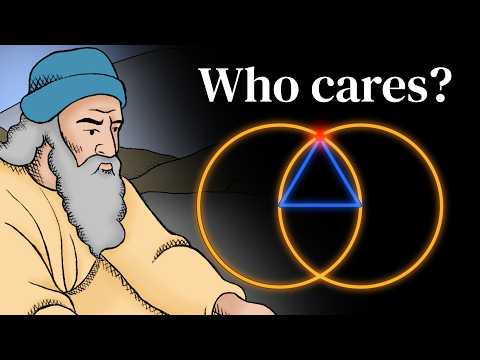 Watch on YouTube →
Overview
Ben Syversen argues that Euclid's Elements used ruler and compass constructions not merely for drawing, but as integral parts of proofs, grounding abstract geometry in physically verifiable actions. This approach, rooted in Greek philosophical debate, provided a framework for irrefutable mathematical truth, with each construction serving as a verified subroutine. The parallel postulate's necessity for constructing even simple shapes like squares highlights how Euclid systematically cataloged the axiomatic foundations of geometry.
Key takeaways
- Euclid's ruler and compass constructions were not just for drawing but were integral to the logical structure of proofs, serving as verifiable subroutines.
- The Greek approach to geometry, influenced by philosophical debate, used diagrams for topological properties but relied on axiomatic proofs for exactness.
- The 'collapsible compass' concept highlights that constructions in Euclid's Elements were theoretical operations, not necessarily practical drawing methods.
- Euclid's Postulate 5 (the parallel postulate) is essential for constructing even basic shapes like squares, demonstrating the interconnectedness of geometric axioms.
- The rigorous construction process in Euclid's Elements provided a mechanism to avoid subtle diagrammatic errors that plagued less formal geometric reasoning.
- Euclid's systematic cataloging of assumptions and constructions laid the foundation for absolute mathematical truth for over two thousand years.
Chapters
0:00
Introduction to Euclid's Elements and Greek Mathematical Practice
- Euclid's Elements, a foundational text for 2,000 years, symbolized exact reasoning.
- Ancient Greek methods differed from modern math, with diagrams being part of the reasoning, not just illustrations.
- Euclid's first proof (Proposition 1) for an equilateral triangle relies on an unstated assumption about circle intersection.
6:35
The Role of Diagrams and Skepticism in Greek Proofs
- Viktor Blåsjö suggests the 'gap' in Euclid's proof is an anachronistic interpretation; diagrams were part of an antagonistic debate.
- Skeptics were expected to visually verify constructions, making claims about non-intersection difficult to credibly assert.
- Diagrams were used for topological properties (point inside/outside, order on a line) but not for exact properties like equality.
13:48
Proposition 2: Copying a Line Segment and the 'Collapsible Compass'
- Proposition 2, copying a line segment, uses an elaborate construction involving an equilateral triangle.
- This construction implies a 'collapsible compass' – it holds a radius for one circle but collapses when lifted.
- Constructions served a theoretical purpose, acting as verified operations (modules/subroutines) constructible from postulates.
18:29
The Philosophical Roots of Greek Proof and Postulates
- Unlike earlier civilizations, Greeks developed proofs to address philosophical questions and establish absolute truth.
- Plato (rationalism) emphasized intuition, while Aristotle (empiricism) focused on observation; math offered a middle ground.
- Postulates (axioms) were grounded in physical actions (straightedge, compass) to ensure plausibility and consistency.
25:25
The Peril of Subtle Mistakes and the Parallel Postulate
- Subtle diagrammatic mistakes could ruin proofs and damage geometry's credibility.
- A flawed proof attempting to show unequal right angles illustrates how visual assumptions can lead to false conclusions.
- Euclid's construction of a square requires the parallel postulate (Postulate 5), which is complex and not intuitively obvious.
Summary, takeaways, and chapters were generated by AI from the video's transcript and may contain errors. The video belongs to its creator, 3Blue1Brown.