What's the longest stick that makes around the corner? The simplest case of the Moving Sofa Problem
 Watch on YouTube →
Overview
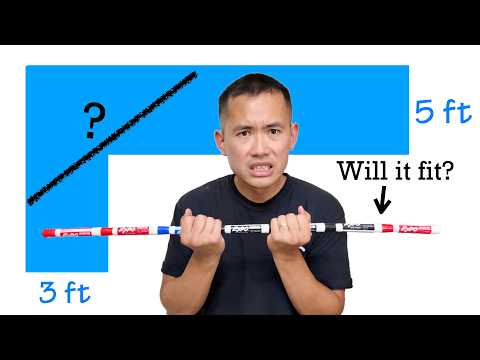
blackpenredpen models a zero-width stick turning through a right-angle hallway with widths 3 ft and 5 ft, expressing the critical stick length as L(θ) = 3 csc θ + 5 sec θ. The key is that the limiting length is the minimum of this function, approximately 11.19 ft; blackpenredpen also gives the general formula (a^(2/3) + b^(2/3))^(3/2), with its proof deferred to a follow-up.
Key takeaways
- For hallway widths 3 ft and 5 ft, a zero-width stick’s critical turning length is the minimum of L(θ) = 3 csc θ + 5 sec θ.
- The 3-by-5-foot hallway’s critical stick length is approximately 11.19 ft.
- The turning problem seeks a minimum contact length, not a maximum: any stick longer than the critical length cannot clear the corner.
- For perpendicular hallway widths a and b, the critical length is (a^(2/3) + b^(2/3))^(3/2).
- The derivation assumes a stick with no width; adding width changes the geometry and makes the problem more difficult.
Chapters
0:00
Modeling the 3-by-5-Foot Turn with Two Right Triangles
- The hallway has perpendicular widths of 3 ft and 5 ft, and the stick is treated as having zero width.
- At turning angle θ, the stick spans two right-triangle segments, L1 and L2, so its total length is L1 + L2.
- Using sine and cosine gives L1 = 3 csc θ and L2 = 5 sec θ, hence L(θ) = 3 csc θ + 5 sec θ.
3:47
Why the Corner-Clearing Length Is the Minimum of L(θ)
- The relevant angle range is 0 < θ < π/2, representing the stick rotating through a 90° corner.
- The hallway can extend indefinitely, so a stick can be made arbitrarily long by extending it down a corridor; there is no finite overall maximum.
- The limiting stick is the shortest one that simultaneously touches the left wall and the top wall; any longer stick cannot make the turn.
- Graphing L(θ) therefore identifies a minimum, approximately 11.19 ft for the 3-ft and 5-ft hallway.
7:15
General Formula for the Critical Length
- For perpendicular hallway widths a and b, blackpenredpen gives the best possible turning length as (a^(2/3) + b^(2/3))^(3/2).
- Substituting a = 3 ft and b = 5 ft yields approximately 11.19 ft, matching the graph of the trigonometric expression.
- The formula resembles the Pythagorean theorem’s combination of two widths, but uses powers 2/3 and 3/2; its proof is left for a follow-up.
Summary, takeaways, and chapters were generated by AI from the video's transcript and may contain errors. The video belongs to its creator, blackpenredpen.