What’s at the center of the earth?: Crash Course Geology #4
 Watch on YouTube →
Overview
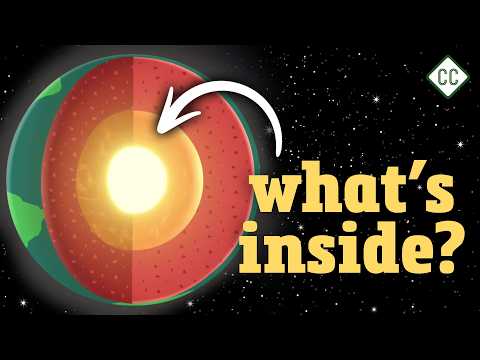
Crash Course Geology #4 explores Earth's core, detailing its discovery and function. Initially theorized by Edmond Halley with a hollow Earth model, the core's existence was evidenced by Richard Oldham in 1906. Inge Lehmann's 1936 research, based on seismic wave analysis, revealed a two-part core: a liquid outer core and a solid inner core, primarily composed of iron and nickel. This core generates Earth's protective magnetic field, which shields the planet from solar wind and radiation, preventing a Mars-like atmospheric stripping.
Key takeaways
- Inge Lehmann's analysis of seismic wave refractions in 1936 led to the discovery of Earth's solid inner core, distinct from its liquid outer core.
- Earth's core, composed of iron and nickel, generates a magnetic field that creates the magnetosphere, protecting the planet from harmful solar wind and radiation.
- The loss of Mars's magnetic field is cited as a reason for its current uninhabitable state, highlighting the importance of Earth's magnetic shield.
- Solar storms, such as solar flares and coronal mass ejections, can temporarily overwhelm Earth's magnetosphere, causing technological disruptions like radio blackouts and power outages.
- While Earth's magnetic poles have reversed numerous times throughout history, these reversals are gradual processes taking thousands of years and have not historically caused mass extinctions or climate catastrophes.
- A geomagnetic storm in 1967 was responsible for jamming US radio communications, an event mistaken for a Cold War attack, underscoring the impact of space weather on human technology.
Chapters
0:00
Early Theories of Earth's Interior and the Dawn of Seismology
- Edmond Halley proposed a hollow Earth model with concentric spheres in 1692.
- Newton's density calculations were used to estimate Earth's mass, though initially inaccurate.
- Seismology emerged as a field to study Earth's internal structure by tracking seismic waves.
- Richard Oldham provided the first evidence of Earth's core in 1906.
3:14
Inge Lehmann's Discovery of the Inner Core
- Inge Lehmann, a Danish geophysicist, studied earthquake seismic waves.
- She observed seismic waves behaving unusually when passing through Earth's center.
- In 1936, Lehmann theorized Earth's core consists of a liquid outer core and a solid inner core.
- Her theory was later confirmed and became the scientific consensus.
6:34
Earth's Magnetic Field, Magnetosphere, and Solar Storms
- The molten outer core's motion generates Earth's magnetic field, a protective shield.
- This field extends into space as the magnetosphere, deflecting solar wind and radiation.
- Mars lost its magnetic field, leading to atmospheric stripping and loss of water.
- Solar storms, like flares and coronal mass ejections, can disrupt the magnetosphere and technology.
Summary, takeaways, and chapters were generated by AI from the video's transcript and may contain errors. The video belongs to its creator, CrashCourse.