What is Plate Tectonics: Crash Course Geology #10
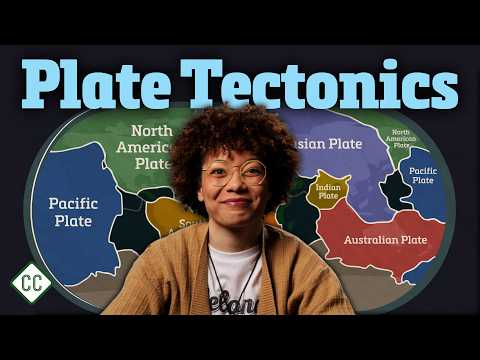 Watch on YouTube →
Overview
Crash Course Geology explains plate tectonics as the movement of Earth's lithosphere, broken into plates that shift due to convection currents in the asthenosphere. This movement occurs at plate boundaries: divergent (seafloor spreading, rift valleys), convergent (subduction, mountain ranges), and transform (earthquakes). Key figures like Alfred Wegener (continental drift) and Marie Tharp (mapping the seafloor) contributed to the theory's acceptance.
Key takeaways
- The Ring of Fire is a direct consequence of subduction zones where oceanic plates converge with continental plates.
- Plate tectonics is driven by convection currents in the asthenosphere, where hot mantle rock rises and cooler rock sinks.
- Divergent boundaries create new oceanic crust through seafloor spreading, while convergent boundaries can lead to subduction or mountain building.
- Alfred Wegener's theory of continental drift, though initially rejected, laid the groundwork for modern plate tectonics.
- Marie Tharp's detailed mapping of the seafloor revealed the mid-ocean ridge, providing crucial evidence for plate movement.
- Plate tectonics is a unifying theory in Earth science, explaining phenomena from earthquakes and volcanoes to mountain formation and continental drift.
Chapters
0:00
Introduction to Plate Tectonics and Earth's Layers
- The Ring of Fire, bordering the Pacific Ocean, accounts for most earthquakes and volcanic eruptions.
- Earth's outermost layer, the lithosphere, is broken into large plates composed of continental and oceanic crust.
- Continental lithosphere is thick, lightweight granite; oceanic lithosphere is denser basalt and gabbro.
- Underneath the lithosphere is the asthenosphere, where heat causes mantle rocks to flow, creating convection currents.
3:19
Plate Boundaries: Divergent, Convergent, and Transform
- Divergent boundaries: plates move apart, causing seafloor spreading and rift valleys (e.g., East African Rift).
- Convergent boundaries: plates move toward each other, leading to subduction (oceanic-continental, oceanic-oceanic) or mountain formation (continental-continental).
- Subduction zones, common in the Ring of Fire, release water, causing melting and volcanic activity.
- Transform boundaries: plates slide past each other, generating earthquakes (e.g., San Andreas Fault).
8:28
Historical Development and Evidence for Plate Tectonics
- Alfred Wegener proposed continental drift in the 1910s, observing continents fitting like puzzle pieces, but lacked a mechanism.
- Marie Tharp and Bruce Heezen mapped the seafloor in the 1950s-60s, discovering the mid-ocean ridge, a key piece of evidence for plate tectonics.
- The theory of plate tectonics gained consensus through decades of evidence and the work of many geologists.
- Plate tectonics shapes Earth's surface, influences climate, and helps predict natural disasters like earthquakes and tsunamis.
Summary, takeaways, and chapters were generated by AI from the video's transcript and may contain errors. The video belongs to its creator, CrashCourse.