What has James Webb discovered about our universe? | Puzzling Science with Maggie Aderin
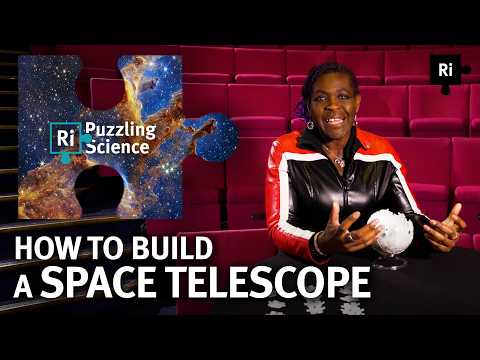 Watch on YouTube →
Overview
Maggie Aderin-Pocock details the James Webb Space Telescope (JWST), an infrared observatory 1.5 million km from Earth, designed to answer questions raised by Hubble. JWST's Near Infrared Spectrograph (NIRSpec) and its microshutter array enable detailed analysis of distant galaxies, providing insights into the early universe and challenging existing cosmological theories.
Key takeaways
- The James Webb Space Telescope (JWST) is an infrared observatory positioned 1.5 million km from Earth, designed to explore the universe's origins.
- JWST's Near Infrared Spectrograph (NIRSpec) utilizes a microshutter array, allowing it to simultaneously observe multiple celestial objects.
- JWST's ability to observe infrared light allows it to see objects as they were millions of years ago, acting as a cosmic time machine.
- Early galaxies observed by JWST appear to have formed more rapidly than current cosmological models predict, challenging existing theories.
- The scientific process involves testing theories with new evidence, adapting models when data contradicts them, as demonstrated by JWST's findings.
- JWST's mirror is 6.5 meters in diameter and specifically coated to detect infrared wavelengths, distinguishing it from optical telescopes.
Chapters
0:00
Introduction to the James Webb Space Telescope
- JWST is the largest space telescope ever built, operating 1.5 million km from Earth.
- It functions as an infrared telescope, extending beyond visible and UV light.
- JWST builds upon Hubble's discoveries, answering previously raised questions about the universe.
3:43
JWST's Technology and Location
- JWST features cutting-edge technology, including a 6.5-meter mirror coated for infrared detection.
- It is positioned at the Sun-Earth Lagrange point 2 (L2), a gravitational null point, allowing it to point away from Earth and the Sun.
- A multi-layered heat shield protects the telescope from solar and Earth's infrared radiation, crucial for sensitive measurements.
7:10
JWST's Scientific Mission and Discoveries
- JWST acts as a time machine, observing objects millions of light-years away as they were in the past.
- Instruments like NIRSpec, equipped with a microshutter array and Integral Field Units (IFUs), allow detailed spectral analysis of galaxies.
- Early observations reveal that some galaxies formed much faster than predicted by current theories, prompting a re-evaluation of cosmological models.
Summary, takeaways, and chapters were generated by AI from the video's transcript and may contain errors. The video belongs to its creator, The Royal Institution.