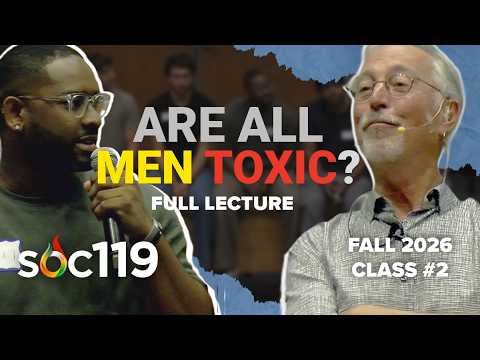
What Does It Mean To Be a Man Today? | The "Red Pill" Discussion | 26FA Class #02 Full Lecture
 Watch on YouTube →
Overview
SOC 119 uses a discussion with four randomly selected male students from New Jersey, Jordan, Philadelphia, and Chennai to examine the manosphere, toxic masculinity, and changing expectations of men. Their accounts connect online influencers such as Andrew Tate and Jordan Peterson with family and cultural norms, while showing disagreement over how widespread these ideas are and emphasizing that masculinity can include caregiving, respect, and support for women’s equality.
Key takeaways
- The four students describe the manosphere as a mix of online influencer content and older cultural expectations, rather than a single organized movement.
- Hemes’s account of Chennai highlights how gender expectations can persist even as younger women pursue education and delay marriage to protect their independence.
- Sam’s experience with a father who cared for children while his mother worked shows how ordinary family arrangements can offer alternatives to provider-only masculinity.
- Students disagree about how many men genuinely endorse Andrew Tate’s ideas: David estimates 10–20% of men in the classroom, while Sam expects fewer and sees some viewing as entertainment.
- The discussion identifies financial provider expectations as a real pressure on men but rejects using that pressure to justify restricting women’s choices.
- David’s account of developing masculinity through his mother, comic books, and a chemistry teacher complicates the claim that a positive father figure is necessary to prevent toxic attitudes.
Chapters
0:00
Four Students Introduce Their Backgrounds and Experiences
- SOC 119 explains that four men were selected without advance notice of the topic and are asked to describe personal experience, not represent all men.
- Sam is a sophomore from Bergen County, New Jersey; Laith is a junior from Amman, Jordan; David is a senior from Philadelphia; and Hemes is an international student from Chennai, India.
- The class is structured as an open discussion, with the instructor stressing that individual accounts should not be treated as universal perspectives.
4:00
Students Define the Manosphere Through Online Influencers and Gender Norms
- David associates the online manosphere with Jordan Peterson, Andrew Tate, extreme discipline, and a rugged ideal of masculinity promoted to young men.
- Laith describes social-media influencers as prescribing how men should act toward one another and women.
- Hemes distinguishes online discourse from Indian social expectations, including the belief that men should provide financially and women should not become homemakers by choice.
8:00
Toxic Masculinity, Misogyny, and the Weight of Being Called Racist
- The students connect toxic masculinity with rigid gender roles, misogyny, and sexism, while noting that the term circulates more online than in conversations among male friends.
- David says being labeled toxic would feel like a damaging accusation; Sam says being called racist would feel worse because race is not a choice.
- A classroom hand-raise suggests relatively few women present consider racism and toxic masculinity equally disturbing in every case.
14:20
Indian Family Expectations and Women’s Independence
- Hemes describes a male relative who expects women to cook and clean and opposes his wife working, despite her completing high school.
- He locates such expectations more often in rural Indian settings and says norms are changing among younger people, especially in cities.
- Hemes’s female friends postpone marriage or pursue higher education to avoid dependence on a husband who might restrict their work; he also notes pressure on Indian men to earn more than their spouses.
19:00
Military Culture, Andrew Tate, and Looksmaxxing
- David recalls misogynistic attitudes in male-dominated spaces during his time in the U.S. Army.
- He describes a fellow soldier drawn to manosphere videos, extreme gym routines, and the claim that monogamy was invented by the government.
- Laith points to Penn State campus attention around Clavicular and looksmaxxing, arguing that self-presentation can be positive until it becomes extreme or infringes on others’ rights.
23:00
Sociological Generalizations and the Limits of Clickbait Narratives
- SOC 119 explains that sociology requires careful generalizations about groups while recognizing that groups such as Nigerians, Arabs, and queer people are internally diverse.
- Laith defines a boundary for toxic behavior as supporting restrictions on other people’s rights, such as preventing women from working.
- The instructor cautions that anger-driven headlines and edited clips can exaggerate conflict, noting that clickbait could substantially increase the class’s YouTube views.
27:20
Male Role Models and Sam’s Stay-at-Home Father
- Laith and Sam suggest that supportive male role models can help boys resist restrictive online versions of masculinity.
- Sam describes his father staying home with him while his mother worked, continuing the arrangement when Sam’s younger sister was born.
- Sam says his father’s caregiving shaped his outlook, even though he stood out in settings where mothers were usually the adults picking up children.
31:20
Gatta Kusthi, Nigerian Family Labor, and Changing Gender Roles
- Hemes cites the Tamil film Gatta Kusthi, featuring a house-husband protagonist and a wife pursuing wrestling, as an example of popular media shifting perspectives in Chennai and Tamil Nadu.
- He remains unsure whether audiences who welcome the film would accept the same arrangement in a neighbor’s real life.
- David recounts his Nigerian grandmother raising six children and working across language communities while her husband received care elsewhere; during that period, the grandfather had another child, adding to her responsibilities.
37:00
Masculinity as a Response to Feminism and Financial Pressure
- The discussion treats toxic masculinity as partly a reaction to feminism and changing expectations, while noting that machismo-like ideals predate today’s social-media influencers.
- Hemes describes a perceived asymmetry in India: women may see marriage to a provider as a fallback, while men are often expected to earn or be considered failures.
- Laith identifies financial responsibility as a pressure on men and says gender equality can feel more competitive, while also acknowledging women face greater difficulties overall.
45:20
Andrew Tate’s Reach, Group Chats, and Estimates of Support
- Hemes says Andrew Tate is popular in India and describes a friend who frequently shares Tate clips in a mixed-gender group chat.
- Friends challenge the posts when they become offensive, particularly when female members object; Hemes thinks the friend sometimes enjoys provoking reactions.
- David estimates that perhaps 10–20% of men in the classroom might genuinely support Tate-like rhetoric, while Sam thinks fewer would agree and many watch figures such as Tate or Clavicular for entertainment.
51:20
Why Some Women Choose Traditional or Toxic Masculinity
- David suggests that some people may underestimate how pride and entitlement shape a man’s behavior, while others may be accommodating patriarchal expectations.
- Sam argues that family examples can make more traditional masculinity seem normal, and cautions that not every masculine man should automatically be labeled toxic.
- Laith says the four students’ approach—caring for a future spouse and children while respecting equality—is one modern form of masculinity, not a rejection of being a man.
57:20
Religion, Household Socialization, and Sources of Masculinity
- Laith says Islamic teaching emphasizes respect and care for women, while distinguishing those teachings from harmful conduct that occurs in some communities.
- An audience member argues that preventing toxic masculinity should begin at home, through how the next generation is raised.
- David challenges the idea that a father figure alone determines masculinity, describing how he drew examples from his mother, comic-book characters, and a chemistry teacher’s intellectual curiosity.
1:03:00
Audience Questions, Incel Terminology, and Class Closing
- The class briefly considers whether men and women can express harmful gender-based rhetoric, with David naming misandry as an example and noting its different structural power.
- SOC 119 explains that an incel is someone who wants a relationship but feels unable to find one, and notes that the label is often used mockingly.
- The session closes with an announcement that four women will join the next Tuesday discussion and a reminder to contact course staff through the staff email.
Summary, takeaways, and chapters were generated by AI from the video's transcript and may contain errors. The video belongs to its creator, SOC 119.