Wed Sep 23, 2026 Lecture (L12) Stewart Sect. 2.5 The Chain Rule
 Watch on YouTube →
Overview
Barsamian's Math Videos teaches Stewart Section 2.5 by identifying inner and outer functions and applying the chain rule, then extends the method to three nested layers. Examples show how to differentiate powers, square roots, and trigonometric compositions, use derivatives to find tangent slopes and horizontal tangencies, and evaluate a composition's derivative from a table.
Key takeaways
- For a two-layer composition outer(inner(x)), evaluate the outer derivative at the unchanged inner function, then multiply by the inner derivative.
- For f(x) = (x³ − 12x + 17)⁵, the chain rule produces 5(x³ − 12x + 17)⁴(3x² − 12); retaining parentheses prevents losing terms in the inner derivative.
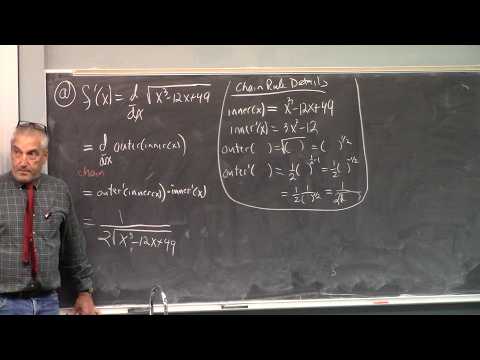
- The derivative of √(x³ − 12x + 49) is (3x² − 12)/(2√(x³ − 12x + 49)), giving a tangent slope of −6/7 at x = 0.
- To find horizontal tangencies, set the derivative to zero and require both a zero numerator and a nonzero denominator; the square-root example has horizontal tangencies at x = ±2.
- For f(θ) = tan²(cos θ), differentiating all three layers gives −2 tan(cos θ) sec²(cos θ) sin θ.
- For h(x) = g(f(x)), h′(1) depends on g′ evaluated at f(1), not at 1; the table values g′(2) = 5 and f′(1) = 6 yield h′(1) = 30.
Chapters
0:00
Chain Rule Notation: Distinguishing Inner and Outer Functions
- A composition such as f(g(x)) has an inner function, g(x), and an outer function, f; those roles matter more than the letters used.
- The chain rule differentiates outer(inner(x)) as outer′(inner(x)) multiplied by inner′(x).
- Barsamian emphasizes learning the unit circle and using consistent inner/outer terminology.
4:00
Differentiating a Fifth Power of a Cubic
- For f(x) = (x³ − 12x + 17)⁵, the inner function is x³ − 12x + 17 and its derivative is 3x² − 12.
- Treat the outer function as an empty-input fifth power; its derivative is 5(parenthesis)⁴.
- The derivative is 5(x³ − 12x + 17)⁴(3x² − 12); parentheses ensure the entire inner derivative is multiplied.
10:20
Square-Root Derivative and Tangent Slope at x = 0
- For √(x³ − 12x + 49), rewrite the outer square root as a power of 1/2 to differentiate it as an empty function.
- The derivative is (3x² − 12) / (2√(x³ − 12x + 49)).
- The tangent slope at x = 0 is f′(0) = −12 / 14 = −6/7.
- Simplify factored expressions by canceling common factors before multiplying.
13:18
Finding Horizontal Tangencies by Setting the Derivative to Zero
- A horizontal tangent has slope zero, so solve f′(x) = 0 rather than evaluating the derivative at a specified x-value.
- For the square-root example, setting the numerator 3x² − 12 equal to zero gives candidate values x = 2 and x = −2.
- A fraction equals zero only when its numerator is zero and its denominator is nonzero; checking both candidates confirms both are valid.
17:40
Applying the Chain Rule Across Three Layers
- For f(θ) = tan²(cos θ), identify the layers as outer squaring, middle tangent, and inner cosine.
- Differentiate each layer: the outer derivative is 2(parenthesis), the middle derivative is sec²(parenthesis), and the inner derivative is −sin θ.
- Multiplying the layer derivatives gives −2 tan(cos θ) sec²(cos θ) sin θ.
- The expression can also be rewritten using sine and cosine, but simplification is optional when it does not improve clarity.
34:21
Using a Function Table to Evaluate a Composition Derivative
- For h(x) = g(f(x)), the chain rule gives h′(x) = g′(f(x))f′(x).
- At x = 1, use f(1) = 2, f′(1) = 6, and g′(2) = 5 from the table.
- Therefore h′(1) = g′(2)f′(1) = 5 × 6 = 30; the main challenge is matching each table value to the correct input.
Summary, takeaways, and chapters were generated by AI from the video's transcript and may contain errors. The video belongs to its creator, Barsamian's Math Videos.