Wed Sep 2, 2026 Lecture (L05) Stewart Section. 1.6 Part 2: Limits at Infinity
 Watch on YouTube →
Overview
Barsamian's Math Videos distinguishes infinite limits at a finite x-value from limits at infinity, where x grows without bound and function values may approach a real number or infinity. The lecture interprets these limits through horizontal asymptotes and shows how dividing rational expressions by the denominator's highest power of x gives their end behavior, including limits of 4/5 and 0.
Key takeaways
- An infinite limit describes f(x) becoming unbounded near a finite input, whereas a limit at infinity describes the behavior of f(x) as x tends to positive or negative infinity.
- A finite end limit L corresponds to a horizontal asymptote y = L, and the graph may cross that horizontal line while approaching it.
- To evaluate the limit of a rational function at infinity, divide every term by the denominator's highest power of x and let the reciprocal-power terms approach zero.
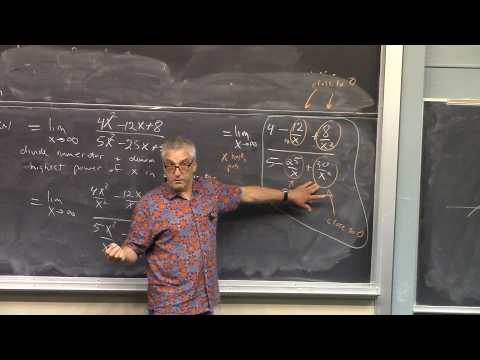
- For (4x² − 12x + 8)/(5x² − 25x + 30), equal numerator and denominator degrees give limits of 4/5 at both ends and horizontal asymptotes y = 4/5.
- When the denominator degree is 3 and the numerator degree is 2, as in the second example, the end limits are 0 and the horizontal asymptote is y = 0.
- Write horizontal asymptotes as line equations—such as y = 4/5—not simply as a number, to distinguish them from vertical lines such as x = 4/5.
Chapters
0:00
Infinite Limits, Vertical Asymptotes, and the Vertical Line Test
- An infinite limit at x = a means f(x) grows without bound positively or negatively as x approaches a, potentially from the left or right.
- A vertical asymptote is a vertical line approached by the graph when one-sided or two-sided limits are positive or negative infinity.
- A graph that crosses a vertical line more than once at the same x-value fails the vertical line test and is not a function.
4:32
Limits at Infinity and Horizontal Asymptotes
- For the example f(x) = (x² − 1)/(x² + 1), values approach 1 as x grows positively or negatively without bound.
- The notation lim x→∞ f(x) = L means function values can be made as close to the real number L as desired by taking x sufficiently large.
- A finite limit as x→∞ gives a horizontal asymptote on the graph's right; a limit as x→−∞ describes its left end.
- Unlike a vertical asymptote, a horizontal asymptote can be crossed repeatedly as a graph approaches it.
9:20
Reading End Behavior on Graphs, Including Infinite Limits at Infinity
- On the left end of a graph, x→−∞ while the y-values may approach a finite height L.
- On the right end of the illustrated graph, both x and y increase without bound, giving an example of lim x→∞ f(x) = ∞.
- The lecture distinguishes a limit at infinity, where x tends to ±∞, from an infinite limit at a finite x-value.
12:29
Rational-Function Limits by Dividing Through by the Highest Power
- For f(x) = (4x² − 12x + 8)/(5x² − 25x + 30), divide every numerator and denominator term by x², the denominator's highest power.
- The resulting expression has leading constants 4 and 5, while terms involving 1/x and 1/x² approach zero; therefore both end limits equal 4/5.
- The graph consequently has horizontal asymptotes y = 4/5 on both the left and right.
- For rational functions in these examples, the same horizontal asymptote applies at both ends; the lecture contrasts this with exponential functions that may have an asymptote on only one side.
21:45
A Higher-Degree Denominator Produces the Asymptote y = 0
- In the second rational-function example, the denominator's degree is raised to 3 while the numerator remains degree 2.
- Dividing through by x³ makes every numerator term tend to zero while the denominator tends to its leading coefficient, so the limit is 0.
- The right-end horizontal asymptote is written as the line equation y = 0; because the example is rational, the left-end limit is also 0.
- Barsamian reminds students to state horizontal asymptotes as equations such as y = 0 or y = 15, rather than just giving a height.
Summary, takeaways, and chapters were generated by AI from the video's transcript and may contain errors. The video belongs to its creator, Barsamian's Math Videos.