Wed Sep 16, 2026 Lecture (L10) Stewart Sect. 2.3 Basic Differentiation Formulas, Part 2
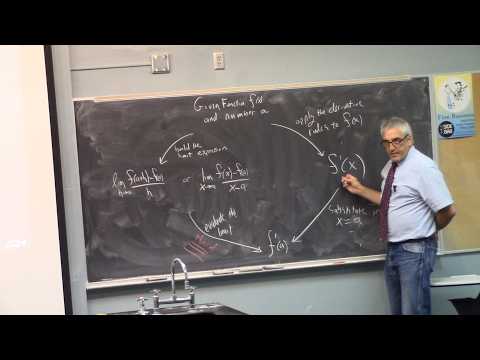 Watch on YouTube →
Overview
Barsamian's Math Videos reviews the sum and constant-multiple rules, emphasizing that quotient-shaped expressions are often easier to differentiate after rewriting them as sums of power functions. The lecture then develops higher-derivative notation and the relationships among position, velocity, and acceleration, before practicing graph interpretation, repeated derivatives of sine, and using derivative rules to evaluate limits from the derivative definition.
Key takeaways
- When a quotient can be algebraically rewritten as a sum of constant multiples of powers, applying the sum, constant-multiple, and power rules is often simpler and safer than using the quotient rule.
- For one-dimensional motion, velocity is the first derivative of position and acceleration is the second derivative: v(t) = s′(t) and a(t) = s″(t).
- Displacement is net change in position, but total distance traveled sums the absolute values of each segment; a 4-meter trip out and 3-meter return has displacement 1 meter and distance 7 meters.
- Derivative graphs encode slopes: the derivative is positive where the original graph rises, negative where it falls, and zero where it has a horizontal tangent.
- The derivatives of sin x repeat every four steps, making the 99th derivative equal to the third derivative, −cos x.
- A limit that matches the derivative definition at x = a can be evaluated by finding f′(a); for f(x) = x¹⁰⁰⁰ at a = 1, the limit is 1000.
Chapters
0:00
Exam 1 Format and Preparation
- Exam 1 is scheduled for Friday; exam and quiz details are available through the course web page linked from Canvas.
- The exam has eight problems: one from each of seven covered sections plus an additional problem from one of those sections.
- At least one problem resembles a textbook example, one a recitation problem, and one a lecture example; students must also generalize techniques to unfamiliar problems.
- Expect at least one derivative-definition problem and one problem about position, velocity, and acceleration.
3:25
Use Linearity and Rewrite Quotients Before Differentiating
- The sum and constant-multiple rules let you pull constants outside derivatives and differentiate added terms separately.
- Barsamian emphasizes showing this rule as a step because skipping it can make work harder and more error-prone.
- For quotient-shaped exercises from recitation, rewrite the expression as a sum of constant multiples of power functions, then apply the power rule.
- Rewriting can be easier and more reliable than applying the quotient rule—even after that rule is introduced—and this algebra skill recurs throughout the course.
9:38
Notation for Second, Third, and Higher Derivatives
- The second derivative, written f″ or d²f/dx², means differentiating f and then differentiating the result.
- The third derivative uses f‴ or d³f/dx³; the dⁿ/dxⁿ notation generalizes to any derivative order n.
- For orders above three, f⁽ⁿ⁾ is more practical than writing an increasingly long string of prime marks.
- The notation d²/dx² resembles multiplication, but it represents repeated differentiation, not multiplication.
14:27
Position, Velocity, Acceleration, and Their Units
- For one-dimensional motion, s(t) gives position, v(t) = s′(t) gives velocity, and a(t) = v′(t) = s″(t) gives acceleration.
- Position and velocity signs describe different things: an object can be at a positive position while moving in the negative direction.
- A one-dimensional track needs one coordinate; more generally, a dimension counts how many numbers are needed to describe a system's state.
- Velocity has units of distance per time, while acceleration has units of distance per time squared—for example, miles per hour and miles per hour squared.
24:45
Position-Function Exercises: Displacement Versus Distance
- Section 2.3 exercises may give a position formula and ask for velocity at time t, velocity at a specific time, when the particle is at rest, or total distance traveled.
- A worked textbook example covers questions similar to the planned cubic-position exercise, so students are directed to study the book example and practice with WebAssign.
- Displacement from time 0 to time 5 is s(5) − s(0), the net change in position.
- In the classroom example, walking 4 meters one way and 3 meters back gives a 1-meter displacement but 7 meters of total distance traveled; distance adds the absolute values of each leg.
31:09
Identify Position, Velocity, and Acceleration from Graphs
- In the three-graph exercise, the red graph is position, the blue graph is velocity, and the green graph is acceleration.
- The blue graph matches the red graph's slope: red is always increasing, and its slope is greatest where blue reaches its highest value.
- The green graph matches the blue graph's slope: it is positive while blue rises, zero at blue's horizontal tangent, and negative while blue falls.
- Use derivative relationships and slope signs—not just the apparent shape of each curve—to identify the graphs.
36:01
Repeated Derivatives of Sine Cycle Every Four Steps
- Successive derivatives of sin x are cos x, −sin x, −cos x, and then sin x again.
- Because the pattern repeats every four derivatives, the 99th derivative is the same as the third derivative: −cos x.
- The calculation uses 99 = 96 + 3, with 96 divisible by four, so the first 96 derivatives return to sin x before the final three are taken.
39:40
Evaluate Derivative-Definition Limits Using f′(a)
- A derivative-definition limit for a function f at a equals f′(a), the slope of the tangent line at x = a; directly evaluating the limit can be difficult.
- Recognize the limit's structure, identify f and a, differentiate f using the rules, and substitute a to reach the same value more efficiently.
- For the expression involving x¹⁰⁰⁰ at a = 1, the power rule gives f′(x) = 1000x⁹⁹⁹ and f′(1) = 1000.
- For the fourth-root expression centered at 16, identify f(x) = x¹ᐟ⁴ and a = 16; then use f′(x) = ¼x⁻³ᐟ⁴ and evaluate at 16.
Summary, takeaways, and chapters were generated by AI from the video's transcript and may contain errors. The video belongs to its creator, Barsamian's Math Videos.