Wed Aug 26, 2026 Lecture (L02) Stewart Section 1.4 (Calculating Limits)
 Watch on YouTube →
Overview
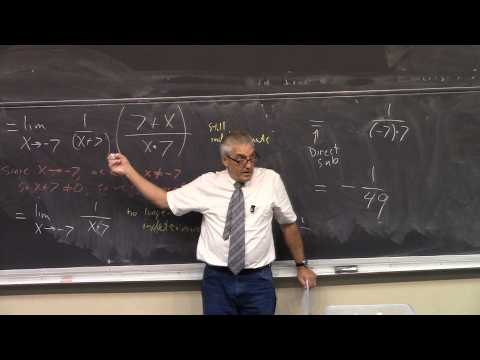
Barsamian's Math Videos explains Stewart Section 1.4 by using limit laws to calculate limits and showing when direct substitution is valid. Examples include evaluating a rational function at x = 2, resolving a 0/0 form at x = 3 by factoring and canceling for a limit of 3/5, and simplifying two further indeterminate limits to 12 and -1/49.
Key takeaways
- Direct substitution evaluates a polynomial limit at any input and a rational-function limit only when the input is in its domain.
- The quotient limit law requires the denominator's limit to be nonzero; if substitution gives 0/0, that law is unavailable.
- A 0/0 form is indeterminate rather than a conclusion that the limit is zero or undefined; further algebra may reveal the limit.
- Canceling a factor in a limit is justified when the input approaches a value but is not equal to it, so the factor is nonzero for the nearby inputs.
- A function and its canceled expression may have different domains: x(x − 3)/((x + 2)(x − 3)) excludes x = 3, whereas x/(x + 2) does not.
- The lecture's three algebraic examples resolve 0/0 forms by simplification, yielding limits of 3/5, 12, and −1/49.
Chapters
0:00
Lecture 2: Course Resources and the Previous Recitation
- Barsamian's Math Videos identifies the class as Math 2301, Lecture 2, on August 26, covering Stewart Section 1.4.
- The course calendar page links to lecture videos and handouts; students can reach the public page through Canvas or bookmark it.
- The recitation review revisits Section 1.3 and interpreting limits from graphs and tables.
2:00
Informal Limits and the Graphical Location (a, L)
- The notation lim x→a f(x) = L informally means that as x approaches a without equaling it, f(x) approaches L.
- A limit describes the graph heading toward the location (a, L), whether or not the function is defined at x = a.
- A recitation table showed y-values approaching 3/5 as x approached 3, motivating analytical methods beyond graphs and estimates.
6:30
Why Limit Laws Replace the Precise Definition in Calculus
- The precise definition can justify limits rigorously, but the lecture describes it as too difficult for the current Math 2301 course.
- Limit laws are presented as theorems derived from the precise definition and its recurring patterns.
- Section 1.4 applies those laws to calculate limits analytically rather than relying on tables or graphs.
10:00
Direct Substitution for a Rational Function at x = 2
- The example uses f(x) = (x² − 3x)/(x² − x − 6), with denominator factored as (x + 2)(x − 3).
- At x = 2, the numerator is −2 and the denominator is −4, so direct substitution gives the limit 1/2.
- The quotient law is valid because the denominator's limit is nonzero; direct substitution also applies because 2 is in the rational function's domain.
15:00
Rational-Function Domains and the Direct Substitution Test
- For a rational function, the excluded inputs are the values that make its denominator zero.
- In the example, x = −2 and x = 3 are excluded, while x = 2 is allowed.
- When the input is in the domain, a polynomial or rational function's limit can be found by plugging in that input.
18:00
At x = 3, the Quotient Law Produces an Indeterminate 0/0
- Substituting x = 3 into x² − 3x and x² − x − 6 gives 0/0.
- Because the denominator limit is zero, the quotient limit law cannot be used for this calculation.
- The 0/0 result does not establish that the limit is undefined; it signals that more work is needed.
22:00
Factoring and Canceling to Find the Limit 3/5
- Factoring gives x(x − 3)/((x + 2)(x − 3)), making the source of the 0/0 form visible.
- Since x approaches 3 but is not equal to 3, x − 3 is nonzero for the nearby inputs under consideration and can be canceled.
- The simplified limit is lim x→3 x/(x + 2), so direct substitution gives 3/5.
26:00
Why Canceling After Substitution Is Invalid
- Canceling x − 3 after plugging in x = 3 would mean canceling zero, so the apparently correct result 3/5 would come from invalid steps.
- The original rational function excludes x = 3, while the simplified expression x/(x + 2) is defined there; they are not the same function over their full natural domains.
- The limit calculation is justified by considering inputs near 3 but unequal to 3, canceling the nonzero factor, and then substituting into the simplified expression.
34:50
Expanding a Difference of Cubes to Evaluate a Limit of 12
- For lim h→0 [(-2 + h)³ + 8]/h, direct substitution produces the indeterminate form 0/0.
- Expanding (-2 + h)³ gives −8 + 12h − 6h² + h³; the constants cancel with +8.
- Factoring h from the remaining numerator allows cancellation for h ≠ 0, leaving 12 − 6h + h², whose limit is 12.
43:00
Combining Fractions to Evaluate a Limit of −1/49
- The final example considers lim x→−7 [(1/x) + (1/7)]/(x + 7), which initially yields 0/0.
- Combining the numerator fractions gives (x + 7)/(7x); writing the denominator factor separately clarifies the algebra.
- Because x approaches −7 without equaling it, x + 7 can be canceled, leaving 1/(7x) and the limit −1/49.
- The lecture closes by previewing other indeterminate limits and the squeeze theorem for a later class.
Summary, takeaways, and chapters were generated by AI from the video's transcript and may contain errors. The video belongs to its creator, Barsamian's Math Videos.