Using Sum and Difference Formulas in Trigonometry (Precalculus - Trigonometry 26)
 Watch on YouTube →
Overview
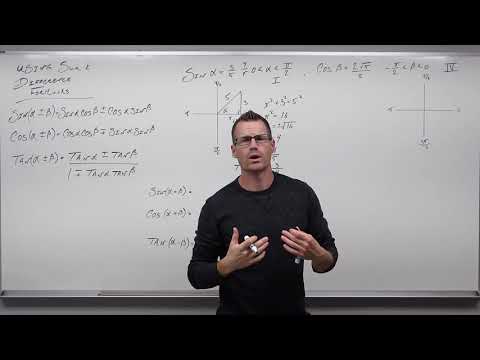
Professor Leonard demonstrates how to use the sum and difference formulas for trigonometric functions, emphasizing the critical importance of determining the correct quadrant for angles to ensure accurate signs for sine, cosine, and tangent. The video covers common examples, inverse trigonometric functions, and proves that sine and cosine are phase shifts of each other, illustrating these concepts with detailed examples and step-by-step calculations.
Key takeaways
- The quadrant of an angle is crucial for determining the correct signs of its trigonometric functions (sine, cosine, tangent), especially when using the Pythagorean theorem to find missing sides.
- Inverse trigonometric functions (e.g., arcsin, arccos, arctan) return angles, and their restricted domains (e.g., [-pi/2, pi/2] for arcsin, [0, pi] for arccos) dictate which quadrant the resulting angle can be in.
- When dealing with inverse trigonometric functions that do not result in angles on the unit circle (e.g., arctan(4/3)), drawing a right triangle and finding the sine and cosine of that angle is necessary for applying sum/difference formulas.
- The sum and difference formulas for sine and cosine can be used to algebraically prove that sine and cosine functions are phase shifts of one another, specifically that cos(theta) = sin(theta + pi/2) and sin(theta) = cos(theta - pi/2).
- When simplifying fractions involving radicals, it's often best to simplify before rationalizing the denominator, as seen with tangent(beta) = -sqrt(3)/1, which simplifies to -1/2 after calculation.
Chapters
0:00
Introduction to Sum and Difference Formulas
- Overview of using sum and difference formulas for common trig functions.
- Introduction to common and more difficult examples involving inverse functions.
- Stating the goal to prove sine and cosine are phase shifts of each other.
0:35
Solving for Unknown Trig Functions
- Addressing scenarios where sine and cosine of unknown angles (alpha, beta) are given.
- The necessity of finding all trig functions (sine, cosine, tangent) for alpha and beta.
- Explaining condensed formula notation for sum and difference identities.
4:11
Determining Trig Functions for Alpha (Quadrant 1)
- Given: sine(alpha) = 3/5, alpha in [0, pi/2] (Quadrant 1).
- Using Pythagorean theorem (x^2 + y^2 = r^2) to find the missing side (x).
- Calculating cosine(alpha) = 4/5 and tangent(alpha) = 3/4.
12:13
Determining Trig Functions for Beta (Quadrant 4)
- Given: cosine(beta) = 2*sqrt(5)/5, beta in [-pi/2, 0] (Quadrant 4).
- Using Pythagorean theorem to find the missing side (y).
- Calculating sine(beta) = -sqrt(5)/5 and tangent(beta) = -1/2.
22:10
Applying Formulas: Sine(alpha + beta)
- Using the sine sum formula: sin(alpha)cos(beta) + cos(alpha)sin(beta).
- Substituting known values: (3/5)*(2*sqrt(5)/5) + (4/5)*(-sqrt(5)/5).
- Simplifying to get 6*sqrt(5)/25 - 4*sqrt(5)/25 = 2*sqrt(5)/25.
27:17
Applying Formulas: Cosine(alpha + beta)
- Using the cosine sum formula: cos(alpha)cos(beta) - sin(alpha)sin(beta).
- Substituting known values: (4/5)*(2*sqrt(5)/5) - (3/5)*(-sqrt(5)/5).
- Simplifying to get 8*sqrt(5)/25 + 3*sqrt(5)/25 = 11*sqrt(5)/25.
30:43
Applying Formulas: Tangent(alpha - beta)
- Using the tangent difference formula: (tan(alpha) - tan(beta)) / (1 + tan(alpha)tan(beta)).
- Substituting known values: (3/4 - (-1/2)) / (1 + (3/4)*(-1/2)).
- Simplifying the numerator to 5/4 and the denominator to 5/8, resulting in 2.
37:16
Example with Awkward Quadrants: Alpha (Quadrant 2)
- Given: sine(alpha) = 5/13, alpha in [-3pi/2, -pi] (Quadrant 2).
- Using Pythagorean theorem to find x, noting x must be negative in Q2.
- Calculating cosine(alpha) = -12/13 and tangent(alpha) = -5/12.
44:15
Example with Awkward Quadrants: Beta (Quadrant 2)
- Given: tangent(beta) = -sqrt(3), beta in [pi/2, pi] (Quadrant 2).
- Adjusting y/x ratio to fit Q2 (positive y, negative x), so y=sqrt(3), x=-1.
- Calculating r=2, sine(beta) = sqrt(3)/2, and cosine(beta) = -1/2.
52:32
Applying Formulas with Q2 Angles
- Calculating sine(alpha + beta) using known values for alpha and beta.
- Calculating cosine(alpha + beta) using known values for alpha and beta.
- Calculating tangent(alpha + beta) using known values for alpha and beta.
Summary, takeaways, and chapters were generated by AI from the video's transcript and may contain errors. The video belongs to its creator, Professor Leonard.