Using AI to Increase Your Intelligence & Enrich Humanity | Dr. Fei-Fei Li
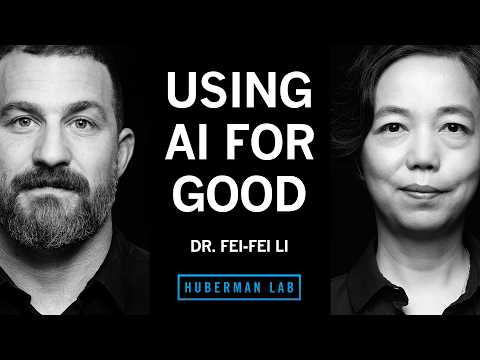 Watch on YouTube →
Overview
Dr. Fei-Fei Li and Andrew Huberman discuss the evolution and future of Artificial Intelligence, emphasizing its potential to augment human intelligence and enrich humanity. They trace AI's roots from computer vision and the ImageNet dataset, highlighting the convergence of neural networks, GPUs, and big data in 2012 as a pivotal moment. The conversation explores AI's capabilities in areas like natural language processing (e.g., ChatGPT) and video generation (e.g., Sora), while also addressing the unique aspects of human cognition like creativity and emotion that remain challenging for AI to replicate. Li advocates for a human-centered approach to AI development, focusing on empowering human agency and fostering collaboration between humans and AI for scientific discovery, healthcare, and creative endeavors.
Key takeaways
- The 2012 convergence of mature neural networks, large datasets (ImageNet), and GPU computing marked a pivotal moment for modern AI, particularly in computer vision.
- AI's ability to learn complex patterns from vast internet data allows it to excel in tasks like object recognition and language generation, but it struggles with deeply personal, unexpressed human experiences like abstract emotion and unique memories.
- Human-centered AI development, as advocated by Fei-Fei Li, is crucial, focusing on augmenting human agency, motivation, and dignity rather than replacing them.
- The future of AI likely involves hybrid creativity and collaboration, where humans and machines work together to solve complex problems in science, medicine, and the arts.
- Effective prompting is a critical skill for interacting with AI, analogous to Socratic dialogue, and requires public education to empower users.
- Embodied AI, extending beyond language to robotics and physical interaction, holds significant potential for assisting in areas like healthcare, elder care, and disaster response, but its integration requires careful societal consideration and ethical frameworks.
Chapters
- Fei-Fei Li expresses optimism about humanity's progress despite setbacks.
- Worries about teachers and parents not adequately preparing children for AI's impact.
- Silicon Valley's role in not serving younger generations well.
- Announcement of live events in New York City (Sept 17), Los Angeles (Oct 8), and San Francisco (Oct 28).
- Events will discuss topics from his new book 'Protocols' and include Q&A.
- Tickets available at hubermanlab.com/events with code 'protocols' for early access.
- Andrew Huberman introduces Dr. Fei-Fei Li, a pioneer in AI and computer vision.
- Discussion on AI's role in enhancing learning, health, and human experience.
- Focus on understanding intelligence from a neuroscience perspective.
- Li directs the Stanford Institute for Human-Centered Artificial Intelligence (HAI).
- Goal: ensure human and societal interests are central to AI's future.
- Known as the 'godmother of AI' for her contributions and emphasis on ethics.
- Fei-Fei Li views vision as fundamental to both biological and artificial intelligence.
- Evolutionary perspective: first light sensing 540 million years ago propelled animal speciation.
- Human brain dedicates significant cortical activity (half) to visual function.
- Neural network algorithms, inspired by early neuroscience (Hubel and Wiesel), were developed in the 1950s.
- Modern neural networks have billions of parameters, departing from early biological models but sharing origins.
- Computer vision research was crucial for AI's recent advancements.
- Struggle in early AI (2006) was due to insufficient data, not just algorithms.
- ImageNet dataset (15 million images, 1000 categories) was created to train object recognition models.
- Conjecture: lack of data was a major bottleneck for AI progress.
- The 2012 inflection point in AI resulted from the convergence of three elements.
- 1. Mature neural network algorithms.
- 2. Availability of large datasets like ImageNet.
- 3. Accelerated computing power from GPUs.
- The ImageNet challenge (2010 onwards) aimed to benchmark object recognition.
- Human error rate on the 1000-category task was ~4%.
- Machines initially performed worse than humans but rapidly improved.
- In 2012, a neural network algorithm dramatically reduced the error rate in object recognition.
- This marked a significant inflection point in AI development.
- By 2016, algorithms surpassed human performance in this task.
- Lingo tracks glucose 24/7 to monitor metabolic health.
- Helps understand how food, activity, and stress impact glucose levels.
- Offers 10% off for Huberman Lab listeners in US/UK at hellolingo.com/huberman.
- Wealthfront offers a cash account with a 3.3% APY (as of Jan 30, 2026).
- Provides instant, no-fee withdrawals and seamless transfer to investment portfolios.
- Exclusive offer: 75% APY boost for 3 months (up to 4.05% variable APY) at wealthfront.com/huberman.
- AI's success in vision opened floodgates for other domains like speech and sound recognition.
- Colleagues use ML for whale song analysis.
- Transformer architecture (2016-2017) significantly advanced NLP, surpassing early vision models.
- Transformer models, combined with more internet data and powerful GPUs, fueled NLP progress.
- Companies like OpenAI and Google leveraged this technology.
- The path from transformers to ChatGPT (2022) took about 5 years.
- Children learn object categories (e.g., 'cat') through experience and probability judgments.
- AI, like humans, learns by identifying patterns and making probabilistic assignments.
- Example: recognizing a cat from a tail based on context and learned data.
- Early AI relied on explicit rules (e.g., identifying indoor furniture to infer 'cat' over 'fox').
- Modern AI learns contextual associations from massive datasets.
- The sheer volume of data allows AI to infer likely scenarios (e.g., a tail indoors is likely a cat's).
- The next step in AI intelligence involves understanding motion and interaction (e.g., a cat moving towards a mouse).
- This capability emerged when video data was incorporated into training sets.
- Sora (released Jan 2024) demonstrated AI's ability to generate plausible video clips from text prompts.
- AI generates video by learning patterns from vast amounts of existing video data.
- It doesn't necessarily understand underlying physics (e.g., cat muscle structure).
- Plausible movement is learned through statistical analysis of countless cat videos.
- AI excels at pattern recognition from internet data, but struggles with deeply personal, unexpressed human experiences.
- Abstract concepts in art (Picasso) or music that evoke emotion are hard for AI to grasp without explicit data.
- Human thoughts and creativity often arise from diffuse brain activity not yet understood or digitized.
- AlphaGo's 'Move 37' against Lee Sedol was seen as a creative, unexpected move in Go.
- Li explains this as AI's ability to process complex mathematical rules and vast computational possibilities.
- It highlights AI's potential in highly structured, mathematical domains.
- AI can help solve complex math problems by accessing vast historical knowledge humans might forget.
- However, problems requiring truly novel concepts may still require human ingenuity.
- The future likely involves hybrid creativity: humans and AI collaborating on unsolved problems.
- AI cannot access deeply personal, subjective experiences tied to specific memories or emotions (e.g., a childhood memory associated with a cup).
- These unique human experiences are not uploaded to the internet and remain inaccessible to current AI.
- This personal context drives unique human reactions and expressions.
- Non-invasive brain activity sensors (e.g., on the head) could become common in 5-10 years.
- These could monitor internal states, comparing them to actions and speech.
- Potential for AI to reveal unconscious aspects of brain activity, aiding self-discovery.
- AI should augment, not replace, human agency, motivation, and dignity.
- AI can improve communication efficiency by learning user patterns (e.g., writing style).
- The key is using AI as a tool to empower individuals.
- Public education about AI's pros and cons is crucial for informed choices.
- Rhetoric should avoid talking down to the public or making decisions for them.
- The goal is to empower understanding, not dictate usage.
- AG1 Pro adds creatine monohydrate, calcium HMB, and zinc carnosine to the original formula.
- Creatine supports muscle strength and brain health; HMB aids muscle recovery; zinc carnosine supports gut health.
- Offers a free bottle of Omega-3 CoQ10 with first subscription at drinkag1.com/huberman.
- Element provides essential electrolytes (sodium, magnesium, potassium) without sugar.
- Crucial for hydration, cognitive function, and physical performance.
- Offers a free sample pack with any purchase at drinkelement.com/huberman.
- Technology should act as a connector, fostering collaboration rather than division.
- Public-facing AI developers need to mature in their communication, avoiding overly technical or alarmist messaging.
- Transparency and clear communication are vital for public trust.
- There's power in sharing knowledge, enabling others to learn and act independently.
- Academia and medicine sometimes withhold information, which is ultimately unhelpful.
- Podcasts like Huberman Lab play a crucial role in public communication and education.
- AI can revolutionize scientific discovery, particularly in biomedicine.
- It can synthesize knowledge across disciplines and process information at speeds unattainable by humans.
- This accelerates research and can lead to better health outcomes.
- While AI can mine existing health information based on known rules, biology's rules are still being discovered.
- New discoveries (e.g., variable action potential shapes) can challenge established neuroscience principles.
- AI's ability to handle complex, variable data could accelerate understanding of biology's intricacies.
- AI can assist clinicians by disambiguating complex symptoms (e.g., vertigo vs. low blood pressure).
- It can synthesize vast amounts of medical data to aid diagnosis and treatment.
- AI can empower patients by providing accessible information and potentially aiding in self-management.
- Robotic surgery (e.g., Da Vinci system) represents deep human-machine collaboration.
- Challenges exist in training AI for complex surgeries due to limited data (e.g., liver surgery variability).
- Human oversight remains critical when patterns are not abundant.
- Intuition, creativity, and premonition are complex human states difficult for current AI to replicate.
- AI's 'intuition' is often context-based pattern matching, not deep subjective experience.
- These abilities rely on inaccessible internal states and are not yet captured by AI.
- AI 'modes' (e.g., 'think deeper' vs. 'quick answer') are mathematical objective functions, not true motivation.
- These modes control processing time and resource allocation.
- AI lacks genuine empathy or subjective experience; its responses are pattern-based.
Summary, takeaways, and chapters were generated by AI from the video's transcript and may contain errors. The video belongs to its creator, Andrew Huberman.