Travel to the Depths of Our Mysterious Oceans | 4K UHD | Blue Planet II | BBC Earth
 Watch on YouTube →
Overview
Across habitats from sunlit reefs to the deep seabed, marine life survives through specialized strategies for feeding, avoiding predators, reproducing, and coping with extreme conditions. Examples include Australian spider crabs molting in groups of hundreds of thousands, giant cuttlefish using camouflage and mating deception, and deep-sea animals relying on bioluminescence, marine snow, or brine-pool margins.
Key takeaways
- Australian spider crabs reduce the danger of molting by gathering in dense groups: hundreds of thousands assemble in mounds nearly 100 meters long while their new shells harden.
- The Portuguese man o’ war combines passive drifting with effective predation: tentacles up to 30 meters long sting and capture prey, and one animal may collect over 100 small fish per day.
- Giant cuttlefish mating success is not determined by size alone: a small male can imitate a female’s appearance to evade a dominant rival and mate.
- Kobudai wrasse can change sex as they grow: large females develop male hormones and enlarged heads, then compete to become territorial breeders.
- Deep-sea food webs depend partly on marine snow—surface-derived debris that feeds filter feeders and gradually accumulates into thick seabed mud.
- Gulf of Mexico brine pools create extreme habitats: dense, hypersaline water can cause toxic shock in visiting eels, while the pool margins support abundant life.
Chapters
0:00
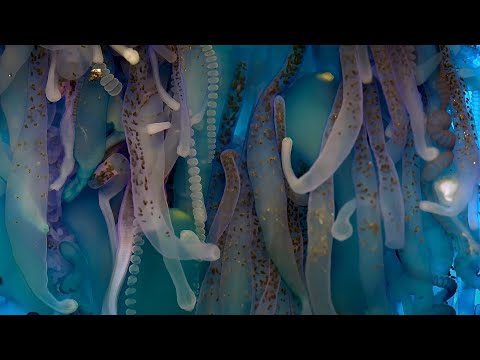
Drifting Jellies and the Portuguese Man o’ War
- More than half of open-ocean animals drift with currents; jellyfish can cross entire oceans and multiply rapidly where plankton is abundant.
- The Portuguese man o’ war floats using a gas-filled bladder and sail-like membrane, trailing tentacles that can reach 30 meters.
- Its stinging tentacles paralyze fish, which specialized tentacles pass to digestive tissues; a single man o’ war may capture over 100 small fish in a day.
5:19
Australian Spider Crabs Gather to Molt
- Around the first full moon of winter, hundreds of thousands of spider crabs assemble on an Australian seagrass meadow after feeding in deeper water.
- Crabs must break out of their rigid shells to grow, leaving their new bodies soft and vulnerable while their replacement shells harden over several days.
- The crowd forms mounds nearly 100 meters long; grouping helps protect freshly molted crabs from predators such as a 4-meter smooth stingray.
11:07
Sally Lightfoot Crabs Race the Tide and Evade Predators
- Sally Lightfoot crabs cross exposed rocks in Brazil to reach seaweed feeding grounds about 100 meters from shore before the tide returns.
- Chain moray eels hunt crabs with blunt teeth capable of crushing shells, and can cross land to reposition for an ambush.
- Octopuses also prey on the crabs; after feeding, the survivors must make the dangerous crossing again when the tide turns roughly two hours later.
16:24
Cuttlefish Use Color Displays to Hunt on Coral Reefs
- The Coral Triangle contains exceptionally rich coral reefs, where animals compete for space, food, and mates.
- A cuttlefish hunts crabs by changing colors and patterns through millions of pigment cells in its skin, apparently mesmerizing its prey.
- When a shark threatens the cuttlefish, it disappears and later resumes hunting with the same visual trick.
20:15
Giant Trevallies Target Fledgling Terns at an Indian Ocean Atoll
- More than half a million terns crowd onto a remote Indian Ocean atoll during the dry season, while their young practice flying over its central lagoon.
- Around 50 giant trevallies gather to hunt the fledglings, timing attacks by calculating a bird’s airspeed, altitude, and trajectory.
- Young terns must progress from flight practice to finding food independently; after a month, they begin venturing over open water.
26:34
Saddleback Clownfish Build a Nest with Found Materials
- A saddleback clownfish family shelters among a carpet anemone’s lethal tentacles; the clownfish are immune to its poison and help clean away debris.
- The dominant female needs a solid surface for her eggs, so the smaller male searches for a nesting site and tries shells and other debris.
- The pair move a coconut shell beneath the anemone, where the female lays eggs and the male tends them until they hatch about 10 days later.
32:55
Blue Sharks Follow Whale-Oil Trails to a Carcass
- A blue shark can travel more than 8,000 kilometers a year on ocean currents and may go two months without eating.
- Fatty oils from a dead whale lead the shark to a carcass, where great white sharks—about 10 times heavier—feed first on energy-rich blubber.
- Blue sharks arrive as the oil spreads and feed on what remains; after the carcass sinks, the blue shark’s replenished fat reserves can sustain it for another two months.
36:56
Giant Cuttlefish Mating: A Small Male’s Disguise
- Giant cuttlefish live only one or two years, and more than 100,000 males may compete for females in a single bay.
- A large male displays sweeping bands of color and guards a female, but a smaller rival imitates a female by changing color and tucking in its arms.
- The disguised male mates with the female while the dominant male is deceived; females mate with multiple partners to increase genetic diversity among their young.
41:54
Kobudai Wrasse Females Transform into Territorial Males
- In northern Japan, kobudai wrasse begin breeding when summer water temperatures reach about 16°C.
- A large female can transform into a male over several months as internal enzymes change and male hormones circulate; her head and chin also enlarge.
- The transformed male challenges the previous territory holder, with a larger, more bulbous head helping intimidate rivals and secure access to multiple mates.
47:24
Puffins Dive for Fish and Evade Arctic Skuas
- Arctic cliffs provide nesting sites for tens of thousands of seabirds; puffin parents take turns feeding a week-old chick that needs five meals a day.
- When nearby fish are scarce, puffins may fly 50 kilometers to fishing grounds, dive as deep as 40 meters, and hold their breath for over a minute.
- Returning puffins face Arctic skuas that steal their catch; declining fish numbers make it increasingly difficult to feed chicks.
55:05
Bioluminescence and Predation in the Midnight Zone
- About a kilometer below the surface, beyond sunlight, bioluminescent displays help animals attract mates, repel predators, and communicate.
- Fangtooth fish use pressure sensors across their heads and bodies to detect movement and have exceptionally large teeth for their size.
- Prey can escape a hunter with luminous ink that acts as a decoy, diverting attention in the darkness.
58:42
Marine Snow Feeds Life on the Deep-Sea Mud Plain
- Siphonophores repeatedly clone themselves and can eventually grow longer than a blue whale.
- Organic debris called marine snow drifts down from surface waters, feeding deep-sea filter feeders such as jellyfish and sea cucumbers.
- The small fraction of marine snow that reaches the bottom accumulates over millions of years into mud layers up to a kilometer thick across a seabed covering roughly half the planet.
1:03:05
Deep-Sea Mud Dwellers and Gulf of Mexico Brine Pools
- Sea toads use enormous mouths and patience to ambush prey on the seabed; their modified fins act like feet for shuffling across the mud.
- Flapjack octopuses hover above the mud and sift for worms, jetting away when danger approaches.
- In the Gulf of Mexico, dense brine forms seafloor pools up to 15 meters deep; their margins support century-old giant mussels, shrimps, and squat lobsters.
- Cutthroat eels scavenge around the pools, but prolonged exposure to brine can cause toxic shock; some escape by rising out of it, while others are preserved along the pool margins.
Summary, takeaways, and chapters were generated by AI from the video's transcript and may contain errors. The video belongs to its creator, BBC Earth.