This is your brain on communication | Uri Hasson
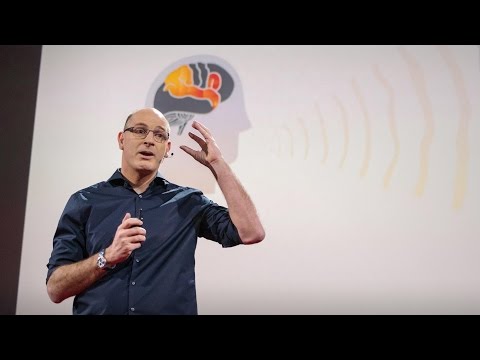 Watch on YouTube →
Overview
Uri Hasson uses fMRI experiments at Princeton to show how storytelling aligns brain activity: sound synchronizes auditory regions, while coherent meaning reaches higher-order regions, even across English and Russian listeners. Comparing speakers with listeners and people primed to interpret a J.D. Salinger story differently, Hasson argues that communication transfers memories through shared neural meaning but depends on common ground—and that dialogue helps sustain it.
Key takeaways
- In fMRI experiments, a coherent story synchronized listeners’ higher-order frontal and parietal brain regions, while reversed audio aligned mainly auditory cortex and scrambled words aligned early language areas.
- Listeners of English and Russian translations showed similar higher-order brain responses when the stories conveyed the same meaning, despite having different sounds and linguistic systems.
- Greater similarity between a storyteller’s and listeners’ brain responses was associated with better communication, linking neural alignment to comprehension.
- A brief framing sentence changed how listeners interpreted a J.D. Salinger story and produced distinct higher-order response patterns between groups.
- Shared context affects whether words successfully evoke memories: Hasson contrasts the familiar “cab” with the British term “hackney carriage.”
- Hasson argues that dialogue, in which people both speak and listen, can help preserve common ground across people with different perspectives.
Chapters
0:00
Uri Hasson’s fMRI Evidence for Story-Driven Neural Entrainment
- In Princeton fMRI experiments, listeners’ auditory cortex responses became synchronized as Jim O’Grady’s story began, an effect Hasson calls neural entrainment.
- Playing the story backward aligned auditory regions but not deeper areas; scrambled words aligned early language areas, while coherent sentences aligned broader language networks.
- A full, engaging story synchronized higher-order frontal and parietal regions, which Hasson links to conveyed meaning rather than sound alone.
- English and Russian versions of the same story produced similar higher-order brain responses across groups, despite different sounds and languages.
7:25
How Shared Meaning Transfers Memories—and Depends on Context
- Comparing fMRI scans of a storyteller and listeners revealed similar complex brain-response patterns; greater speaker-listener alignment corresponded to better communication.
- In a Sherlock experiment, people who watched a BBC episode later retold it to someone who had not seen it; words such as “Sherlock,” “London,” and “murderer” prompted listeners to reconstruct patterns similar to the viewer’s.
- Hasson argues that successful retelling requires common ground: an unfamiliar term such as “hackney carriage” can disrupt alignment compared with “cab.”
- Before a J.D. Salinger story, one sentence suggesting either an affair or a jealous husband made each group’s higher-order brain responses more similar within the group and different between groups.
11:03
Shared Media Perspectives, Dialogue, and Human Connection
- Hasson warns that repeated exposure to outlets such as Fox News or The New York Times can create different interpretive frames, weakening common ground even when people hear the same news.
- He proposes dialogue—taking turns speaking and listening—as a way to build shared understanding and generate new ideas.
- Hasson’s example of his young son Jonathan vocalizing with his wife illustrates how early social interaction helps shape a person’s development.
- He concludes that everyday connections influence who people become and encourages people to keep sharing ideas and engaging with others.
Summary, takeaways, and chapters were generated by AI from the video's transcript and may contain errors. The video belongs to its creator, TED.