This calculus proof is only for math majors (National Taiwan University entrance exam)
 Watch on YouTube →
Overview
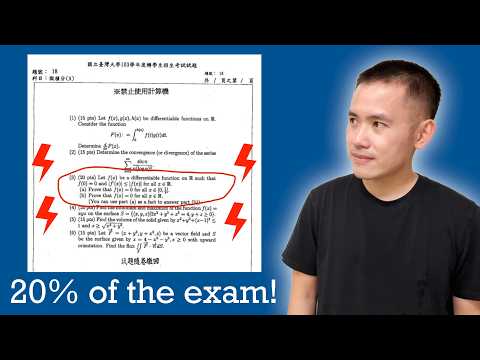
blackpenredpen works through a National Taiwan University calculus A transfer-exam proof: if a differentiable function satisfies f(0)=0 and |f′(x)|≤f(x) for every real x, then f vanishes on [0, 1/2]. The argument combines the Mean Value Theorem with the Extreme Value Theorem to bound the maximum absolute value M by at most M/2, forcing M=0; blackpenredpen then challenges viewers to extend the result to all real x and consider a nonzero initial value.
Key takeaways
- For 0<x≤1/2, the Mean Value Theorem gives f(x)=x f′(c) for some c∈(0,x), so |f(x)|≤x f(c)≤xM when M bounds |f| on [0, 1/2].
- The Extreme Value Theorem is essential because continuity on the compact interval [0, 1/2] guarantees that |f| attains a maximum M.
- At a point x₀ where |f(x₀)|=M, the estimate gives M≤x₀M≤M/2; therefore M=0 and f is identically zero on the interval.
- The assumption |f′(x)|≤f(x) also implies f(x)≥0 everywhere, since an absolute value is nonnegative.
- A nonzero function satisfying the derivative condition with f(0)=1/2 is f(x)=½eˣ, since |f′(x)|=f(x) for every real x.
Chapters
0:00
Set Up the NTU Proof with the Mean Value Theorem
- The NTU transfer-exam problem assumes f is differentiable on ℝ, f(0)=0, and |f′(x)|≤f(x) for all real x.
- The target is to prove f(x)=0 on [0, 1/2]; blackpenredpen frames equality as showing both upper and lower bounds.
- Applying the Mean Value Theorem on [0,x], for 0<x≤1/2, gives a c between 0 and x with f(x)=x f′(c).
- Taking absolute values and using the derivative condition reduces the task to controlling f(c) on the interval.
5:39
Use the Extreme Value Theorem to Bound the Function
- The Intermediate Value Theorem does not provide the needed size bound, so blackpenredpen instead uses the Extreme Value Theorem.
- Differentiability makes f continuous on the closed, bounded interval [0, 1/2], ensuring |f| has a maximum M there.
- Since c lies in [0, 1/2], the maximum bound gives |f(c)|≤M; also |f′(c)|≤f(c), so the Mean Value Theorem estimate is at most xM.
- Because x≤1/2, every point in the interval satisfies |f(x)|≤M/2.
10:26
Force M=0 and Extend the Problem
- The Extreme Value Theorem guarantees some x₀∈[0, 1/2] with |f(x₀)|=M.
- Applying the bound at x₀ yields M≤x₀M≤M/2, which is possible only when M=0.
- Thus |f(x)|=0 throughout [0, 1/2], and f(0)=0 covers the endpoint explicitly.
- blackpenredpen leaves extending the proof to all real x as a challenge and asks for a nonconstant example when f(0)=1/2.
Summary, takeaways, and chapters were generated by AI from the video's transcript and may contain errors. The video belongs to its creator, blackpenredpen.